


Introduction
Most people skip this step entirely — and then wonder why they aren’t losing weight. They start a diet based on guesswork, cut random amounts of food, follow someone else’s calorie plan, and hope for the best. Sometimes it works for a week. Then it stalls. Then it stops.
The reason almost always comes back to the same thing: they never properly calculated their deficit.
Calculating your deficit — based on your personal body stats, activity level, and goal rate of loss — is the difference between a plan that produces consistent, predictable results and one that keeps letting you down. This guide walks you through the complete, five-step process using the exact formulas recommended by the Cleveland Clinic, the National Academy of Sports Medicine (NASM), and the National Institutes of Health.
What Does Calculating Your Deficit Actually Mean?
Calculating your deficit means finding the precise gap between how many calories your body burns each day and how many calories you eat. When this gap sits at 300–500 calories per day, your body draws on stored fat to cover the shortfall, producing measurable fat loss of approximately 0.5–1 pound per week. Your daily calorie target is simply your Total Daily Energy Expenditure (TDEE) minus your chosen deficit size.
This number is personal to you — not borrowed from a celebrity diet, copied from a friend, or set by an app’s default.
Step 1: Calculate Your BMR Using the Mifflin-St Jeor Equation
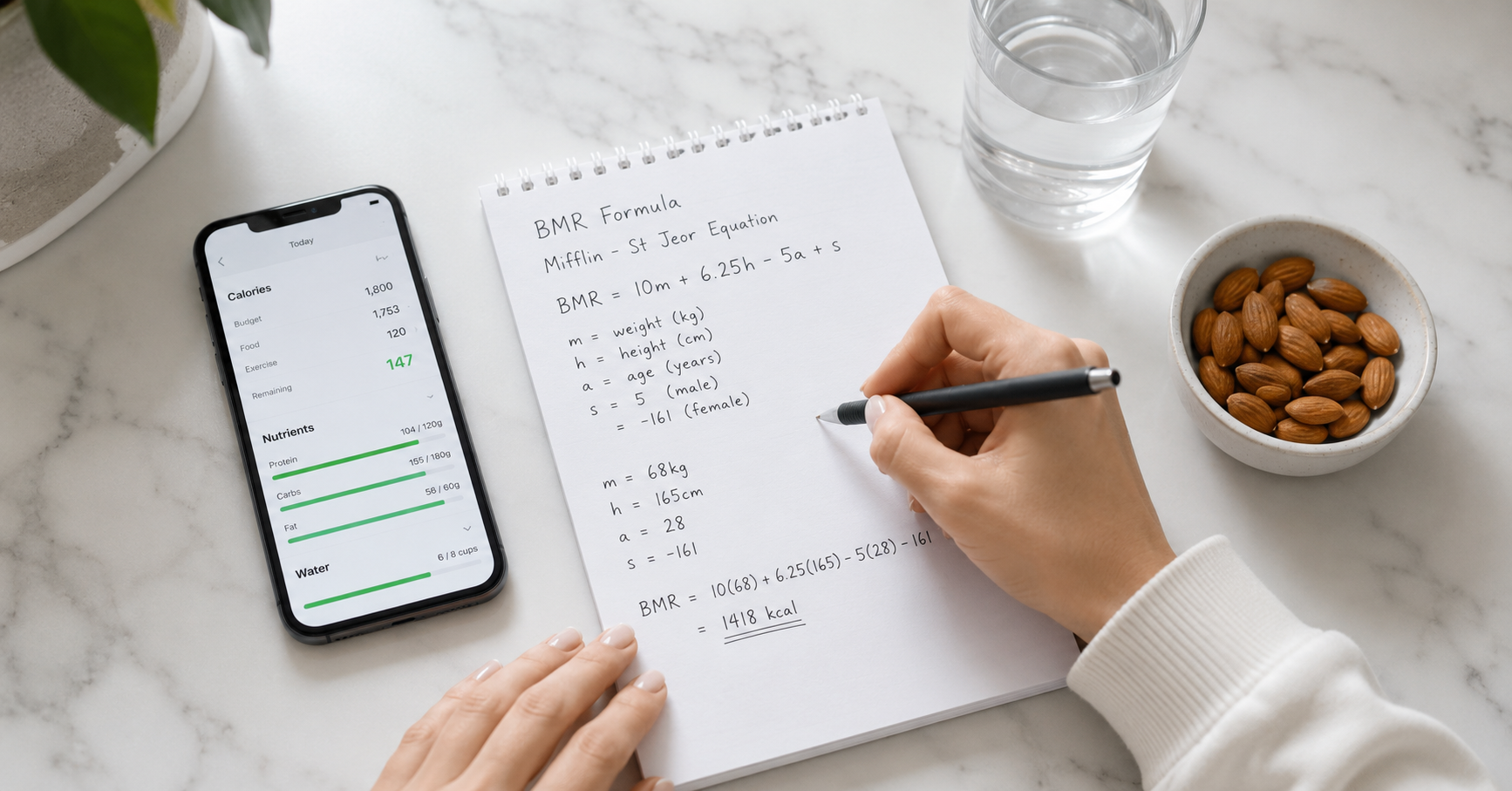
Before calculating your deficit, you need your Basal Metabolic Rate (BMR) — the number of calories your body burns at complete rest to keep your heart beating, lungs breathing, and organs functioning. Even lying still all day, you burn a significant number of calories.
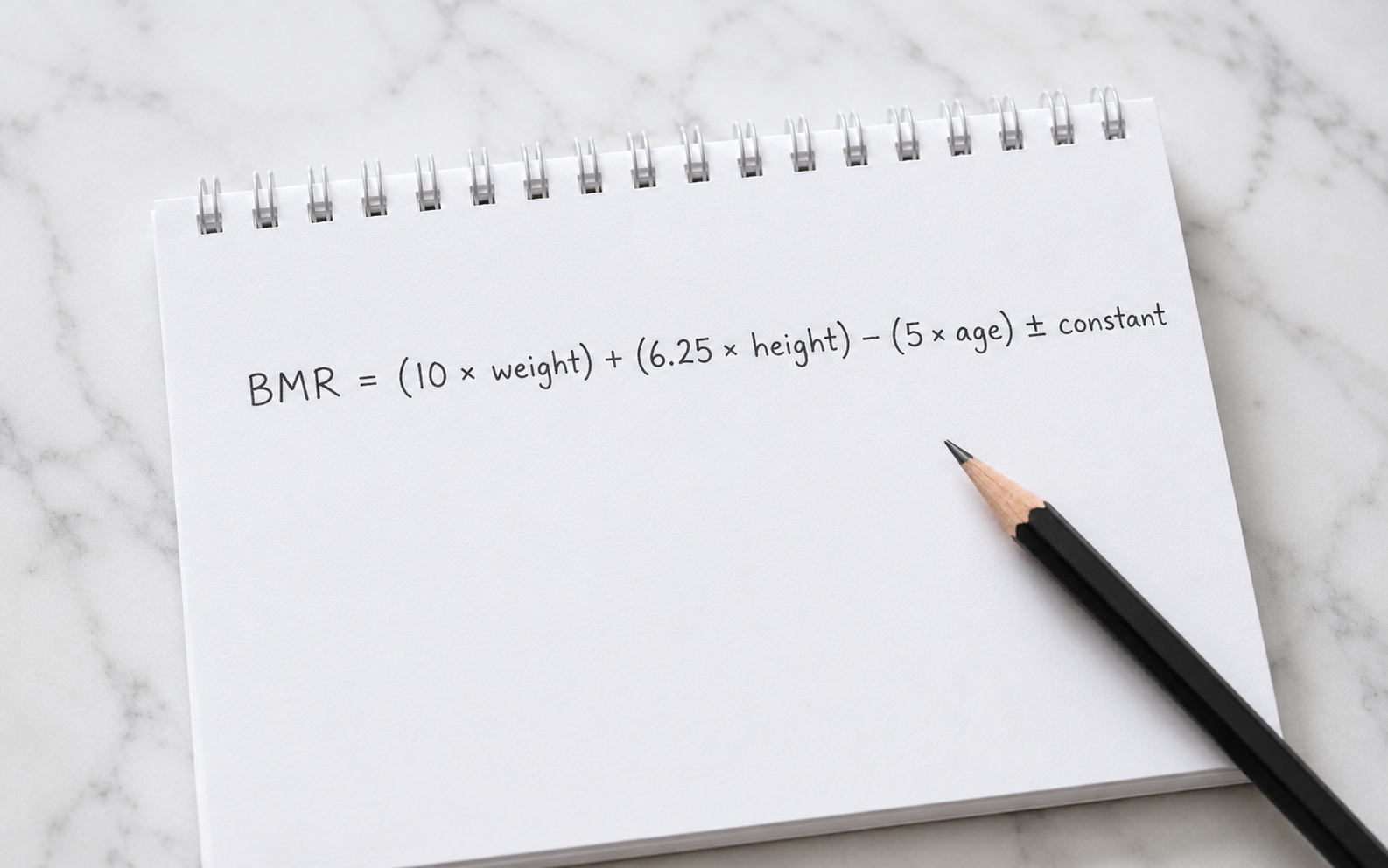
The most accurate method for calculating BMR is the Mifflin-St Jeor equation, which is recommended by NASM, the Cleveland Clinic, and cited by the NIH Body Weight Planner as the preferred formula for healthy adults.
For men: BMR = (10 × weight in kg) + (6.25 × height in cm) − (5 × age in years) + 5
For women: BMR = (10 × weight in kg) + (6.25 × height in cm) − (5 × age in years) − 161
Worked example — woman, 30 years old, 65 kg, 165 cm tall: BMR = (10 × 65) + (6.25 × 165) − (5 × 30) − 161 BMR = 650 + 1,031 − 150 − 161 BMR = 1,370 calories/day
This is your survival floor — the minimum energy your body needs to function. But since you move around throughout the day, your actual calorie burn is always higher. That brings us to Step 2.
Quick unit conversions if needed: Weight in kg = weight in pounds ÷ 2.205 Height in cm = height in inches × 2.54
Step 2: Multiply Your BMR by Your Activity Factor to Get Your TDEE

Your Total Daily Energy Expenditure (TDEE) is your BMR adjusted for how active you actually are day to day. It accounts for exercise, walking, standing, digestion, and all other movement. TDEE is the most important number when calculating your deficit because it represents your true maintenance calories — the amount of food that keeps your weight perfectly stable.
Multiply your BMR by the activity multiplier that most honestly describes your typical week:
| Activity Level | What It Looks Like | Multiplier |
|---|---|---|
| Sedentary | Desk job, little or no exercise | × 1.2 |
| Lightly active | Light exercise 1–3 days/week | × 1.375 |
| Moderately active | Moderate exercise 3–5 days/week | × 1.55 |
| Very active | Hard exercise 6–7 days/week | × 1.725 |
| Extremely active | Physical job plus hard daily training | × 1.9 |
Continuing the example (lightly active): TDEE = 1,370 × 1.375 = 1,884 calories/day
One critical warning: most people overestimate their activity level. If you sit at a desk most of the day and exercise 2–3 times a week, choose Lightly Active rather than Moderately Active. Overestimating your multiplier inflates your TDEE by 150–300 calories, which can completely erase your deficit without you realising it.
Step 3: Choose the Right Deficit Size for Your Goals
Now you are ready to start calculating your deficit properly — choosing how large a gap to create between your TDEE and your daily intake.
The right size depends on how much weight you want to lose, how quickly you want to lose it, and how well you handle eating less over time.
| Deficit Size | Daily Cut | Weekly Fat Loss | Best Suited For |
|---|---|---|---|
| Mild | 200–300 cal | 0.2–0.6 lb | Beginners, those close to goal weight |
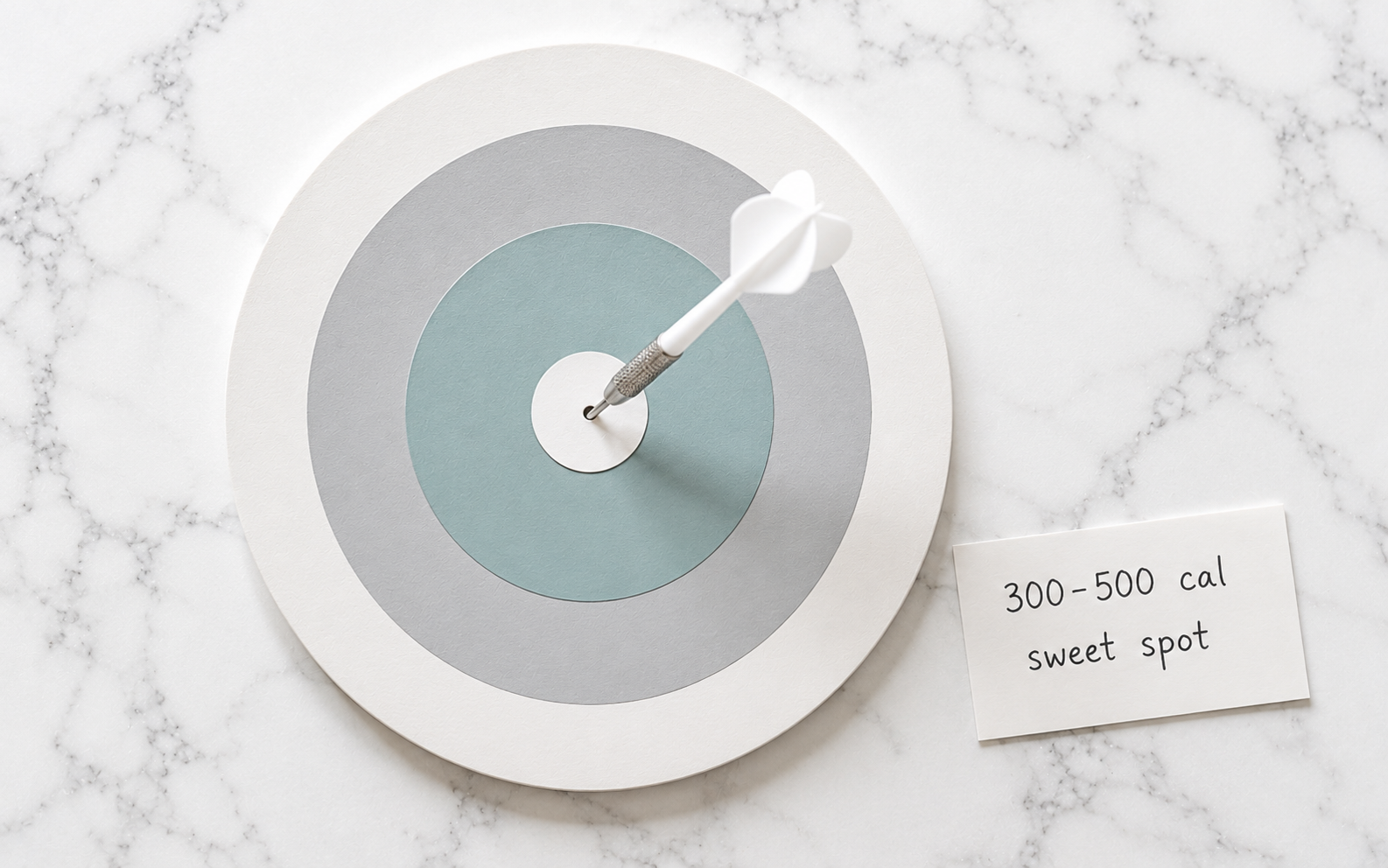
| Moderate | 300–500 cal | 0.5–1 lb | Most people — the recommended range |
| Aggressive | 500–750 cal | 1–1.5 lbs | Those with significant weight to lose |
| Very aggressive | 750–1,000 cal | 1.5–2 lbs | Medical supervision recommended |
The moderate range of 300–500 calories per day is the widely agreed sweet spot, recommended by the American College of Sports Medicine and consistent with CDC guidance on safe weight loss of 1–2 pounds per week maximum.
Two hard minimums you must respect when calculating your deficit:
- Women: never eat fewer than 1,200 calories per day
- Men: never eat fewer than 1,500 calories per day
Dropping below these floors increases the risk of nutritional deficiencies, significant muscle loss, hormonal disruption, and metabolic slowdown — all of which make long-term weight loss harder, not easier.
Step 4: Calculate Your Personal Daily Calorie Target
Now put it all together. Calculating your deficit produces a single daily calorie number:
Daily calorie goal = TDEE − chosen deficit
Example at a 400-calorie deficit: TDEE: 1,884 calories Deficit: 400 calories Daily goal: 1,484 calories/day Projected weekly fat loss: approximately 0.8 pounds
Same person with a gentler 250-calorie deficit: TDEE: 1,884 calories Deficit: 250 calories Daily goal: 1,634 calories/day Projected weekly fat loss: approximately 0.5 pounds
The gentler approach produces slower visible results, but it is significantly more sustainable, easier to maintain, and far less likely to trigger hunger-driven overeating, muscle loss, or energy crashes. For many people, especially those starting a deficit for the first time, beginning at 200–300 calories below TDEE and building gradually over 2–3 weeks is the most effective long-term strategy.
Step 5: Track Results and Adjust Every 3–4 Weeks
This is the step most guides leave out — and it is the most important one.
Calculating your deficit gives you an evidence-based estimate, not a perfect prediction. The Mifflin-St Jeor equation can be off by 10–20% for any individual because real metabolism varies based on genetics, muscle mass, sleep quality, stress hormones, and gut microbiome. Real-world adjustment based on your actual results is what makes the calculation reliable.
How to track correctly:
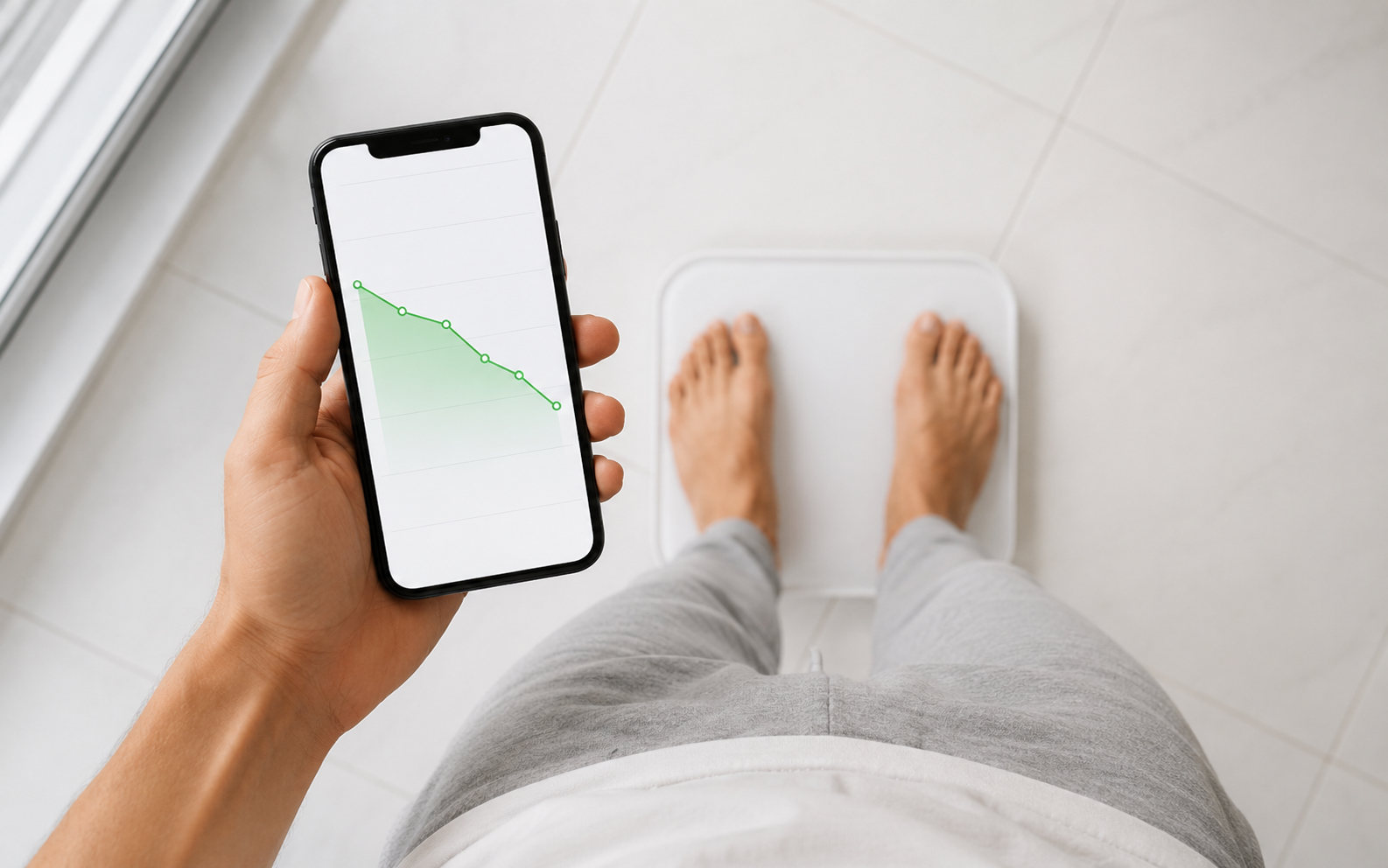
- Weigh yourself every morning under identical conditions — after waking, after using the bathroom, before eating or drinking anything.
- Ignore daily fluctuations. Focus only on your weekly average weight. Daily weight shifts by 1–3 pounds based on water retention, sodium intake, menstrual cycle, and digestive content. The weekly trend is the only meaningful data.
- Track food intake honestly for at least 3–4 weeks. Research consistently shows people underestimate their calorie intake by 30–50% on average without careful tracking. Apps like Cronometer or MyFitnessPal handle this well with their barcode scanning features.
When and how to adjust:
- Losing more than 1.5 lbs/week consistently → add 100–200 calories. You are in too large a deficit and risk muscle loss.
- Losing less than 0.3 lbs/week after 3+ honest, consistent weeks → reduce by 100–200 calories or add 1,500–2,000 daily steps (approximately 100 extra calories burned).
- Weight not moving at all after 4 consistent weeks → recalculate your TDEE using your new, lower body weight. TDEE drops as you lose weight, and the same calorie intake that produced a deficit at your starting weight may now be close to maintenance.
The 3,500-Calorie Rule — What It Gets Right and Wrong
A widely referenced rule states that 1 pound of fat equals 3,500 calories, meaning a 500-calorie daily deficit equals exactly 1 pound of weekly fat loss. This is a useful starting estimate but should not be taken as a precise formula.
Research published in the International Journal of Obesity clarifies that the 3,500-calorie rule significantly overestimates actual weight loss because it ignores the physiological changes that occur as the body adapts to calorie restriction — including reduced TDEE, changes in lean mass, and shifts in glycogen and fluid levels. A model developed by researcher Kevin D. Hall, PhD, at the NIH accounts for these dynamics and consistently predicts more realistic (and slower) weight loss curves than the 3,500-calorie rule suggests.
In practice, this means your initial rate of fat loss will slow down as you lose weight — not because something is wrong, but because your body’s energy needs are decreasing alongside your body mass. Recalculating your deficit every 5–10 pounds lost addresses this naturally.
The Most Common Mistakes When Calculating Your Deficit
Getting the right number is only useful if you avoid the errors that consistently undermine it.
Overestimating your activity level. Choosing “moderately active” when you are largely sedentary inflates your TDEE by 150–300 calories per day, potentially erasing your entire deficit.
Using goal weight instead of current weight. BMR and TDEE must always be calculated from your current body weight. Using goal weight drastically understates how many calories your body actually burns right now.
Not recalculating as you lose weight. Every 5–10 pounds lost, your TDEE decreases. A deficit perfectly calibrated at 90 kg may be barely a deficit at 80 kg. Recalculate regularly.
Eating back all tracked exercise calories. Fitness trackers and calorie apps overestimate exercise calorie burn by 30–50% on average. Eating back 100% of tracked exercise calories frequently cancels the deficit entirely.
Expecting linear progress. Weight loss does not follow a straight line. Water retention, hormonal cycles, and digestive contents all cause the scale to fluctuate. Judge your deficit by the weekly trend over 3–4 weeks, never by any single day’s reading.
How to Make Your Calculated Deficit Sustainable

The numbers are straightforward. Sustaining them over weeks and months is the real challenge.
Prioritise protein above every other food decision. Eating 1.2–1.6 grams of protein per kilogram of body weight while calculating your deficit and eating in one preserves lean muscle, reduces hunger between meals, and maintains your resting metabolic rate. According to the American Journal of Clinical Nutrition, protein intake is the single most important dietary variable for muscle retention during calorie restriction.
Use steps to extend your deficit, not structured cardio. Adding 1,500–2,000 daily steps burns roughly 100 extra calories without triggering the appetite increase that intense cardio often causes. This creates a slightly larger effective deficit without eating less.
Consider a planned maintenance phase every 8–12 weeks. Eating at TDEE for 2–4 weeks partially reverses adaptive thermogenesis — the metabolic slowdown that builds up over prolonged deficits — and resets appetite hormones like leptin and ghrelin. Far from sabotaging progress, periodic maintenance phases are a recognised tool for improving long-term fat loss outcomes.
Set a realistic timeline from the start. Losing 20 pounds at a 500-calorie daily deficit takes approximately 20 weeks of consistency. Knowing this prevents the unrealistic expectations that cause people to abandon effective plans prematurely.
What is the easiest method for calculating your deficit?
The most accessible starting method is using the Mifflin-St Jeor equation to find your BMR, multiplying by your activity factor to get your TDEE, then subtracting 300–500 calories for your daily target. The full calculation takes under five minutes and produces a personalised, evidence-based starting number more reliable than any generic online calculator’s default output.
How accurate is calculating your deficit with the Mifflin-St Jeor formula?
The Mifflin-St Jeor equation is accurate to within 10–15% for most healthy adults, making it the most precise widely available prediction formula. However, individual metabolism varies, which is why treating your result as a starting estimate and adjusting based on your actual 3–4 week weight trend produces more reliable results than trusting the initial calculation as a fixed number.
How often should you recalculate your deficit?
Recalculate your deficit every time you lose 5–10 pounds, since your TDEE decreases as your body weight drops. Failing to recalculate is the most common cause of weight loss plateaus — what was a 500-calorie deficit at 90 kg may only be a 200-calorie deficit at 82 kg, dramatically slowing your results without any change in behavior.
What is the safest deficit size when calculating your deficit?
The safest and most widely recommended range is 300–500 calories below your TDEE, producing 0.5–1 pound of weekly fat loss. This range is endorsed by the American College of Sports Medicine and the CDC. It preserves muscle mass, keeps energy levels stable, and avoids the metabolic adaptation and hormonal disruption associated with more aggressive deficits.
Can you calculate your deficit without tracking calories?
You can estimate using the body weight multiplier method — multiply your body weight in pounds by 15 for a rough maintenance figure, then subtract 300–500 calories. This requires no tracking and works as a starting point. However, for accuracy and reliable results, tracking actual food intake with a calorie app for at least 2–4 weeks provides real data that no formula alone can match.
Why is my calculated deficit not producing the expected weight loss?
The most common explanations are overestimating your activity level when calculating TDEE, underestimating calorie intake (studies show an average error of 30–50% without careful tracking), water retention masking fat loss on the scale, or metabolic adaptation after weeks in a deficit. Recalculate your TDEE at your current weight, track food intake for 2 weeks honestly, and evaluate your weekly weight average rather than daily readings.
Conclusion
Calculating your deficit does not require advanced maths or a nutrition degree. Find your BMR using the Mifflin-St Jeor equation, multiply it by your activity factor to get your TDEE, subtract 300–500 calories, and you have your daily calorie target. Then track consistently, weigh weekly, and recalculate every 5–10 pounds.
The calculation gives you a starting point. Real results come from the consistency with which you execute it, the honesty with which you track, and the patience to let a moderate, sustainable deficit do its work over time. Start with the right number, adjust based on what your body shows you, and trust the process.
Disclaimer: This article is provided for educational and informational purposes only and does not constitute medical or nutritional advice. Always consult a qualified healthcare provider or registered dietitian before beginning any calorie restriction programme, particularly if you have an existing health condition.
References:
- National Academy of Sports Medicine: Calorie Calculator and Mifflin-St Jeor Equation — nasm.org
- Cleveland Clinic: How to Safely Use a Calorie Deficit to Lose Weight (Updated May 2026) — health.clevelandclinic.org
- MedicineNet: How to Calculate Calorie Deficit for Weight Loss (Updated December 2025) — medicinenet.com
- U.S. Dietary Guidelines for Americans 2020–2025 — dietaryguidelines.gov
- International Journal of Obesity: Limitations of the 3,500-Calorie Rule — nature.com/ijo
- American Journal of Clinical Nutrition: Protein Intake and Lean Mass During Calorie Restriction — academic.oup.com/ajcn



Comments (1)
Weight Loss Diets: Complete Guide to Popular Diet Planssays:
July 2, 2026 at 2:14 pm[…] diving into specific diet plans, it is vital to understand what makes any weight loss diet work. Every successful plan is built on one core mechanism: a caloric deficit. Beyond calories, the […]