


Introduction
For decades, video games were dismissed as mere child’s play or a waste of time. But if you look deeper, you find something far more complex. Today, gaming isn’t just a hobby; it is a lens through which we can understand human behavior, motivation, and cognitive development. The intersection of Gaming Psychology & Lifestyle has become a crucial area of study, revealing surprising truths about how our brains work and how we choose to live our lives.
Whether you are a casual player who enjoys a quick match of Candy Crush on the subway or a hardcore gamer grinding ranked matches in League of Legends, psychology is at play. It dictates why you pick up the controller, why you can’t put it down, and how those digital experiences bleed into your real-world habits.
In this comprehensive guide, we will explore the science of gaming. We will dissect the mechanisms of addiction, celebrate the cognitive gains, navigate the mental health nuances, and uncover how virtual challenges prepare us for real-world problem solving.
The Science of Immersion: Why Gaming Is So Addictive
Have you ever sat down to play for “just twenty minutes” only to look up and realize four hours have passed? This phenomenon isn’t accidental. It is a byproduct of careful design and basic human biology colliding. To understand Gaming Psychology & Lifestyle, we must first look at the chemical reactions happening inside the gamer’s brain.
The Dopamine Feedback Loop
At the heart of gaming compulsion lies dopamine—the brain’s “feel-good” neurotransmitter. Contrary to popular belief, dopamine isn’t just about pleasure; it is about motivation and reward prediction. When you defeat a boss, find rare loot, or level up, your brain releases a hit of dopamine. This reinforces the behavior, telling your brain, “That was good. Do it again.”
Game developers are masters of the “variable ratio reinforcement schedule.” This is a psychological concept famously observed in Skinner Box experiments. If a rat presses a lever and gets food every time, it presses it only when hungry. But if the rat gets food unpredictably—sometimes after one press, sometimes after twenty—it presses the lever compulsively.
Modern games utilize this perfectly:
- Loot Boxes: You never know what is inside, but the potential for a high-tier item keeps you opening them.
- Critical Hits: That random spike of high damage feels exhilarating because it is unpredictable.
- Drop Rates: Farming for hours for a specific item creates a massive dopamine spike when it finally drops.
The Psychology of Progression
Competence and mastery are something that humans are naturally drawn to. Progress in real life is frequently gradual and imperceptible. You might work hard at a profession and not get noticed right away, or you can go to the gym for weeks and not show any muscular growth.
Games circumvent this structure by offering instantaneous, palpable feedback. Numbers rise, ranks rise, and experience bars fill up. A psychological condition known as “flow” is produced as a result, in which the individual is totally engrossed in a sensation of focused energy. You’re in the zone when the difficulty level is exactly the same as your degree of expertise.
A fundamental element of Gaming Psychology & Lifestyle is this feeling of advancement. For a lot of people, gaming gives them the accomplishment and organization that their everyday routine may lack. It fulfills a fundamental psychological demand for development, even if such development is simulated.
The Role of Social Connection
It is impossible to discuss addiction without bringing up the social component. Our yearning for belonging is exploited by multiplayer video games. Squad-based shooters and massively multiplayer online games (MMOs) are dependent on social responsibility. You are playing for your guild, your squad, or your raid team, not just for yourself.
Engagement is driven by the fear of disappointing other people or the fear of missing out (FOMO) on a social event. This social bond is strong. It turns a solitary hobby into a social way of life in which your online persona is equally as significant as your real one.
Cognitive Benefits of Video Games: Training the Brain
While the media often focuses on the potential downsides, a growing body of research suggests that gaming acts as a rigorous workout for the brain. The narrative that games “rot your brain” is outdated. Instead, Gaming Psychology & Lifestyle research shows that specific genres can sharpen mental acuity in ways that traditional learning cannot.
Enhancing Visual-Spatial Skills
First-person shooters (FPS) and fast-paced action games require players to process vast amounts of visual information in milliseconds. You must track enemies, monitor ammunition, navigate complex 3D maps, and react to sudden changes.
Studies indicate that gamers often outperform non-gamers in visual-spatial tasks. This includes:
- Mental Rotation: The ability to visualize and rotate 3D objects in your mind.
- Peripheral Awareness: Noticing details outside your direct line of sight.
- Attention Splitting: Managing multiple streams of information simultaneously without losing focus.
For a surgeon using robotic tools or a pilot navigating through turbulence, these skills are invaluable. It turns out that those hours spent in Call of Duty or Overwatch might actually be refining the neural pathways responsible for spatial awareness.
Memory and Executive Function
In essence, strategy games like StarCraft and Civilization are intricate tests of long-term planning and resource management. A player needs to retain build orders, opponent strategies, map layouts, and unit statistics in order to succeed. The working memory is severely taxed by this.
These games also enhance executive function. The brain’s management system is in charge of organizing, planning, and controlling impulses. Gamers weigh costs and benefits all the time. “Should I spend resources now for a quick defense, or save them for a stronger attack later?”
Constantly making decisions under duress helps to improve the prefrontal cortex. It increases cognitive flexibility, which is the capacity to quickly adjust to new rules and transition between tasks. This adaptability is essential to a successful existence in a world that is changing quickly.
Neuroplasticity and Aging
The effect of gaming on aging brains is one of the most fascinating areas of Gaming Psychology and Lifestyle. Cognitive decline is a normal part of aging. However, this process can be slowed by mentally taxing activities.
The hippocampus, the part of the brain linked to memory and navigation, has been found to have more gray matter when playing 3D platformers. Gaming can serve as a type of digital medication for senior citizens, keeping their minds active and possibly postponing the onset of diseases like dementia.
Gaming & Mental Health: A Complex Relationship
The relationship between gaming and mental health is not black and white. It is a spectrum. For some, gaming is a therapeutic escape; for others, it is a mechanism of avoidance. Understanding this duality is essential for maintaining a healthy Gaming Psychology & Lifestyle.
Gaming as a Coping Mechanism
Life is stressful. Work demands, relationship issues, and financial pressures can be overwhelming. Games offer a “magic circle”—a safe space where real-world consequences don’t exist.
- Emotional Regulation: Games allow players to experience and process emotions safely. A sad narrative game might help someone process grief. A high-intensity shooter might help release frustration.
- Stress Relief: The immersion of a game acts as a circuit breaker for anxiety. It forces the brain to focus on the task at hand, quieting the ruminating thoughts that fuel anxiety disorders.
- Community Support: For individuals with social anxiety, online gaming provides a low-stakes environment to interact with others. It allows for socialization without the pressure of face-to-face contact.
The Dark Side: Escapism vs. Avoidance
It is beneficial to take a vacation from reality, but it is not healthy to hide from it. When gaming becomes the main coping method for all bad feelings rather than just a pastime, it becomes dangerous.
Playing video games as a coping mechanism for depression can lead to a vicious cycle. The game’s momentary respite obscures the real problem. The issues persist after turning off the game, frequently made worse by the time lost. This is the point at which gaming psychology and lifestyle lean toward unhealthy behavior.
Keeping an eye on your motivations for playing is essential. Are you playing for fun (motivation from within)? Or are you engaging in play to numb depressive or inadequate sensations (avoidance motivation)?
Toxicity and Self-Esteem
The anonymity of the internet can bring out the worst in people. Competitive gaming environments are notorious for “toxicity”—verbal abuse, harassment, and griefing.
Constant exposure to toxicity can impact mental health, leading to:
- Decreased Self-Esteem: Being constantly told you are “bad” or receiving insults can wear down a player’s confidence.
- Anxiety: The pressure to perform in ranked matches can cause genuine performance anxiety.
- Burnout: Turning a leisure activity into a high-pressure job destroys the fun.
A healthy gaming lifestyle involves setting boundaries. It means muting toxic players, taking breaks when frustration mounts, and remembering that your rank in a game does not define your worth as a person.
How Games Improve Problem-Solving Skills
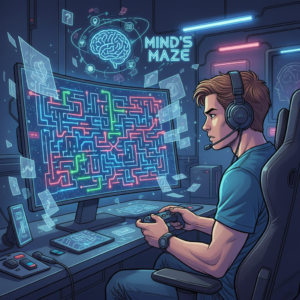
Perhaps the most practical application of Gaming Psychology & Lifestyle is the enhancement of problem-solving skills. Every game, at its core, is a series of problems waiting to be solved.
Trial and Error Learning
Failure is frequently penalized in traditional education. You feel embarrassed after receiving a poor grade. The main instructor in gaming is failure. “Game Over” is an encouragement to try again with fresh knowledge, not the end.
Gamers discover that perseverance is rewarded, which cultivates a “growth mindset.” “I stood in the fire,” “I ran out of mana,” and “I took the wrong path” are few examples of the reasons they learn to examine and modify their approach. The scientific method is applied in this iterative process of hypothesis, testing, and improvement.
Resilience is created when this is applied in real life. After spending three hours battling a challenging enemy, a gamer realizes that success is rarely achieved on the first try. They are more inclined to see obstacles in the real world as challenges to be overcome rather than insurmountable obstacles.
Strategic Planning and Resource Management
Role-playing games (RPGs) and survival games are masterclasses in logistics. You have limited inventory space, limited currency, and limited time. You must constantly prioritize.
- Resource Allocation: “Do I buy the better armor or the better weapon?” This mirrors financial budgeting.
- Long-term Strategy: “If I invest in this skill tree now, I will be powerful in the late game.” This mirrors career planning or investing.
These games teach players to think several steps ahead. They encourage a systemic view of problems, understanding how one small decision can have cascading effects down the line.
Collaborative Problem Solving
In multiplayer raids or objective-based games, you cannot succeed alone. You encounter complex challenges that require coordination.
Players must:
- Identify Roles: Who is the tank? Who is the healer? Who is the leader?
- Communicate Effectively: conveying critical info quickly and clearly.
- Resolve Conflict: Disagreements on strategy must be settled instantly to avoid a team wipe.
These are soft skills that are highly prized in the modern workplace. A raid leader in World of Warcraft is effectively managing a remote team of 20 people, handling personnel issues, logistics, and performance reviews in real-time.
Balancing the Digital and Physical: A Healthy Gaming Lifestyle
Understanding the psychology is only half the battle. The goal is to integrate gaming into a balanced lifestyle. We call this “Holistic Gaming.”

Physical Health for Gamers
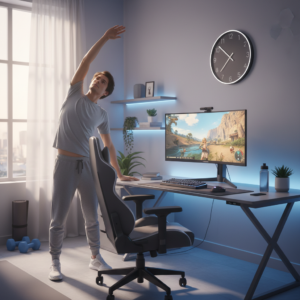
The stereotype of the unhealthy gamer is fading, but the risks of a sedentary lifestyle remain. Prolonged sitting, repetitive strain injuries (like carpal tunnel), and eye strain are real issues.
To maintain a healthy Gaming Psychology & Lifestyle, consider these pillars:
- Ergonomics: Invest in a chair that supports your spine. Keep your monitor at eye level. Your physical comfort dictates your mental focus.
- The 20-20-20 Rule: Every 20 minutes, look at something 20 feet away for 20 seconds. This reduces eye strain.
- Micro-Workouts: Use loading screens or matchmaking queues to do push-ups, squats, or stretching. It keeps blood flowing to the brain.
Mindful Gaming
Mindfulness is the practice of being present. Mindful gaming means being aware of your emotional state while playing. It means noticing when the fun stops and the compulsion begins.
Ask yourself:
- “Am I having fun right now?”
- “Is my body tense?”
- “Am I neglecting other needs (hunger, sleep, social interaction)?”
If the answer to the first question is “no,” it is time to log off. A healthy gamer controls the game; the game does not control the gamer.
The Psychological Profiles of Gamers
Recent research into Gaming Psychology & Lifestyle has identified distinct profiles that drive the global gaming craze. Understanding which profile fits you can help you maximize the benefits and minimize the risks.
- The Achiever: Driven by goals, points, and status. They love 100% completion and leaderboards. Risk: Burnout and obsession with numbers over enjoyment.
- The Socializer: Motivated by relationships. They play to hang out with friends. Risk: Peer pressure and staying online too late to accommodate others.
- The Explorer: Driven by discovery. They love lore, hidden areas, and world-building. Risk: Getting lost in the fantasy to the detriment of real-world responsibilities.
- The Killer/Competitor: Motivated by defeating others. They thrive in PvP environments. Risk: High stress, rage, and toxicity.
Recognizing your primary motivation allows you to choose games that feed your soul without draining your energy. If you are a Socializer, a solitary single-player game might feel isolating. If you are an Explorer, a high-stress competitive shooter might just make you anxious.
Conclusion: Leveling Up Your Life
The world of Gaming Psychology & Lifestyle is vast. It is a mirror reflecting our deepest needs for connection, achievement, and mastery. Video games are neither inherently good nor bad; they are powerful tools.
When used correctly, they sharpen our minds, soothe our anxieties, and connect us with people across the globe. They teach us that failure is temporary and that persistence is key. However, like any powerful tool, they require respect and balance.
By understanding the dopamine loops that drive us, acknowledging the cognitive gains we make, and remaining vigilant about our mental health, we can craft a lifestyle where gaming enriches our reality rather than replacing it. So, the next time you pick up a controller, remember: you aren’t just playing a game. You are engaging in a complex psychological exercise. Play smart, play healthy, and game on.


Leave a Reply