


Introduction
High cholesterol is a major risk factor for heart disease, but the good news is that exercise is one of the most powerful tools for managing it. Regular physical activity can lower LDL (“bad”) cholesterol, increase HDL (“good”) cholesterol, reduce triglycerides, and improve overall cardiovascular health. Unlike some health interventions that require strict adherence or medication side effects, exercise offers immediate benefits both for your cholesterol levels and your overall well-being. This comprehensive guide explains how exercise lowers cholesterol and provides practical workout plans you can start today.
Understanding How Exercise Lowers Cholesterol
The Science Behind Exercise and Cholesterol
Exercise affects cholesterol through multiple biological mechanisms. When you engage in regular physical activity, your body makes several positive changes to how it processes and transports cholesterol.
How Exercise Changes Cholesterol Levels:
- HDL Cholesterol Increase: Regular aerobic exercise increases HDL cholesterol by 3-9% for every hour of moderate activity per week. HDL is protective—it removes LDL from your arteries.
- LDL Cholesterol Reduction: While the effect is modest (5-10% reduction), combined with diet and medication (if needed), exercise significantly improves cholesterol profiles.
- Triglyceride Reduction: Exercise is particularly effective at lowering triglycerides, which are an independent risk factor for heart disease. Aerobic exercise can reduce triglycerides by 20-30%.
- Improved LDL Quality: Exercise makes LDL cholesterol particles larger and fluffier (less dense), making them less likely to stick to artery walls.
- Enhanced Metabolism: Regular activity improves how your liver processes cholesterol and increases the number of LDL receptors, allowing better cholesterol removal from blood.
The Cardiovascular Adaptations:
- Stronger heart muscle
- Lower resting heart rate
- Improved blood vessel function
- Better blood pressure control
- Reduced inflammation
- Improved blood sugar control
How Much Exercise Do You Need?
Current guidelines from the American Heart Association recommend:
For Cholesterol and Heart Health:
- 150 minutes per week of moderate-intensity aerobic activity (like brisk walking), OR
- 75 minutes per week of vigorous-intensity activity (like running), OR
- A combination of both
Additionally:
- Strength training 2+ days per week
- Flexibility exercises 2+ days per week
- Reduce sedentary time throughout the day
What This Means in Practice:
- 30 minutes, 5 days a week of moderate activity
- OR 25 minutes, 3 days a week of vigorous activity
- OR 45-60 minutes, 3-4 days a week of moderate activity
The good news: Even amounts below these recommendations provide benefits. Starting with 15-30 minutes, 3 days a week is excellent for beginners and shows measurable improvements in cholesterol profiles within 6-8 weeks.
Types of Exercise That Lower Cholesterol
Aerobic/Cardio Exercise for Cholesterol
Aerobic exercise is the most effective type of physical activity for improving cholesterol levels. Any activity that elevates your heart rate and keeps it elevated for sustained periods works.
Benefits of Aerobic Exercise:
- Highest impact on HDL cholesterol increase
- Significant triglyceride reduction
- Modest LDL reduction
- Weight loss support
- Overall cardiovascular fitness
- Mental health benefits
Aerobic Exercise Examples:
- Walking (brisk, 3-4 mph)
- Jogging or running
- Cycling (stationary or outdoor)
- Swimming
- Elliptical trainer
- Rowing machine
- Dancing
- Aerobic classes
- Jump rope
- Sports (tennis, basketball, soccer)
Intensity Guidelines:
- Moderate intensity: You can talk but not sing during activity (50-70% max heart rate)
- Vigorous intensity: Difficult to speak during activity (70-85% max heart rate)
Sample Target Heart Rates:
- Age 50: Moderate 85-119 bpm, Vigorous 120-170 bpm
- Age 60: Moderate 80-112 bpm, Vigorous 112-160 bpm
- Age 70: Moderate 75-105 bpm, Vigorous 105-150 bpm
Strength Training and Cholesterol
Strength training provides additional benefits beyond aerobic exercise, particularly for:
- Increasing muscle mass (which burns calories at rest)
- Supporting weight loss efforts
- Improving insulin sensitivity
- Boosting metabolism
- Enhancing bone health
- Improving functional fitness
Strength Training Benefits for Cholesterol:
- Supports weight loss (major cholesterol factor)
- Improves blood sugar control
- Reduces inflammation
- Complements aerobic exercise
- Prevents muscle loss with age
Strength Training Methods:
- Free weights (dumbbells, barbells)
- Resistance bands
- Weight machines
- Bodyweight exercises (push-ups, squats)
- Functional training
- Kettlebells
Key Muscles to Target:
- Legs (largest muscle groups)
- Chest
- Back
- Shoulders
- Arms
- Core
Frequency and Volume:
- 2+ sessions per week
- 1-3 sets per exercise
- 8-12 repetitions per set
- 1-2 days rest between working same muscles
High-Intensity Interval Training (HIIT)
HIIT involves alternating short bursts of intense activity with recovery periods. Research shows HIIT is particularly effective for cholesterol management.
HIIT Benefits:
- More effective time use
- Increases metabolism for hours after exercise
- Improves cholesterol levels quickly
- Enhances cardiovascular fitness
- Can be adapted to any fitness level
Sample HIIT Workout:
- Warm-up: 2-3 minutes easy movement
- 30 seconds maximum effort (sprinting, intense cycling)
- 90 seconds recovery (easy movement)
- Repeat 5-8 times
- Cool-down: 2-3 minutes
HIIT Examples:
- Sprint intervals
- Burpees alternating with walking
- Cycling sprints
- Jump rope intervals
- Stair climbing
- Swimming intervals
Important Note: HIIT is intense. Consult your doctor before starting, especially if you have existing heart conditions.
Flexibility and Balance Exercise
While not directly affecting cholesterol, flexibility and balance work support overall fitness and injury prevention.
Examples:
- Yoga
- Pilates
- Tai Chi
- Stretching routines
- Balance training
Benefits:
- Injury prevention
- Improved posture
- Enhanced recovery
- Stress reduction
- Better overall function
Best Exercises for Cholesterol Management
Walking for Cholesterol Reduction
Walking is the most accessible exercise for cholesterol management. It requires no equipment, can be done anywhere, and is suitable for almost all fitness levels.
Benefits of Walking:
- Lower injury risk than running
- Sustainable long-term
- Improves HDL cholesterol
- Reduces triglycerides
- Supports weight loss
- Low financial cost
- Enjoyable for most people
Walking Guidelines:
- Brisk pace: 3-4 mph (feels like you’re purposefully moving)
- Intensity: Can talk but not sing
- Frequency: 5+ days per week
- Duration: 30+ minutes per session
- Start gradually: 10-15 minutes if new to exercise
Walking Tips:
- Wear proper shoes
- Walk on varied terrain when possible
- Include hills for intensity
- Walk with friends for motivation
- Use a pedometer or app to track steps
- Aim for 10,000 steps daily
Walking Schedule Sample:
- Monday: 30 minutes brisk walk
- Tuesday: 30 minutes brisk walk
- Wednesday: 30 minutes with hills
- Thursday: 30 minutes brisk walk
- Friday: 30 minutes brisk walk
- Saturday: 45 minutes leisurely walk
- Sunday: Rest or easy 20 minute walk
Running and Jogging Programs
Running is more intensive than walking and provides faster results for cholesterol management.
Benefits of Running:
- High calorie burn
- Rapid triglyceride reduction
- Significant HDL increase
- Improves cardiovascular fitness quickly
- Enhances mental health
- Efficient time use
Running Guidelines:
- Moderate pace: Conversational but slightly breathless
- Vigorous pace: Difficult to speak
- Frequency: 3-4 days per week (with rest days)
- Duration: 20-60 minutes
- Start carefully: Alternate running and walking if new
Couch to 5K Program (Beginner-Friendly):
- Week 1-3: Alternate 60 seconds running, 90 seconds walking
- Week 4-6: Increase running intervals to 2-3 minutes
- Week 7-9: Run 20+ minutes continuously
- Total: 9 weeks to 5K (3 miles) running fitness
Running Safety:
- Invest in proper running shoes
- Run on softer surfaces (track, grass, trail)
- Warm up and cool down
- Don’t increase distance too quickly (10% rule)
- Listen to your body
Cycling for Heart Health
Cycling is excellent for cholesterol management, especially for those with joint concerns.
Benefits of Cycling:
- Low impact on joints
- Builds leg muscle
- Improves cardiovascular health
- Can be social
- Adjustable intensity
- Enjoyable activity for many
Cycling Options:
- Road cycling
- Mountain biking
- Stationary/indoor cycling
- Recumbent cycling
Cycling Guidelines:
- Moderate pace: 12-14 mph road cycling
- Vigorous pace: 16+ mph
- Frequency: 4-5 days per week
- Duration: 30-60 minutes
- Resistance: Include some hill work
Indoor Cycling Benefits:
- Weather-independent
- Adjustable resistance
- Group class opportunities
- Entertainment options
- Safer for urban cyclists
Swimming and Water Exercise
Swimming is an excellent full-body exercise for cholesterol with minimal joint stress.
Benefits of Swimming:
- Works all major muscle groups
- Excellent cardiovascular exercise
- Low impact
- Suitable for various fitness levels
- Accessible for joint problems
- Enjoyable and meditative
Swimming Guidelines:
- Pace: Moderate to vigorous intensity
- Frequency: 3-4 sessions per week
- Duration: 20-45 minutes
- Strokes: Vary strokes for balanced workout
- Intensity: Include intervals
Swimming Workouts:
- Continuous steady pace: 30-45 minutes
- Interval training: 5 × 200m with 30 seconds rest
- Mixed strokes: Vary freestyle, backstroke, breaststroke
- Water aerobics: Group classes
- Treading water intervals
Water Exercise Alternatives:
- Water aerobics
- Aqua jogging
- Water walking
- Poolside exercises
Weight Training Routines
Strength training builds muscle mass, which supports cholesterol management through weight loss and metabolism improvement.
Sample Weight Training Routine (3x per week):
Session 1 (Lower Body):
- Squats: 3 sets × 10-12 reps
- Leg press: 3 sets × 10-12 reps
- Leg curls: 2 sets × 10-12 reps
- Calf raises: 2 sets × 12-15 reps
Session 2 (Upper Body – Chest/Back):
- Bench press: 3 sets × 8-10 reps
- Bent-over rows: 3 sets × 8-10 reps
- Lat pulldowns: 2 sets × 10-12 reps
- Chest flyes: 2 sets × 10-12 reps
Session 3 (Shoulders/Arms):
- Shoulder press: 3 sets × 8-10 reps
- Lateral raises: 2 sets × 12-15 reps
- Bicep curls: 2 sets × 10-12 reps
- Tricep dips: 2 sets × 10-12 reps
- Core work: Planks, ab wheels
Strength Training Principles:
- Progressive overload (gradually increase weight)
- Proper form over heavy weight
- Full range of motion
- 1-2 minute rest between sets
- 2+ days rest between same muscle group
Group Fitness Classes
Group fitness provides motivation, structure, and social benefits that support long-term adherence.
Popular Group Classes:
- Aerobic dance classes
- Spinning/cycling studios
- Zumba
- CrossFit
- Boot camp classes
- Aqua aerobics
- Kickboxing
- Step aerobics
Benefits:
- Structured instruction
- Motivating atmosphere
- Social connections
- Variety prevents boredom
- Professional guidance
- Accountability
Sample Workout Plans for Cholesterol
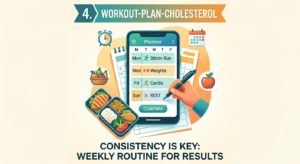
Beginner Fitness Routine (Start Here)
Goal: Build exercise habit and establish baseline fitness
Duration: 4 weeks
Week 1-4 Schedule:
- Monday: 20 minutes brisk walking
- Tuesday: Rest or easy 15-minute walk
- Wednesday: 20 minutes brisk walking
- Thursday: Rest or gentle stretching (10 min)
- Friday: 25 minutes brisk walking
- Saturday: 30 minutes leisurely activity (hiking, casual cycling)
- Sunday: Complete rest
Progression:
- Week 1-2: Focus on consistency
- Week 3: Add 5 minutes to walks
- Week 4: Include one 10-minute hill section
Expected Results: Improved cholesterol in 6-8 weeks, increased energy, better sleep
Intermediate Workout Plan (Build Momentum)
Goal: Establish solid fitness and significant cholesterol improvements
Duration: 8 weeks
Weekly Schedule:
- Monday: 40 minutes moderate cycling
- Tuesday: 30 minutes strength training (upper body)
- Wednesday: 30 minutes running/walk intervals
- Thursday: Rest or 20 minutes yoga
- Friday: 30 minutes strength training (lower body)
- Saturday: 45 minutes activities (hiking, swimming, sports)
- Sunday: Complete rest
Details:
Monday Cycling:
- 5-minute warm-up
- 30 minutes moderate pace (conversational intensity)
- 5-minute cool-down
Tuesday Strength (Upper Body):
- Warm-up: 5 minutes light cardio
- Bench press: 3 × 10
- Bent rows: 3 × 10
- Lat pulldowns: 2 × 12
- Bicep curls: 2 × 12
- Tricep dips: 2 × 10
- Cool-down stretch
Wednesday Run/Walk:
- Warm-up: 5 minute walk
- Repeat 6 times: 3 min run, 1 min walk
- 5 minute walk cool-down
Friday Strength (Lower Body):
- Warm-up: 5 minutes light cardio
- Squats: 3 × 12
- Leg press: 3 × 10
- Leg curls: 2 × 12
- Walking lunges: 2 × 10
- Calf raises: 2 × 15
- Core: 1 minute plank
- Cool-down stretch
Expected Results: Significant cholesterol reduction, noticeable fitness improvements, weight loss, increased energy
Advanced Training Program (Maximize Results)
Goal: Achieve peak fitness and optimal cholesterol levels
Duration: Ongoing (sustainable program)
Weekly Schedule:
- Monday: 45 minutes HIIT cycling
- Tuesday: 45 minutes strength training (upper body)
- Wednesday: 60 minutes running or trail running
- Thursday: 30 minutes yoga/flexibility
- Friday: 45 minutes strength training (lower body)
- Saturday: 60 minutes varied activity (swimming, sports, group class)
- Sunday: Complete rest
Monday HIIT Cycling:
- 5-minute warm-up
- 12 × (30 sec high intensity, 90 sec recovery)
- 5-minute cool-down
- Total: 45 minutes
Tuesday Upper Body:
- Warm-up: Light cardio, 5 min
- Dumbbell bench press: 4 × 6-8
- Bent-over barbell rows: 4 × 6-8
- Weighted dips: 3 × 8-10
- Lat pulldowns: 3 × 8-10
- Barbell curls: 3 × 8-10
- Overhead tricep extension: 3 × 8-10
- Core work: Advanced ab exercises
- Stretch: 10 minutes
Wednesday Running:
- 10-minute easy warm-up
- 40 minutes moderate to hard pace
- 10-minute easy cool-down
- (OR interval workout: 8 × 4 min hard, 2 min easy)
Friday Lower Body:
- Warm-up: Light cardio, 5 min
- Barbell squats: 4 × 6-8
- Romanian deadlifts: 3 × 8-10
- Leg press: 3 × 8-10
- Bulgarian split squats: 3 × 10
- Leg curls: 3 × 10
- Calf raises: 3 × 12
- Core: Advanced exercises
- Stretch: 10 minutes
Expected Results: Peak cardiovascular fitness, optimal cholesterol levels, significant weight loss, athletic performance
Combining Exercise with Diet for Maximum Results
Exercise and Nutrition Synergy
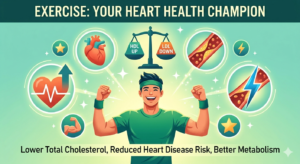
Exercise and diet work together synergistically. Combining regular physical activity with heart-healthy nutrition produces results superior to either approach alone.
Combined Effects:
- Exercise + heart-healthy diet: 15-25% LDL reduction potential
- Exercise alone: 5-10% reduction
- Diet alone: 10-15% reduction
Nutrition Support for Exercise:
Before Workouts (30-60 minutes prior):
- Light snack with carbs and protein
- Examples: banana with almond butter, oatmeal, toast with egg
- Small amount to avoid digestive upset
After Workouts (within 30-60 minutes):
- Protein + carbs for recovery
- Examples: Greek yogurt with berries, chicken with sweet potato, protein smoothie
- Helps muscle recovery and replenishes energy
Throughout the Day:
- Adequate hydration (water primarily)
- Whole grains for sustained energy
- Lean proteins for muscle support
- Fruits and vegetables for nutrients
- Healthy fats from fish, nuts, olive oil
Calorie Considerations:
- Don’t “earn” excessive calories through exercise
- Moderate calorie deficit supports weight loss
- Fueling for performance is important
- Balance is key
Weight Loss and Cholesterol
Weight loss is one of the most powerful ways to improve cholesterol. Exercise supports weight loss through:
- Calorie burning during activity
- Increased metabolic rate
- Reduced appetite
- Improved food cravings
- Better stress management (reduces emotional eating)
Weight Loss Impact on Cholesterol:
- 5-10% weight loss: Visible cholesterol improvement
- 10-15% weight loss: Significant improvements
- 20%+ weight loss: Major cholesterol transformation possible
Exercise for Weight Loss:
- Aerobic activity burns calories directly
- Strength training preserves muscle during weight loss
- HIIT maximizes calorie burn in short time
- Consistency matters more than intensity
- Combine with moderate calorie reduction
Recovery and Rest Days
Rest days are crucial for:
- Muscle repair and growth
- Preventing injury
- Mental recovery
- Sustainable long-term program
- Continued progress
Rest Day Activities:
- Gentle stretching (10-15 minutes)
- Leisurely walk
- Yoga or tai chi
- Complete rest (completely inactive)
- Light housework or activity
Sleep and Cholesterol:
- 7-9 hours per night optimal
- Poor sleep worsens cholesterol
- Exercise improves sleep quality
- Consistent bedtime helps
Exercise Safety and Precautions
Consulting Your Doctor
Before starting any exercise program, especially if you have existing health conditions:
See Your Doctor If You Have:
- Existing heart disease
- Uncontrolled high blood pressure
- Recent heart attack or stroke
- Severe chest pain or angina
- Undiagnosed symptoms
- Taking new medications
- Any chronic health conditions
What to Ask Your Doctor:
- Is it safe for me to start exercising?
- What intensity is appropriate?
- Should I wear a heart monitor?
- Any exercises to avoid?
- Should I start slowly?
- When should I see results?
Medical Evaluation May Include:
- Physical examination
- Blood pressure check
- Possibly stress test
- EKG (electrocardiogram)
- Other tests based on history
Warning Signs to Watch
Stop exercising and seek medical attention if you experience:
Chest Pain or Pressure:
- Pain in center of chest
- Tightness or discomfort
- Pain radiating to arm, neck, or jaw
Shortness of Breath:
- Unusual difficulty breathing
- Extreme breathlessness
- Persistent dyspnea
Heart Symptoms:
- Irregular heartbeat or palpitations
- Severe dizziness or fainting
- Sudden weakness
Other Concerns:
- Severe joint or muscle pain
- Unusual fatigue
- Chest discomfort after exercise that persists
Action to Take:
- Stop exercising immediately
- Rest and sit down
- Contact your doctor
- Call 911 if symptoms severe
- Don’t resume until cleared
Injury Prevention
Prevent exercise injuries through:
Proper Warm-up (5-10 minutes):
- Light activity to increase heart rate
- Dynamic stretches
- Prepares body for exercise
- Injury prevention
Good Form:
- Proper technique essential
- Learn correct form before heavy weight
- Consider trainer for weight training
- Watch videos for movement quality
Gradual Progression:
- 10% rule: Increase volume/intensity by max 10% weekly
- Listen to body
- Some muscle soreness normal, sharp pain not
- Progress training, not just fitness level
Cool-Down (5-10 minutes):
- Gradual heart rate reduction
- Gentle activity
- Improves recovery
- Reduces dizziness
Cross-Training:
- Vary exercise types
- Prevents overuse injury
- Maintains interest
- Works different muscles
Recovery:
- Adequate sleep
- Nutrition
- Stretching and flexibility
- Massage or foam rolling
- Active recovery days
Tracking Progress and Staying Motivated
Measuring Results
Cholesterol Improvements:
- Baseline test before starting
- Retest after 3 months
- Then every 6-12 months
- Track trends over time
Fitness Improvements:
- Distance/time (how far you can go)
- Weights lifted
- Resting heart rate (should decrease)
- Recovery heart rate
- Subjective energy levels
Other Health Markers:
- Weight and body composition
- Blood pressure
- Energy levels
- Sleep quality
- Mood and stress levels
Staying Motivated
Set SMART Goals:
- Specific: Not “get fit” but “run 5K”
- Measurable: Track progress
- Achievable: Realistic for your level
- Relevant: Meaningful to you
- Time-bound: 8 weeks, 3 months, etc.
Motivation Strategies:
- Find activities you enjoy (sustainability key)
- Exercise with friends
- Join clubs or group classes
- Track workouts
- Celebrate milestones
- Vary routine to prevent boredom
- Use apps for accountability
- Reward progress (non-food rewards)
Dealing with Setbacks:
- Missing workouts is normal
- Don’t give up after one missed session
- Return to routine next scheduled day
- Adjust if needed (life circumstances change)
- Progress isn’t always linear
- Consistency over perfection
FAQs About Exercise and Cholesterol
Q: How long before exercise lowers my cholesterol? A: Some benefits appear within 1-2 weeks, but measurable cholesterol changes typically appear within 3-6 weeks of consistent exercise.
Q: Is walking enough to lower cholesterol? A: Brisk walking 5+ days weekly can lower cholesterol 5-10%. Combined with diet changes, it’s often sufficient. Some may need medication alongside.
Q: Can exercise alone lower cholesterol to safe levels? A: For mild elevations, possibly. For moderate to severe, usually needs combination of exercise, diet, and possibly medication. Work with your doctor.
Q: How much weight do I need to lose to improve cholesterol? A: Even 5-10% weight loss provides benefits. Larger losses produce larger improvements.
Q: Is running better than walking for cholesterol? A: Running produces faster results but is harder to sustain. Walking is more sustainable. Combined routine is best.
Q: Can I do the same exercise every day? A: Mix varies types to prevent injury and maintain motivation. Repetitive daily exercise increases overuse injury risk.
Q: Do I need a gym membership for exercise? A: No. Walking, running, home strength training, online classes provide excellent options.
Q: How do I stay motivated long-term? A: Find enjoyable activities, exercise with others, track progress, set goals, and vary routine.
Q: Is strength training as important as cardio? A: Both are valuable. Cardio most directly improves cholesterol, but strength training supports weight loss and overall fitness.
Q: What if I have joint problems? A: Swimming, cycling, elliptical, and water aerobics are low-impact options. Always consult your doctor.
Medical Disclaimer: This article is for educational purposes only and should not be considered medical advice. Always consult with a healthcare provider before starting any exercise program, especially if you have existing heart conditions or other health concerns. Individual responses to exercise vary, and what works for one person may differ for another. Exercise should complement medical treatment, not replace it.
Fitness Disclaimer: The workout plans and exercises described are for general informational purposes. If you’re new to exercise or have physical limitations, consult a certified fitness professional before beginning any program.



Leave a Reply