


Introduction
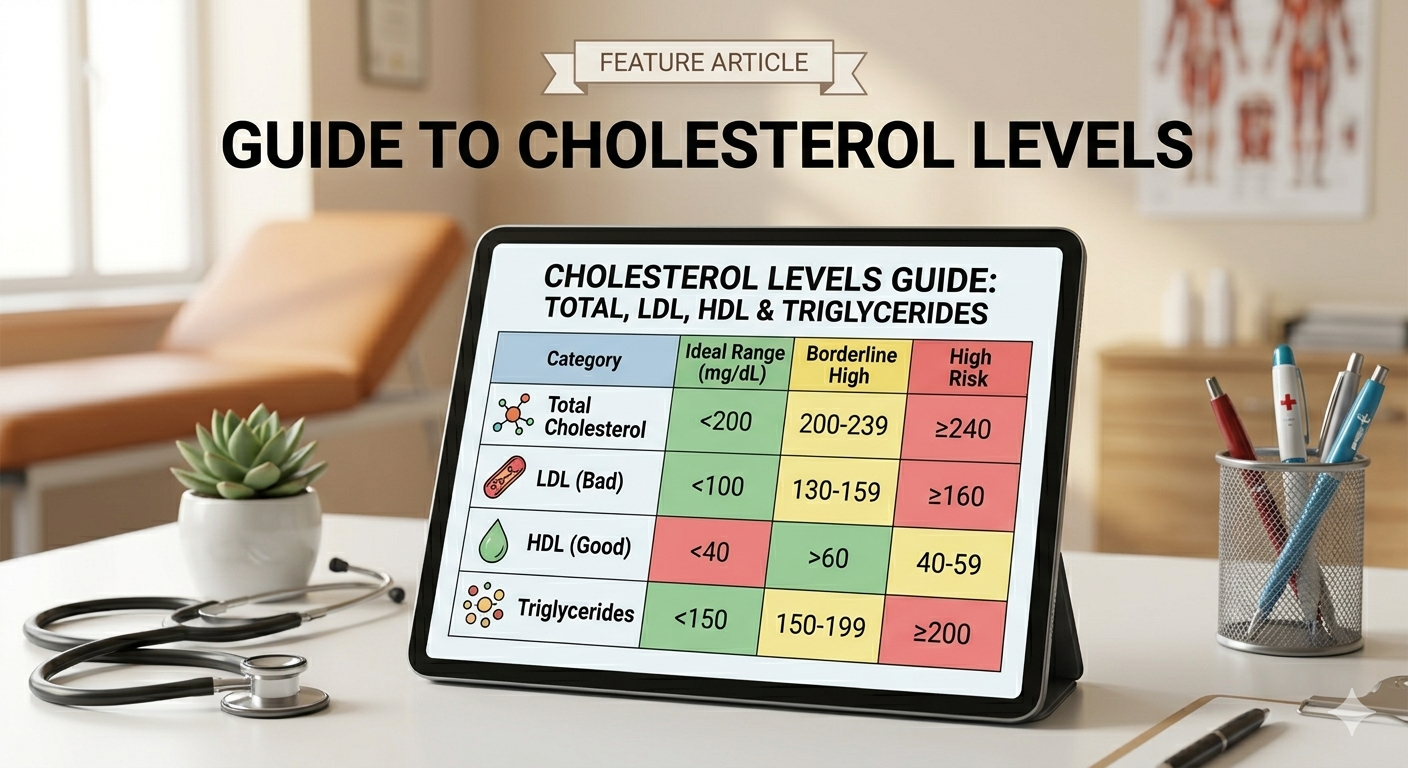
Understanding your cholesterol levels is one of the most important steps you can take toward maintaining heart health. Yet many people receive their cholesterol test results and feel confused about what the numbers mean. Is 200 good? What should HDL be? How do your levels compare to others your age? This comprehensive guide provides a complete cholesterol levels chart and explains exactly what all those numbers mean, so you can take informed action to protect your health.
What Are Cholesterol Levels and Why They Matter
Understanding Different Types of Cholesterol
Cholesterol is a waxy substance that travels through your bloodstream in protein packages. Your cholesterol test measures different types of cholesterol, each affecting your heart health differently.
Total Cholesterol:
- Sum of all cholesterol in your blood
- Includes LDL, HDL, and 20% of triglycerides
- First number on most cholesterol tests
- Gives overall picture but not complete story
LDL Cholesterol (Low-Density Lipoprotein):
- Called “bad cholesterol”
- Builds up in arteries creating plaque
- Major risk factor for heart disease and stroke
- Most important number to lower
- Dangerous at high levels
HDL Cholesterol (High-Density Lipoprotein):
- Called “good cholesterol”
- Removes LDL from arteries
- Higher levels are protective
- Lower risk when HDL is high
- People often need to raise this number
Triglycerides:
- Type of fat in blood
- Elevated levels increase heart disease risk
- Often overlooked but important
- Can be very high in certain conditions
- Respond well to lifestyle changes
VLDL Cholesterol (Very Low-Density Lipoprotein):
- Carries triglycerides
- Often calculated from triglyceride levels
- Less commonly discussed but important
- Usually provided on comprehensive panel
Why Cholesterol Levels Are Important
High cholesterol is often called a “silent killer” because it typically has no symptoms. Many people with dangerous cholesterol levels feel completely fine. This makes regular testing crucial—you can’t know your levels without a blood test.
Why Cholesterol Matters:
- Builds plaque in arteries (atherosclerosis)
- Restricts blood flow to heart
- Increases heart attack risk
- Increases stroke risk
- Can damage other organs
- Often runs in families (genetic factors)
High cholesterol affects millions of Americans. According to the CDC, about 1 in 3 American adults has high cholesterol. The scary part: most don’t know they have it.
Cholesterol Levels Chart: Normal, Borderline, High
Here’s your complete reference guide for cholesterol levels:
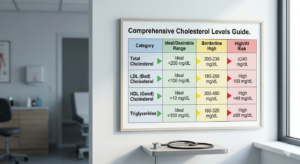
Total Cholesterol Levels Range
Total Cholesterol Chart:
| Level (mg/dL) | Category | Meaning |
|---|---|---|
| Less than 200 | Desirable | Lowest risk for heart disease |
| 200-239 | Borderline High | Increased risk, monitor carefully |
| 240 and above | High | Significant risk, needs treatment |
What This Means:
- Less than 200: Ideal for most people
- 200-239: Talk to doctor about cholesterol reduction
- 240+: Very high risk, likely needs medication
Most doctors consider under 200 mg/dL ideal, but individual targets vary based on other risk factors. Someone with multiple heart disease risk factors might benefit from lower total cholesterol.
LDL Cholesterol (Bad Cholesterol) Levels
LDL is the most important number to manage. This is the cholesterol that builds up in your arteries.
LDL Cholesterol Chart:
| Level (mg/dL) | Category | Risk Level |
|---|---|---|
| Less than 100 | Optimal | Best for heart health |
| 100-129 | Near Optimal | Good for most people |
| 130-159 | Borderline High | Increased risk |
| 160-189 | High | Significantly elevated risk |
| 190 and above | Very High | Very dangerous |
Understanding LDL Goals:
- Less than 100: Optimal for most people
- Less than 70: For those with heart disease or diabetes
- Less than 55: For very high-risk patients
- The lower, the better (within reason)
Key Point: LDL is the number most doctors focus on lowering. If this is high, your doctor will likely recommend treatment (diet, exercise, medication, or combination).
HDL Cholesterol (Good Cholesterol) Levels
HDL is the protective cholesterol. You want this number HIGH, not low.
HDL Cholesterol Chart:
| Level (mg/dL) | Category | Risk |
|---|---|---|
| 60 and above | High (Good) | Protective against heart disease |
| 40-59 | Acceptable | Okay, but could be higher |
| Less than 40 (Men) | Low | Increased risk |
| Less than 50 (Women) | Low | Increased risk |
Understanding HDL Goals:
- 60+: Protective level (ideal)
- 40-59: Acceptable but work to raise it
- Below 40 (men) or 50 (women): Low, increases risk
- Higher is always better with HDL
Note: Women naturally have slightly higher HDL than men. Post-menopausal women may see changes in HDL levels.
Triglyceride Levels Chart
Triglycerides are fats in your blood. High levels often go unnoticed but increase heart disease risk.
Triglyceride Levels Chart:
| Level (mg/dL) | Category | Risk |
|---|---|---|
| Less than 150 | Normal | Good |
| 150-199 | Borderline High | Increased risk |
| 200-499 | High | Significant risk |
| 500 and above | Very High | Very dangerous |
Understanding Triglycerides:
- Less than 150: Normal and healthy
- 150-199: Borderline; lifestyle changes recommended
- 200-499: High; usually needs treatment
- 500+: Very high; immediate intervention needed
Important: Triglycerides are very responsive to diet and exercise. Reducing sugar, refined carbs, and alcohol significantly lowers triglycerides.
Cholesterol Levels by Age and Gender
Cholesterol levels naturally change with age. Here’s what’s typical for different age groups:
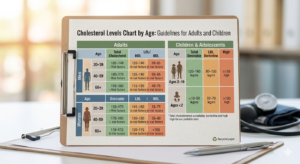
Cholesterol Levels Chart for Adults
Men (Age 20+):
| Age | Total Chol | LDL Goal | HDL Goal |
|---|---|---|---|
| 20-39 | <200 | <130 | >40 |
| 40-49 | <200 | <130 | >40 |
| 50-59 | <200 | <130 | >40 |
| 60+ | <200 | <130 | >40 |
Women (Age 20+):
| Age | Total Chol | LDL Goal | HDL Goal |
|---|---|---|---|
| 20-39 | <200 | <130 | >50 |
| 40-49 | <200 | <130 | >50 |
| 50-59 | <200 | <130 | >50 |
| 60+ | <200 | <130 | >50 |
Key Observations:
- Goals remain consistent across ages
- Women naturally have higher HDL
- Cholesterol often increases with age
- More frequent testing as you age
Cholesterol Levels in Children and Teens
The American Academy of Pediatrics recommends cholesterol screening for all children ages 9-11, and again at ages 17-21.
Children and Teen Cholesterol Chart:
| Age | Total Chol | LDL | HDL |
|---|---|---|---|
| Under 18 | <170 | <110 | >45 |
Important Notes:
- Children typically have lower cholesterol
- Childhood obesity increasing childhood cholesterol
- Family history matters—test earlier if parents have high cholesterol
- Lifestyle habits in youth affect adult cholesterol
Cholesterol Levels for Women
Women have unique cholesterol considerations:
Women’s Cholesterol Facts:
- Naturally have higher HDL than men
- Estrogen helps maintain healthy cholesterol (pre-menopause)
- Menopause often increases LDL and decreases HDL
- Heart disease is leading cause of death in women
- Risk increases after menopause
Post-Menopausal Women:
- LDL often increases 5-10%
- HDL may decrease
- Triglycerides may rise
- More frequent monitoring recommended
Cholesterol Levels for Men
Men face different cholesterol challenges:
Men’s Cholesterol Facts:
- Tend to have lower HDL than women
- Risk increases earlier than women
- More likely to have heart disease in 50s and 60s
- Baseline screening important for all men
- Regular monitoring critical
Men Age Considerations:
- Baseline test by age 35 recommended
- Every 5 years if normal
- More frequently if elevated
- Earlier screening if family history
How to Read Your Cholesterol Test Results
When you get your cholesterol test back, you’ll see numbers that might look confusing. Here’s exactly what they mean:
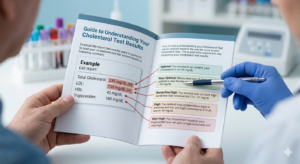
Understanding Your Lab Report
Your cholesterol report (lipid panel) typically shows:
Standard Lipid Panel:
Total Cholesterol: ___ mg/dL
LDL Cholesterol: ___ mg/dL
HDL Cholesterol: ___ mg/dL
Triglycerides: ___ mg/dL
Reading Tips:
- Compare each number to the reference ranges above
- Look at all numbers together, not just one
- Understanding trend (improving or worsening) important
- Bring chart above to appointments
Comprehensive Panel May Also Include:
- VLDL cholesterol
- Cholesterol ratio calculations
- Risk assessments
- Doctor’s interpretation
What Numbers Mean
Optimal Results Look Like:
- Total Cholesterol: Below 200
- LDL: Below 100
- HDL: 60 or higher
- Triglycerides: Below 150
These indicate lowest heart disease risk
Borderline Results Look Like:
- Total Cholesterol: 200-239
- LDL: 130-159
- HDL: 40-59
- Triglycerides: 150-199
These warrant lifestyle changes, possible medication
High-Risk Results Look Like:
- Total Cholesterol: 240+
- LDL: 160+
- HDL: Below 40
- Triglycerides: 200+
These typically require medication plus lifestyle changes
Questions to Ask Your Doctor
When discussing your cholesterol results:
Important Questions:
- Are my numbers at goal?
- What is my risk for heart disease?
- Should I make lifestyle changes?
- Do I need medication?
- When should I retest?
- What are my personal cholesterol goals?
- How do my results compare to previous tests?
- Are there any risk factors I should know about?
Bring These to Appointments:
- Your cholesterol levels chart
- Previous cholesterol results
- List of current medications
- Family history information
- Questions written down
Cholesterol Goals by Risk Level
Your personal cholesterol targets depend on your overall heart disease risk:
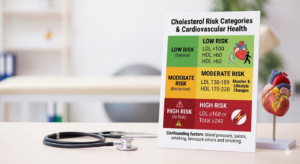
Low-Risk Cholesterol Targets
You’re Low-Risk If:
- No heart disease or diabetes
- No family history of early heart disease
- Fewer than one risk factor
- Healthy weight and lifestyle
Your Cholesterol Goals:
- Total Cholesterol: Less than 200
- LDL: Less than 130
- HDL: 60 or higher
- Triglycerides: Less than 150
How to Achieve:
- Diet changes often sufficient
- Regular exercise (150 min/week)
- Maintain healthy weight
- Don’t smoke
- Regular monitoring
Moderate-Risk Cholesterol Targets
You’re Moderate-Risk If:
- Multiple heart disease risk factors
- Diabetes without previous heart disease
- Family history of early heart disease
- 10-year heart disease risk 6-20%
Your Cholesterol Goals:
- Total Cholesterol: Less than 200
- LDL: Less than 100
- HDL: 60 or higher
- Triglycerides: Less than 150
How to Achieve:
- Significant diet changes
- Regular exercise critical
- Possible medication
- Weight loss if overweight
- Stress management
High-Risk Cholesterol Targets
You’re High-Risk If:
- Existing heart disease
- Previous heart attack or stroke
- Diabetes with other risk factors
- 10-year heart disease risk above 20%
- Severe family history
Your Cholesterol Goals:
- Total Cholesterol: Less than 180
- LDL: Less than 70 (often less than 55)
- HDL: 60 or higher
- Triglycerides: Less than 150
How to Achieve:
- Medication almost always needed
- Very strict diet changes
- Exercise critical
- Aggressive risk factor management
- Close monitoring (every 3-6 months)
How to Improve Your Cholesterol Levels
Lowering High Cholesterol
If Your Cholesterol Is High:
Diet Changes (Can reduce LDL 10-15%):
- Reduce saturated fat
- Eliminate trans fats
- Add soluble fiber (oats, beans, apples)
- Include plant sterols (nuts, seeds)
- Eat fatty fish (omega-3s)
- Reduce processed foods
- Limit refined carbs and sugar
Exercise (Can reduce LDL 5-10%, increase HDL 3-9%):
- 150 minutes moderate aerobic activity weekly
- Add strength training 2x weekly
- Reduce sitting time
- Start gradually if sedentary
Weight Loss (Can improve all numbers):
- 5-10% weight loss improves cholesterol
- Reduces LDL and triglycerides
- Increases HDL
- Each pound helps
Other Lifestyle Changes:
- Quit smoking (significant improvement)
- Limit alcohol
- Manage stress
- Improve sleep
- Regular monitoring
Medication (If lifestyle changes insufficient):
- Statins (most common)
- PCSK9 inhibitors (for high-risk)
- Ezetimibe
- Fibrates
- Bile acid sequestrants
Raising Low HDL
Low HDL (“good cholesterol”) increases risk even if LDL is normal.
Strategies to Raise HDL:
Exercise (Most effective):
- Aerobic activity raises HDL most
- 150+ minutes weekly of moderate activity
- HDL can increase 3-9% with regular exercise
- Consistency matters more than intensity
Weight Loss:
- Losing weight increases HDL
- Even 5% loss helps
- Improves HDL/LDL ratio
Dietary Changes:
- Healthy fats (olive oil, nuts, fish)
- Reduce refined carbs
- Add soluble fiber
- Limit sugar and alcohol
Smoking:
- Quitting improves HDL
- One of biggest improvements you can make
- Important for overall heart health
Alcohol (Moderate Only):
- Moderate alcohol may raise HDL slightly
- Not recommended to start drinking for this reason
- Women: 1 drink per day max
- Men: 2 drinks per day max
Monitoring Progress
When to Retest:
- Initial high cholesterol: 6 weeks after lifestyle changes
- Starting medication: 6-8 weeks after starting
- Normal cholesterol: Every 5 years if low-risk
- Borderline/high: Every 1-2 years or as directed
- On medication: As recommended by doctor
Tracking Your Progress:
- Keep copies of all test results
- Note what date each test was done
- Record lifestyle changes made
- Note how you’re feeling
- Share with your doctor
Signs of Success:
- LDL decreasing (trending down)
- HDL increasing (trending up)
- Triglycerides decreasing
- Feeling more energetic
- Weight loss if overweight
- Better overall health markers
FAQs About Cholesterol Levels
Q: What is the best cholesterol level? A: Less than 200 total cholesterol is desirable. But more important is LDL below 100, HDL above 60, and triglycerides below 150.
Q: How often should I get my cholesterol checked? A: Adults should be checked every 5 years starting at age 20. More frequently if results abnormal or at higher risk.
Q: Can I lower cholesterol without medication? A: Many people can with diet and exercise alone. Some (especially with family history) need medication. Work with your doctor.
Q: Why did my cholesterol go up? A: Many causes: diet high in saturated fat, weight gain, less exercise, stress, certain medications, aging, or genetic factors.
Q: Is 200 cholesterol bad? A: 200 is borderline. Ideally you want under 200, but the other numbers (LDL, HDL) matter more.
Q: What’s a normal cholesterol level by age? A: Targets are the same across ages (under 200 total, under 100 LDL, 60+ HDL). But what’s “normal” increases with age.
Q: Can young people have high cholesterol? A: Yes, especially with family history. Family history is the strongest predictor regardless of age.
Q: How long does it take to lower cholesterol? A: Diet changes show results in 4-6 weeks. Medications take 6-8 weeks. Best results with combination.
Q: What if my cholesterol keeps rising despite diet changes? A: Genetic factors (familial hypercholesterolemia) make some people resistant to diet changes. Medication often needed.
Q: Should I follow a specific diet for cholesterol? A: Mediterranean or DASH diets work well. The key is reducing saturated fat and adding whole foods.



Comments (1)
Complete Guide to Cholesterol: Stop Heart Disease Todaysays:
May 29, 2026 at 4:38 pm[…] Cholesterol testing involves a blood test called a lipid profile or lipid panel. Understanding your cholesterol numbers is essential for effective cholesterol treatment planning. […]