


Introduction
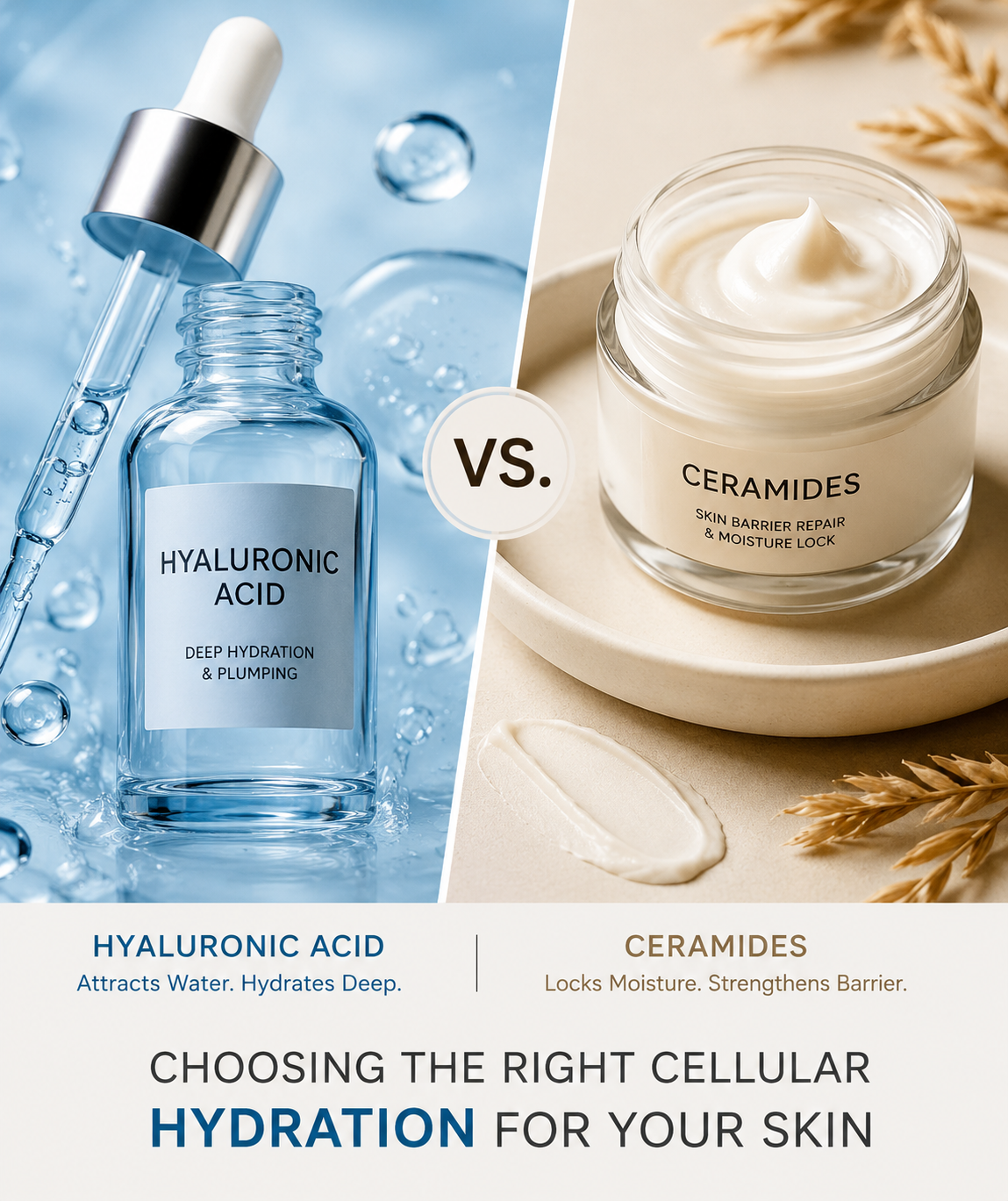
Stand in front of any skincare shelf and you’ll see the same two words fighting for your attention: hyaluronic acid and ceramides. Both promise hydration. Both show up in nearly every “holy grail” serum and moisturizer on the market. And both get thrown around so loosely that most people genuinely don’t know which one their skin actually needs.
Here’s the truth: hyaluronic acid and ceramides aren’t rivals. They’re two completely different players solving two completely different problems. One pulls water into your skin. The other makes sure that water doesn’t disappear an hour later. Understanding this distinction is the difference between skincare that works at a cellular level and skincare that just feels nice for twenty minutes.
This guide breaks down exactly what hyaluronic acid and ceramides do, how each one supports cellular hydration, which ingredient your skin type needs most, and whether you should be using both at once (spoiler: probably yes).
What Is Hyaluronic Acid? The Moisture Magnet
Hyaluronic acid, often shortened to HA, is a naturally occurring polysaccharide already present in your skin, joints, and eyes. Its superpower is water retention — a single gram of hyaluronic acid is often cited as being able to hold up to 1,000 times its weight in water. That’s how it earned nicknames like “nature’s moisture magnet” and the “king of hydration” across the skincare world.
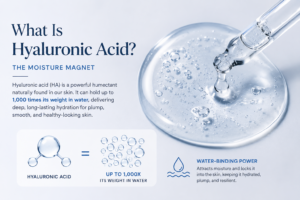
As a humectant, hyaluronic acid works by drawing moisture from the environment, and from deeper layers of your skin, up toward the surface. This plumps cells almost instantly and softens the look of fine lines. Your body produces hyaluronic acid naturally, but that production declines steadily with age, which is exactly why topical hyaluronic acid serums became such a staple anti-aging tool.
The catch: hyaluronic acid doesn’t create new moisture, it redistributes whatever moisture is already available. In a dry climate or a low-humidity room, hyaluronic acid can actually pull water out of your deeper skin layers when there’s nothing else around to draw from, leaving skin feeling more parched than before. That’s why it should never be used alone.
What Are Ceramides? The Architects of Your Skin Barrier
Ceramides are naturally occurring lipids, or fats, that make up roughly 40 to 50 percent of your skin’s outermost layer, the stratum corneum. Picture your skin as a brick wall: skin cells are the bricks, and ceramides are the mortar holding everything together. That mortar is what keeps your skin barrier intact, flexible, and sealed against water loss.
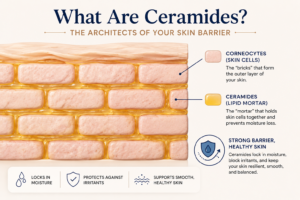
When ceramide levels drop, due to age, harsh weather, over-exfoliation, or aggressive cleansers, that mortar weakens. Gaps form between skin cells, moisture escapes through a process called transepidermal water loss (TEWL), and irritants find it easier to get in. The result is the tight, flaky, reactive skin most of us associate with a damaged barrier.
Unlike hyaluronic acid, ceramides don’t pull moisture in. Their job is structural: they arrange themselves into organized lipid layers between skin cells and physically block water from escaping. Ceramide-rich formulas have been shown to meaningfully reduce TEWL, which matters enormously if your skin feels dehydrated no matter how much product you layer on.
Hyaluronic Acid vs. Ceramides: The Core Difference
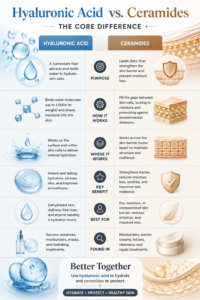
| Factor | Hyaluronic Acid | Ceramides |
|---|---|---|
| What it is | Humectant (a sugar molecule) | Lipid (a fat molecule) |
| Main job | Draws water into the skin | Locks water in, prevents loss |
| Best known for | Instant plumping, softer fine lines | Long-term barrier repair |
| Texture | Lightweight, gel-like | Richer, slightly creamy |
| Visible results | Minutes to hours | Days to weeks of consistent use |
| Risk if used alone | Can dehydrate skin in dry air | Slower to deliver an instant “plump” |
| Best suited for | Oily, dehydrated, or combination skin | Dry, sensitive, mature, or barrier-damaged skin |
How Each One Supports Cellular Hydration
True cellular hydration isn’t just water sitting on top of your skin. It’s water held inside and between skin cells, where it actually does something. This is where the difference between hyaluronic acid and ceramides gets genuinely interesting.
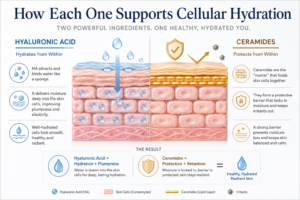
Hyaluronic acid works largely at the surface and within the upper layers of skin, binding water molecules around skin cells so they appear fuller and more elastic. Lower-molecular-weight hyaluronic acid can penetrate slightly deeper, delivering hydration closer to where new skin cells are formed.
Ceramides, on the other hand, integrate directly into the lipid bilayer between corneocytes, the flattened, hard-working cells that make up your skin’s outer shield. This intercellular lipid matrix is what actually traps water at the cellular level and keeps it from evaporating into the air. Without sufficient ceramides, even the most hydrated cells lose their water content within hours.
In short: hyaluronic acid hydrates the cell, and ceramides protect that hydration. You genuinely need both mechanisms working together for skin that stays plump, not skin that only looks plump for a moment.
Hyaluronic Acid vs. Ceramides: Which Is Right for Your Skin Type?
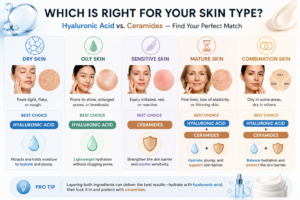
Dry or Dehydrated Skin
Ceramides should be your priority. Dry skin usually signals a compromised barrier, and no amount of hyaluronic acid will fix dryness if moisture keeps escaping through the cracks. Pair a ceramide-rich moisturizer with a light hyaluronic acid serum underneath for the best of both ingredients.
Oily or Acne-Prone Skin
Hyaluronic acid is typically the lighter, non-comedogenic choice, but don’t write off ceramides entirely. A healthy skin barrier actually helps regulate excess oil production, since dehydrated skin tends to overcompensate with sebum. A lightweight ceramide gel-cream works well here.
Sensitive or Reactive Skin
Ceramides win this category. They calm inflammation, reduce visible redness, and rebuild a barrier that’s likely been weakened by irritation, over-cleansing, or harsh actives like retinoids.
Mature Skin
Both ingredients matter, but ceramides become increasingly important with age, since natural ceramide production declines over time, much like collagen and hyaluronic acid do. A combination formula addresses fine lines and structural firmness at the same time.
Combination Skin
Use a hyaluronic acid serum on oilier zones, like the T-zone, and a ceramide-based cream on drier areas, like the cheeks, or simply reach for a hybrid formula that contains both.
Can You Use Hyaluronic Acid and Ceramides Together?
Absolutely, and most dermatologists actively recommend it. These two ingredients aren’t competing for the same job; they’re a tag team. Hyaluronic acid delivers the immediate hydration hit, and ceramides make sure that hydration sticks around instead of evaporating by lunchtime.
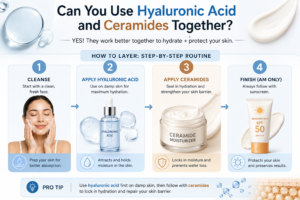
The correct layering order for maximum cellular hydration:
- Cleanse with a gentle, non-stripping formula
- Apply hyaluronic acid serum to slightly damp skin (this helps it bind more water)
- Seal everything in with a ceramide-rich moisturizer
- Finish with SPF in the morning to protect the barrier you just built
Applying hyaluronic acid without sealing it in is one of the most common skincare mistakes, especially in air-conditioned or low-humidity environments. The moisturizing step isn’t optional. It’s what locks hydration into your skin barrier rather than letting it evaporate straight off the surface.
Common Mistakes That Sabotage Cellular Hydration
- Skipping moisturizer after hyaluronic acid, which can leave skin more dehydrated than before you started
- Over-exfoliating, which strips away the very ceramides your barrier depends on
- Confusing “hydrating” with “moisturizing.” Hydration adds water; moisturizing seals it in. They are not interchangeable
- Using strong actives like retinol or AHAs without first rebuilding ceramide levels, which can worsen an already compromised barrier
- Picking a side. Choosing only one ingredient and ignoring the other, especially with dry or sensitive skin
The Verdict: Hyaluronic Acid vs. Ceramides
If you’re adding just one ingredient to your routine today, let your skin concern make the call. Need an instant plumping effect or you’re dealing with surface-level dehydration? Reach for hyaluronic acid. Dealing with chronic dryness, flaking, redness, or a barrier that feels constantly compromised? Ceramides are your foundation.
But for genuine, lasting cellular hydration, the kind that doesn’t vanish by mid-afternoon, your skin needs both. Hyaluronic acid fills the cells with water, and ceramides build the wall that keeps it there. Skip one, and you’re only ever solving half the problem.
Frequently Asked Questions
1. Can I use hyaluronic acid and ceramides together? Yes. They work through different mechanisms and are designed to complement each other. Apply hyaluronic acid first for hydration, then follow with ceramides to seal it in.
2. Which is better for dry skin: hyaluronic acid or ceramides? Ceramides. Dry skin typically signals a weakened skin barrier, and ceramides directly repair that barrier and reduce water loss in a way hyaluronic acid alone cannot.
3. Do ceramides help with anti-aging the way hyaluronic acid does? Yes, just through a different mechanism. Hyaluronic acid plumps skin and softens the look of fine lines, while ceramides improve elasticity and resilience over time by strengthening the barrier, which also supports a more youthful look.
4. Can hyaluronic acid make my skin drier? In very dry or low-humidity environments, hyaluronic acid can pull moisture from deeper skin layers if there’s nothing else nearby to draw from. Always follow it with a moisturizer, ideally one containing ceramides.
5. How long does it take to see results from ceramides? Hyaluronic acid shows visible plumping within minutes to hours, while ceramides typically take several weeks of consistent use to noticeably strengthen the barrier and reduce dryness.
6. Are ceramides good for oily or acne-prone skin? Yes. A healthy, ceramide-supported barrier can help regulate excess oil production, since skin often overproduces sebum to compensate for underlying dehydration.
7. What’s the correct order to apply hyaluronic acid and ceramide products? Apply your hyaluronic acid serum to damp skin first, then follow with a ceramide-based moisturizer to lock that hydration into the skin barrier.




Comments (1)
Retinoids & Facial Therapies: Transform Your Skinsays:
June 19, 2026 at 2:49 pm[…] Your Skin Barrier: Use a robust moisturizer containing ceramides, peptides, and hyaluronic acid. Apply moisturizer to damp skin after cleansing but before retinoid application (if using […]