


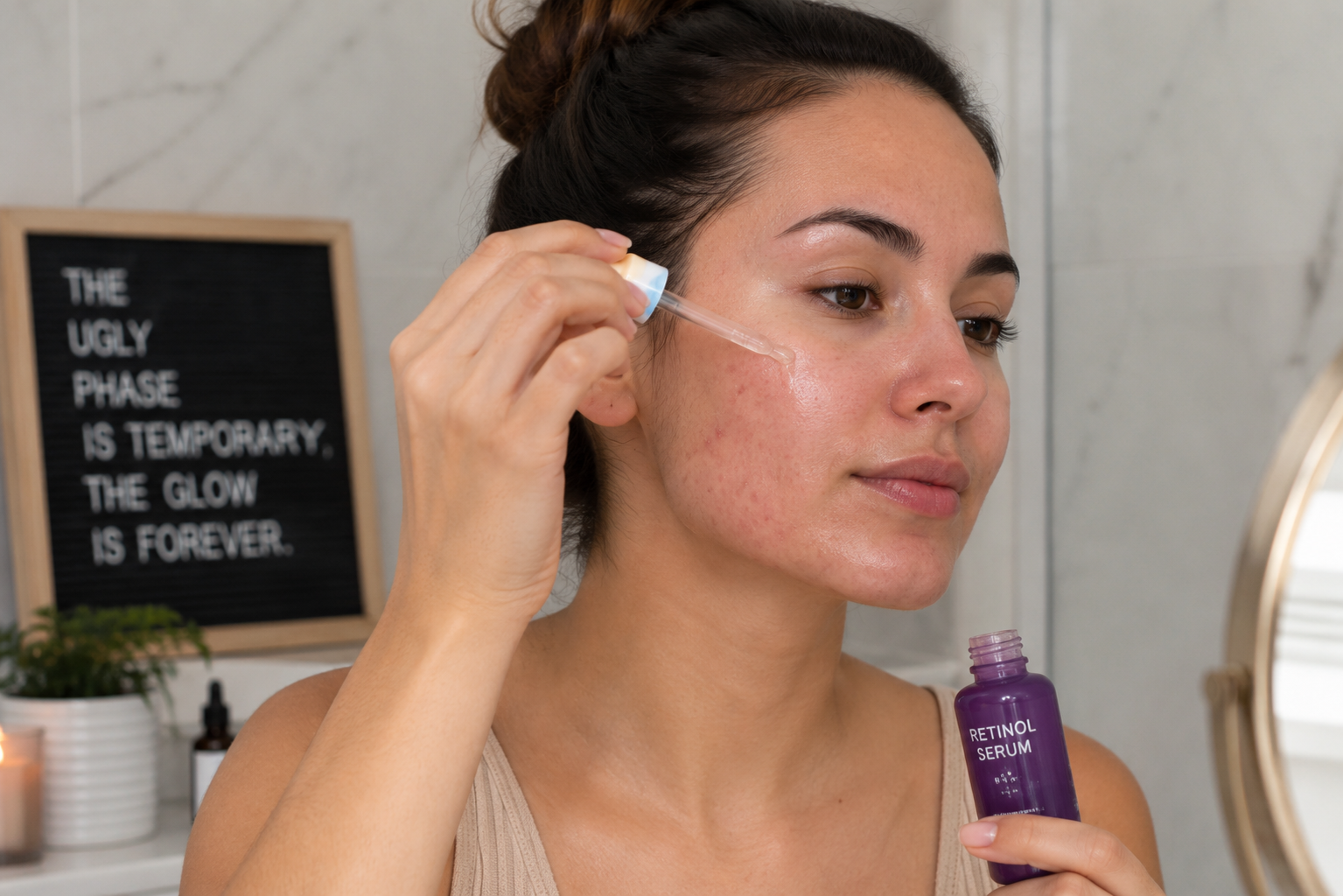
What Is the Retinol Ugly Phase?
The retinol ugly phase — also widely known as the “retinol uglies,” the retinol purge, or retinoid dermatitis — refers to the temporary period of skin worsening that many people experience during the first few weeks of using retinol or other retinoid products. Think of breakouts, peeling, redness, dryness, and that overall look of skin that seems to be falling apart despite your best efforts.
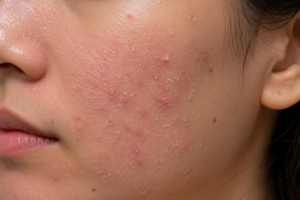
The term “retinol ugly phase” has become a staple of skincare communities, TikTok threads, and Reddit forums precisely because it describes something so many first-time retinol users go through — and because it’s the number-one reason people quit prematurely, before the real benefits ever have a chance to arrive.
Important truth: The retinol ugly phase is not a sign that retinol is damaging your skin. In most cases, it is evidence that the ingredient is doing exactly what it’s supposed to do — only your skin hasn’t finished adjusting yet.
Retinol belongs to the broader family of retinoids — derivatives of Vitamin A — and is widely considered one of the most scientifically validated ingredients in dermatology. It treats acne, reduces fine lines, fades hyperpigmentation, smooths texture, and stimulates collagen production. But that potency comes with a short-term trade-off: the retinol ugly phase.
The Science Behind the Retinol Ugly Phase
Understanding the biology makes it far easier to tolerate the retinol ugly phase — because once you know why it’s happening, it transforms from a disaster into a process.
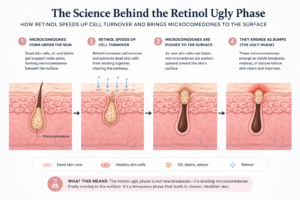
When retinol is absorbed into the skin, it is converted into retinoic acid — the active form of Vitamin A — which binds to nuclear receptors and directly influences gene expression. One of its most powerful and immediate effects is a dramatic acceleration of epidermal cell turnover. Under normal circumstances, a skin cell takes roughly 28 to 40 days to travel from the deepest layer of the epidermis to the surface and shed. Retinol fast-forwards this process significantly.
Here’s where the retinol ugly phase originates: beneath the surface of your skin, there are countless microcomedones — tiny, invisible clogged pores that were slowly forming into future breakouts. Retinol’s accelerated cell turnover pushes all of these to the surface simultaneously, causing what looks like a sudden wave of breakouts. It’s not new acne. It’s your skin’s existing congestion being expelled faster than it normally would be.
At the same time, the faster shedding of dead skin cells (corneocytes) can temporarily compromise the skin barrier, causing dryness, flaking, tightness, and mild stinging — all hallmarks of the retinol ugly phase. Retinoids also influence desmosomes — the protein bridges holding skin cells together — making the outer layer temporarily looser and more fragile.
What Does the Retinol Ugly Phase Look Like?
The retinol ugly phase has a distinctive appearance that dermatologists consistently describe as:
| Symptom | Description |
|---|---|
| Uniform breakouts | Small whiteheads, blackheads, papules, and pustules appearing in areas you normally break out — all looking similar (“a sea of bumps”) |
| Peeling & flaking | Skin sheds faster than it can replace itself smoothly; most noticeable around the nose, chin, and forehead |
| Dryness & tightness | A compromised skin barrier loses moisture more rapidly, causing dehydration and uncomfortable tightness |
| Redness & sensitivity | Increased skin sensitivity to touch, temperature, and other products |
| Overall dullness | Paradoxically, skin can look duller during this phase before revealing luminosity after |
Retinol Purge vs. Real Breakout: The Critical Difference
The single most important skill you need during the retinol ugly phase is knowing whether you’re genuinely purging — or whether retinol is simply not the right fit for your skin right now. These are very different situations that call for very different responses.
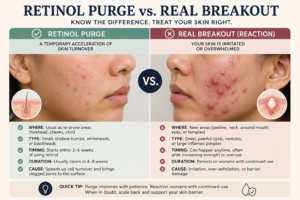
| Retinol Purge (Normal) | True Breakout / Reaction (Stop & Reassess) |
|---|---|
| Breakouts in your usual problem areas | Breakouts in new, unfamiliar locations |
| Small, uniform, shallow lesions | Deep, painful, inflamed cysts |
| Resolves within 2–8 weeks | Worsens or persists beyond 8 weeks |
| Mild dryness and manageable flaking | Severe rash, intense burning, or swelling |
| Skin improves as it adjusts | No improvement; new lesions constantly forming |
You develop a rash with intense itching, facial swelling, burning that doesn’t subside, or if you suspect an allergic reaction. These are not part of the normal retinol ugly phase and require professional evaluation.
How Long Does the Retinol Ugly Phase Last?
Most people experience the retinol ugly phase for somewhere between 2 and 6 weeks, though the exact duration depends on your skin type, the retinol concentration you’re using, and how often you apply it. Here is a realistic week-by-week breakdown of what to expect:
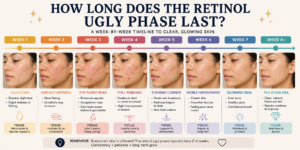
If the retinol ugly phase persists beyond 8 weeks without improvement, it’s time to consult a dermatologist. They may recommend reducing concentration, switching the formula, or transitioning to a prescription retinoid with a better-tolerated delivery system.
How to Purge Safely Without Quitting: 6 Expert-Backed Strategies
The retinol ugly phase is temporary — but your approach during this period determines how comfortable the journey is and whether you make it through to the benefits. Here are six dermatologist-backed strategies to help you purge safely without quitting.
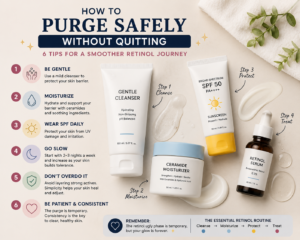
Start Low and Slow
Begin with a 0.25% or 0.3% retinol and apply it just 2 to 3 nights per week. Gradually increase frequency as your skin acclimates. Jumping straight to a high concentration dramatically intensifies the retinol ugly phase and is the most common beginner mistake.
Try the Retinol Sandwich Method
Apply a gentle moisturizer first, then your retinol, then another layer of moisturizer. Research presented at AAD 2025 confirmed that a single moisturizer layer before retinol does not meaningfully reduce its efficacy, while significantly buffering irritation during the ugly phase.
Keep Your Routine Minimal
During the retinol ugly phase, simplicity is your best ally. Strip your routine back to a gentle cleanser, a fragrance-free moisturizer, and SPF. Layering actives on already-sensitive skin escalates irritation and makes it impossible to tell what’s causing what.
Hydrate Aggressively
Use a rich, barrier-supporting moisturizer containing ceramides, hyaluronic acid, or squalane. Moisturizing generously helps counteract the water loss caused by retinol’s accelerated cell turnover and is one of the most effective ways to reduce discomfort during the retinol ugly phase.
Never Skip Sunscreen
Retinol makes skin significantly more photosensitive. A broad-spectrum SPF 30 or higher, applied every single morning — cloudy days included — is non-negotiable during the retinol ugly phase. UV exposure will worsen purging symptoms, compromise your barrier, and undermine retinol’s anti-aging results.
Don’t Pick or Squeeze
Purge blemishes are congestion that’s being cleared, and picking disrupts that process while creating a high risk of post-inflammatory hyperpigmentation and scarring. Let the retinol ugly phase run its natural course — the blockages need to come out, and they will on their own timeline.
Ingredients to Avoid During the Retinol Ugly Phase
During the retinol ugly phase, your skin barrier is temporarily compromised. Layering other potent actives on top dramatically increases the risk of genuine irritation masquerading as purging. Avoid the following until the ugly phase has resolved:
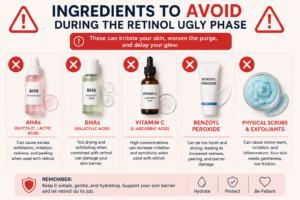
- AHAs & BHAs (glycolic acid, lactic acid, salicylic acid) — over-exfoliation will shred a fragile barrier
- Vitamin C (L-Ascorbic Acid) — can create a pH conflict and heighten sensitivity alongside retinol
- Benzoyl peroxide — when used on the same night as retinol, it can oxidize and deactivate it
- Physical scrubs and exfoliants — completely unnecessary when retinol is already exfoliating at a cellular level
- Alcohol-based toners and astringents — strip the very barrier you need to protect during the retinol ugly phase
- Fragranced products — a common source of additional sensitivity on already-reactive skin
Safe companions during the retinol ugly phase: Niacinamide, hyaluronic acid, ceramides, centella asiatica, and panthenol are all gentle, barrier-supportive ingredients that pair beautifully with retinol without amplifying the ugly phase.
When to See a Dermatologist
While the retinol ugly phase is a normal part of the retinoid journey for many people, it has real limits. Seek professional advice if any of the following are true:
- The retinol ugly phase persists beyond 8 weeks without any improvement
- Breakouts are deep, painful, cystic, or appearing in entirely new locations
- You experience severe redness, rash, burning, or signs of an allergic reaction
- You have active eczema, rosacea, or other inflammatory skin conditions
- You are pregnant or breastfeeding — retinoids are contraindicated
A dermatologist can guide you to a lower concentration, a prescription-strength retinoid better suited to your skin type, or a gentler retinoid alternative such as retinaldehyde.
Life After the Retinol Ugly Phase: What to Expect
Once your skin has moved through the retinol ugly phase, the transformation is genuinely remarkable. As your skin acclimates and the initial purge resolves, you’ll start to notice smoother texture, minimized pores, reduced breakouts, a more even skin tone, and — over months of consistent use — a measurable reduction in fine lines and hyperpigmentation.
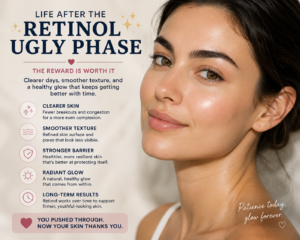
Dermatologists recommend using retinol consistently for at least three months before making a final judgment on its results. The retinol ugly phase is just the opening chapter — the payoff lies in staying the course.
Remember: Retinol is a marathon, not a sprint. The retinol phase is the price of admission for some of the most effective, evidence-backed skin transformation available without a prescription. Purge safely, be patient, and let the science work for you.



Leave a Reply