


Introduction
Ever put on a moisturizer you’ve used a hundred times before, only to feel it sting, burn, or leave your face blotchy and red? That sudden shift usually has nothing to do with the product itself — it’s your skin barrier talking. Once your skin barrier is compromised, even the gentlest formulas can feel like they’re working against you instead of for you.
The skin barrier is the foundation of every effective skincare routine, especially one that includes retinoids, exfoliating acids, or other dermatologist-recommended actives. When your skin barrier is strong, it allows those ingredients to do their job — smoothing texture, fading dark spots, supporting collagen — without the redness, peeling, and sensitivity that cause so many people to give up on their routines altogether.
In this guide, we’re breaking down the real science behind the skin barrier: what it’s made of, how it protects you, what damages it, and — most importantly — exactly how to prevent irritation and keep your skin barrier strong, whether you’re just starting out or deep into a retinoid-based routine.
What Is the Skin Barrier? The Science Behind Your Skin’s Protective Shield
To prevent irritation, it helps to understand exactly what you’re protecting. The skin barrier — technically known as the stratum corneum — is the outermost layer of your skin, and dermatologists often compare its structure to a brick wall.
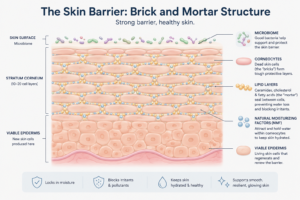
The “bricks” are corneocytes: flattened, tightly packed skin cells that have completed their journey from deep within the epidermis to the surface. The “mortar” holding everything together is a mixture of lipids — primarily ceramides, along with cholesterol and free fatty acids — arranged in tightly organized layers. Ceramides make up the largest share of this lipid matrix, which is why they’re so often highlighted in skin barrier repair products.
But the skin barrier is more than cells and lipids. Inside each corneocyte sits the natural moisturizing factor (NMF) — a blend of amino acids, lactic acid, urea, and glycerin that draws in and holds onto water, keeping skin cells plump and flexible. Covering it all is the acid mantle, a slightly acidic film (typically pH 4.5–5.5) that supports a thriving community of beneficial bacteria known as the skin microbiome. Emerging dermatology research increasingly shows that this microbiome plays a direct role in regulating inflammation and maintaining barrier function.
When the lipid matrix, NMF, acid mantle, and microbiome are all working in balance, your skin barrier does its job quietly — locking in moisture, keeping out irritants, and giving you skin that looks and feels healthy.
How a Healthy Skin Barrier Prevents Irritation
A strong skin barrier works in two directions at once. Internally, it minimizes transepidermal water loss (TEWL) — the gradual evaporation of water from your skin — which keeps your complexion hydrated, plump, and comfortable. Externally, it acts as a selective filter, blocking irritants, allergens, pollution, and microbes from penetrating into deeper layers of skin where they can trigger inflammation.
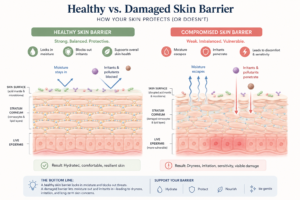
This is the real reason a healthy skin barrier prevents irritation so effectively: it gives your skin a buffer. A new product, a change in weather, an extra-long shower, or an occasional skipped step doesn’t immediately spell disaster, because your skin barrier absorbs that stress.
When the barrier is compromised, that buffer disappears. Water escapes more quickly, irritants penetrate more easily, and nerve endings closer to the surface become more reactive. That’s exactly why a damaged skin barrier doesn’t just look different — it feels different, often showing up as stinging, burning, or tightness from products that should feel calming.
7 Signs Your Skin Barrier Is Damaged
A compromised skin barrier doesn’t always announce itself dramatically. Often, it shows up as a collection of small, frustrating symptoms. Here are the most common signs dermatologists watch for:
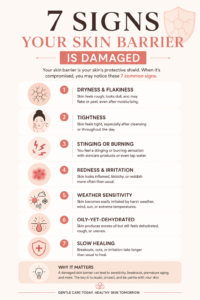
- Persistent dryness or flaking that doesn’t improve even with regular moisturizing.
- Tightness immediately after cleansing, as if your skin has been stretched or “squeaky cleaned.”
- Stinging, burning, or tingling from products you’ve used comfortably for months.
- Visible redness, blotchiness, or inflammation, even without applying anything new.
- Heightened sensitivity to weather, where wind, heat, or cold suddenly feels harsh.
- Oily yet dehydrated skin, with breakouts in some areas and tightness or flaking in others.
- Slow healing, where small bumps, irritations, or blemishes take longer than usual to settle down.
If two or more of these sound familiar, your skin barrier is likely asking for a break — and a shift from “results-driven” skincare to “repair-driven” skincare.
What’s Really Damaging Your Skin Barrier?
A weakened skin barrier is rarely caused by one dramatic event. It’s usually the slow accumulation of everyday habits. The most common causes include:
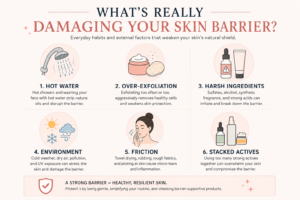
- Over-cleansing and hot water — Long, steamy showers and cleansing more than necessary strip away the natural lipids your skin barrier relies on.
- Over-exfoliation — Physical scrubs, daily acid toners, and frequent at-home peels break down the lipid matrix faster than your skin can rebuild it.
- Harsh or fragranced formulas — Sulfates, drying alcohols, and synthetic fragrance can disrupt both the skin barrier and the acid mantle that protects it.
- Environmental stress — UV exposure, pollution, dry indoor heating, and cold wind all increase water loss and gradually weaken barrier function.
- Friction — Rough towels, cleansing brushes, and aggressive rubbing physically wear down the skin’s outer layer.
- Stacking too many actives at once — Introducing retinoids, vitamin C, AHAs, and BHAs all in the same week can overwhelm your skin barrier before it has time to adapt.
Individually, none of these habits seem extreme. But layered together over weeks or months, they’re one of the most common reasons people experience ongoing irritation, even while using high-quality products.
The Retinoid Connection: Protecting Your Skin Barrier While Using Actives
If retinoids are part of your routine — and if you’re reading this as part of a broader guide to dermatological skincare, there’s a good chance they are — your skin barrier deserves extra attention. Retinoids work by speeding up cell turnover, which is exactly what makes them so effective for acne, uneven texture, and visible signs of aging. But that same accelerated turnover can temporarily thin the outer layer of skin, increasing water loss and leaving the skin barrier more vulnerable while it adjusts.
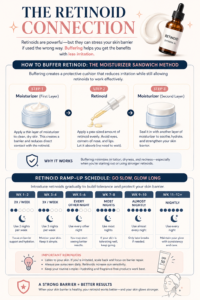
This is the underlying cause of what’s often called “retinoid dermatitis” — redness, peeling, dryness, and stinging that tend to appear in the first few weeks of use. Research consistently shows these effects are dose-dependent, meaning a slower, more strategic introduction can dramatically reduce irritation. Dermatologists often recommend starting retinoids just two to three nights a week, applying them to fully dry skin, and “buffering” with a moisturizer underneath or immediately afterward to soften the impact on the skin barrier.
Pairing retinoids with niacinamide — an ingredient shown to calm inflammation while reinforcing barrier function — can make a noticeable difference. And because retinoids increase photosensitivity, daily broad-spectrum sunscreen isn’t optional. It’s one of the most important steps for protecting a skin barrier that’s already working hard to keep up.
How to Prevent Irritation: 8 Ways to Strengthen Your Skin Barrier
The good news is that preventing irritation and repairing your skin barrier doesn’t require an expensive overhaul — just a handful of consistent, evidence-based habits.
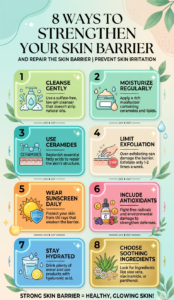
- Simplify your routine. Strip things back to a gentle cleanser, a barrier-supporting moisturizer, and sunscreen. Fewer products mean fewer chances for conflict while your skin barrier recovers.
- Choose a pH-balanced, sulfate-free cleanser. Look for labels that say “gentle” or “hydrating,” and wash with lukewarm — never hot — water to avoid stripping the lipids your skin barrier depends on.
- Read labels for ceramides, cholesterol, and fatty acids. These three lipids form your skin barrier’s “mortar,” and formulas containing them can directly replenish what’s been lost.
- Add niacinamide and hyaluronic acid. Niacinamide helps reinforce barrier function and calm redness, while also supporting your skin’s own ceramide production. Hyaluronic acid draws water into the skin to support hydration from within.
- Introduce actives slowly. Whether it’s a retinoid, vitamin C, or an exfoliating acid, add new ingredients one at a time, a few nights a week, and increase gradually as your skin barrier builds tolerance.
- Moisturize on damp skin. Applying moisturizer while your skin is still slightly damp — right after cleansing or a hydrating serum — helps lock in extra water and support the skin barrier’s ability to retain it.
- Never skip sunscreen. UV exposure is one of the fastest ways to break down a skin barrier, so daily SPF 30 or higher protects every bit of progress you make.
- Be gentle, always. Pat — don’t rub — your skin dry, skip abrasive tools, and resist picking at flaking or peeling skin, which can reopen barrier damage and slow healing.
None of these steps require intensity. A simplified, barrier-focused routine practiced consistently will do far more to prevent irritation than an aggressive routine used only occasionally.
How Long Does It Take to Repair a Damaged Skin Barrier?
This is one of the most common questions people ask once they realize what’s behind their irritation — and the honest answer is: it depends on how compromised your skin barrier is, and how consistently you stick to a repair-focused routine.
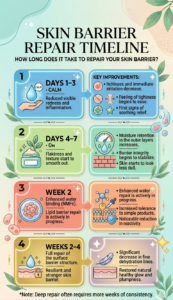
For mild barrier damage — occasional tightness, mild dryness, or sensitivity — many people notice less stinging and redness within just a few days of simplifying their routine, with more complete improvement in hydration and comfort by the one-to-two-week mark.
For more significant damage — caused by months of over-exfoliation, harsh products, or unmanaged use of actives — full skin barrier repair typically takes two to four weeks, sometimes longer in severe cases. This timeline roughly mirrors your skin’s natural renewal cycle, which takes about 28 days to complete.
The most important factor isn’t speed — it’s consistency. If your skin barrier shows no improvement after several weeks of gentle care, or if you notice signs of infection, severe pain, or persistent swelling, it’s worth consulting a board-certified dermatologist to rule out underlying conditions like eczema, rosacea, or contact dermatitis.
Final Thoughts: Make Your Skin Barrier the Foundation of Your Routine
Every retinoid, exfoliant, and facial therapy in your routine performs better when your skin barrier is healthy. A strong barrier is what allows active ingredients to deliver real results — smoother texture, fewer breakouts, more even tone — without the redness, peeling, and sensitivity that so often derail good skincare habits.
Instead of chasing the next trending ingredient, the most effective — and most overlooked — strategy is protecting what your skin already has: its own natural defenses. By recognizing the early signs of barrier damage, understanding what’s causing it, and building your routine around gentle, barrier-supporting ingredients, you can prevent irritation before it starts and create the kind of resilient, balanced skin that makes every other step of your routine work harder for you.
Frequently Asked Questions
1. What exactly is the skin barrier, and why does it matter? The skin barrier, or stratum corneum, is the outermost layer of your skin, made up of skin cells held together by lipids like ceramides, cholesterol, and fatty acids. It matters because it locks in moisture and blocks out irritants — when it’s healthy, your skin barrier prevents irritation; when it’s damaged, your skin becomes more reactive and sensitive.
2. What are the most common signs of a damaged skin barrier? Common signs include persistent dryness or flaking, tightness after cleansing, stinging from familiar products, redness, heightened sensitivity to weather, and breakouts paired with dehydration. If several of these sound familiar, your skin barrier likely needs a repair-focused routine.
3. How long does it take to repair a damaged skin barrier? Mild damage often improves within a few days to two weeks of simplifying your routine. More significant damage, especially from over-exfoliation or unmanaged actives, can take two to four weeks or longer, roughly matching your skin’s natural 28-day renewal cycle.
4. Can retinoids damage my skin barrier? Retinoids can temporarily thin the skin and increase water loss while your skin adjusts, which is why irritation is common early on. This effect is dose-dependent, so starting with a lower frequency, buffering with moisturizer, and pairing with niacinamide can help protect your skin barrier while still getting retinoid benefits.
5. What ingredients help repair and strengthen the skin barrier? Ceramides, cholesterol, and fatty acids directly replenish the lipids in your skin barrier, while niacinamide, hyaluronic acid, panthenol, and centella asiatica support hydration and calm inflammation. Look for these in fragrance-free moisturizers and serums.
6. Should I stop using retinol if my skin barrier feels irritated? If you’re experiencing ongoing stinging, burning, redness, or peeling, it’s often best to pause actives temporarily and focus on barrier repair with gentle cleansing, rich moisturizers, and sunscreen. Once your skin barrier calms down, reintroduce actives slowly and at a lower frequency.
7. Can a damaged skin barrier cause breakouts? Yes. A damaged skin barrier struggles to regulate oil production and can trigger excess sebum as your skin tries to compensate for moisture loss, which may lead to clogged pores and breakouts alongside dryness and irritation.



Comments (1)
Retinoids & Facial Therapies: Transform Your Skinsays:
June 12, 2026 at 4:16 pm[…] skin concerns through pharmaceutical-grade formulations and clinical methodologies proven to improve skin barrier function, texture, and […]