


Introduction
If you’ve ever searched for the most reliable, science-backed path to losing weight, you’ve likely come across one idea that keeps rising to the top — the calorie deficit diet for weight loss. Not a fad. Not a celebrity trend. Just time-tested biology. But while the concept sounds simple on the surface, most people struggle because they misunderstand how it works, miscalculate their numbers, or sacrifice their nutrition along the way. This guide fixes all three.
Whether you’re just starting your weight loss journey or you’ve been spinning your wheels for months, this complete breakdown of the calorie deficit diet for weight loss will give you the clarity, strategy, and confidence to finally make progress — sustainably.
What Is a Calorie Deficit Diet for Weight Loss?
At its core, a calorie deficit diet for weight loss is straightforward: you consume fewer calories than your body burns in a day. When that gap exists consistently, your body turns to its stored fat for energy — and that’s when the scale starts moving.
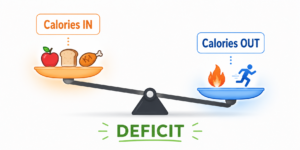
Think of your body as an energy account. Every calorie you eat is a deposit. Every calorie you burn — through breathing, digestion, movement, and exercise — is a withdrawal. A calorie deficit means you’re withdrawing more than you deposit, and your body dips into its fat savings to make up the difference.
Research published in peer-reviewed journals consistently confirms that an energy deficit is the most critical factor in sustained weight loss. It doesn’t matter whether you’re following keto, low-fat, intermittent fasting, or a Mediterranean-style approach — if you’re losing weight, you’re in a calorie deficit.
1.1 How Calorie Deficits Work
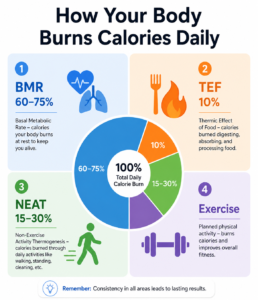
Your body burns calories through four main processes:
- Basal Metabolic Rate (BMR): The calories your body needs to keep you alive at complete rest — powering your heart, lungs, brain, and organs. This accounts for roughly 60–75% of your total daily calorie burn.
- Thermic Effect of Food (TEF): The energy used to digest, absorb, and metabolize food — about 10% of total burn.
- Non-Exercise Activity Thermogenesis (NEAT): Fidgeting, walking, standing, doing household tasks — surprisingly significant, accounting for 15–30% of total burn.
- Exercise Activity: Planned physical activity, which most people overestimate.
When you adopt a calorie deficit diet for weight loss, your body eventually notices the reduced fuel supply. In the short term, you may lose water weight and glycogen stores rapidly. Over time, fat stores are metabolized for energy, producing meaningful, visible fat loss.
One critical warning: cut calories too aggressively and your body adapts by reducing its metabolic rate — a defense mechanism that makes further weight loss increasingly difficult. This is why crash dieting and extreme calorie restriction almost always backfire. The sweet spot for a calorie deficit diet for weight loss is a moderate, steady reduction — not a dramatic slash.
1.2 Calculating Your Deficit: The BMR & TDEE Method
To follow a calorie deficit diet for weight loss effectively, you need two numbers: your BMR and your TDEE.
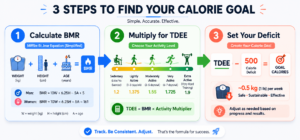
Step 1: Calculate Your BMR
Use the Mifflin-St Jeor Equation, the most clinically validated formula:
Men: BMR = (10 × weight in kg) + (6.25 × height in cm) − (5 × age) + 5 Women: BMR = (10 × weight in kg) + (6.25 × height in cm) − (5 × age) − 161
Example: A 30-year-old woman, 165 cm tall, weighing 70 kg: BMR = (10 × 70) + (6.25 × 165) − (5 × 30) − 161 = 1,470 calories/day
Step 2: Multiply for TDEE
Your Total Daily Energy Expenditure (TDEE) factors in your activity level:
| Activity Level | Multiplier |
|---|---|
| Sedentary (desk job, little movement) | BMR × 1.2 |
| Lightly Active (light exercise 1–3 days/week) | BMR × 1.375 |
| Moderately Active (exercise 3–5 days/week) | BMR × 1.55 |
| Very Active (hard training 6–7 days/week) | BMR × 1.725 |
| Extremely Active (physical job + daily training) | BMR × 1.9 |
Continuing the example: 1,470 × 1.55 (moderately active) = 2,279 calories/day (TDEE)
Step 3: Set Your Deficit
This is where your calorie deficit diet for weight loss is born:
- 250–500 calorie deficit/day → 0.5–1 lb of fat loss per week (recommended for most people)
- 500–750 calorie deficit/day → 1–1.5 lbs per week (clinically proven safe range)
- 1,000 calorie deficit/day → 2 lbs/week (maximum safe limit; requires medical supervision)
Using the example above: 2,279 − 500 = 1,779 calories/day target intake
Pro Tip from Dietitians: Don’t subtract directly from your BMR. Eat against your TDEE. Eating at or below your BMR is aggressive, unsustainable, and increases the risk of muscle loss and nutrient deficiency.
Tracking your calorie deficit diet for weight loss is made easier with apps like MyFitnessPal, Cronometer, or the NIH Body Weight Planner — all free, reliable tools that remove the guesswork.
1.3 Maintaining Nutrition: Eating Less Without Eating Poorly
Here is where most calorie deficit diets for weight loss collapse. People slash calories by cutting out entire food groups, eating diet products, or skipping meals — and end up fatigued, nutrient-depleted, and hungry. The solution is not eating less. It’s eating smarter.
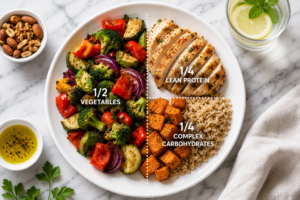
Prioritize Protein — Every Single Meal
Protein is the cornerstone of any effective calorie deficit diet for weight loss. It does three crucial things:

- Preserves lean muscle mass while you’re in a deficit (muscle keeps your metabolism high)
- Increases satiety — protein keeps you fuller for longer than carbs or fats
- Boosts TEF — your body burns more calories digesting protein
Target: 1.6–2.2g of protein per kg of body weight daily. Prioritize chicken breast, eggs, Greek yogurt, legumes, fish, tofu, and low-fat cottage cheese.
Make Every Calorie Count with Volume Eating
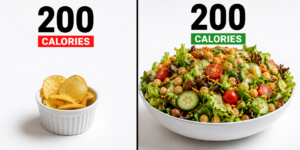
On a calorie deficit, volume matters. Choose high-volume, low-calorie foods that fill your plate and your stomach without busting your budget:
- Non-starchy vegetables (spinach, broccoli, zucchini, cucumbers)
- Berries and citrus fruits
- Oats, lentils, chickpeas
- Broth-based soups
- Air-popped popcorn
These foods deliver fiber — and fiber is your second most powerful satiety ally. Clinical nutrition data from 2025 shows that higher fiber intake is strongly associated with better weight loss outcomes.
Don’t Fear Macros — Balance Them
A well-structured calorie deficit diet for weight loss is not about eliminating carbohydrates or fats. Both are essential:
- Carbohydrates: Choose complex, fiber-rich sources (sweet potato, brown rice, oats, quinoa)
- Fats: Include healthy fats (avocado, olive oil, nuts, salmon) for hormonal health and satiety
- Micronutrients: Never neglect vitamins and minerals — zinc, magnesium, iron, calcium, B vitamins all become harder to consume in adequate amounts at lower calorie levels. A daily multivitamin acts as nutritional insurance.
Combine Diet With Movement

The most effective calorie deficit diet for weight loss pairs reduced intake with increased activity. Leading dietitians recommend creating a combined deficit: burn 200–300 extra calories through activity and cut only 200–300 from food. This is easier to sustain, less taxing on your metabolism, and far more enjoyable.
Aim for 7,000–10,000 steps per day as a baseline, add two to three strength training sessions weekly (to protect muscle), and supplement with cardio you actually enjoy.
When a Calorie Deficit Diet Isn’t Safe
A calorie deficit diet for weight loss is not appropriate for everyone. Avoid it or consult a doctor first if you:
- Have a history of disordered eating
- Are pregnant or breastfeeding
- Have type 1 diabetes or serious metabolic conditions
- Are underweight
- Are under 18
The Bottom Line
A calorie deficit diet for weight loss is the most flexible, evidence-based, and sustainable weight loss approach available today. You don’t have to ban food groups, survive on salads, or suffer through hunger. You simply need to understand your numbers, respect your body’s nutritional needs, and commit to a moderate, consistent deficit over time.
Calculate your TDEE. Set a 300–500 calorie deficit. Prioritize protein and fiber. Move daily. And trust the process — because 1–2 pounds of real fat loss per week adds up to a dramatically different body in just a few months.
Frequently Asked Questions (FAQs)
Q1. What is a calorie deficit diet for weight loss, and does it actually work? A calorie deficit diet for weight loss means consuming fewer calories than your body burns daily. Yes, it works — it’s the foundational mechanism behind every successful diet. Peer-reviewed research consistently shows that an energy deficit is the single most critical factor in achieving and maintaining weight loss.
Q2. How many calories should I cut for a safe calorie deficit? Most registered dietitians and health organizations recommend a deficit of 500–750 calories per day, which results in approximately 1–1.5 pounds of fat loss per week. Deficits larger than 1,000 calories per day are generally not recommended without medical supervision, as they can lead to muscle loss and nutrient deficiencies.
Q3. Will a calorie deficit cause muscle loss? A calorie deficit can cause muscle loss if protein intake is too low or the deficit is too aggressive. To protect muscle while in a calorie deficit diet for weight loss, consume 1.6–2.2g of protein per kilogram of body weight daily and include resistance training (strength exercises) at least twice per week.
Q4. What’s the difference between BMR and TDEE in a calorie deficit diet? BMR (Basal Metabolic Rate) is the number of calories your body needs at complete rest to maintain basic functions. TDEE (Total Daily Energy Expenditure) is your BMR multiplied by an activity factor — it reflects how many calories you actually burn in a day with movement included. For a calorie deficit diet for weight loss, you should eat below your TDEE, never below your BMR.
Q5. How fast can I lose weight with a calorie deficit diet? A safely structured calorie deficit diet for weight loss produces 1–2 pounds of fat loss per week. Faster weight loss (more than 2 lbs/week) typically involves losing water and muscle, not fat, and is difficult to sustain. Slow, consistent progress produces better long-term results and is far less likely to trigger metabolic adaptation.
Q6. Can I eat any food on a calorie deficit diet for weight loss? Technically yes — but the quality of your food choices matters enormously for health, energy, and sustainability. Focus on lean proteins, complex carbohydrates, healthy fats, and fiber-rich vegetables. Minimize ultra-processed foods, alcohol, and sugary beverages as they are calorie-dense, nutritionally poor, and make it harder to stay in deficit.
Q7. How long should I follow a calorie deficit diet for weight loss? Most people follow a calorie deficit diet for weight loss for several months until they reach their target weight. How long depends on how much weight you want to lose. After achieving your goal, you transition to eating at your TDEE (maintenance calories) to sustain results. Periodic “diet breaks” every 8–12 weeks can also help prevent metabolic adaptation.
Q8. Will I feel hungry all the time on a calorie deficit? Not if you do it right. Prioritizing high-protein, high-fiber, high-volume foods dramatically reduces hunger even in a calorie deficit diet for weight loss. Drinking adequate water (often confused with hunger), eating consistently timed meals, and avoiding ultra-processed foods also help manage appetite effectively.



Comments (1)
Weight Loss Diets: Complete Guide to Popular Diet Planssays:
June 27, 2026 at 7:03 pm[…] of 30 or higher. Weight loss diets provide a structured, intentional framework for achieving that calorie deficit — the non-negotiable foundation of all fat loss. No matter which diet you choose, if you are not […]