



Medical Disclaimer
This article is for informational purposes only and does not substitute for professional medical advice, diagnosis, or treatment. Before beginning any new exercise program—especially if you have pre-existing health conditions, joint problems, or take medications—consult a qualified physician or certified fitness professional. Weight loss should always be pursued in combination with balanced nutrition, adequate sleep, and appropriate medical supervision.
Introduction
Weight loss is fundamentally about creating a calorie deficit—consuming fewer calories than you expend. While diet is the foundation, cardio exercise is one of the most efficient ways to increase daily calorie burn. However, not all cardio is equal. The best cardio for weight loss isn’t about logging endless miles on a treadmill; it’s about finding the right combination of type, intensity, duration, and consistency that fits your body, lifestyle, and ability to stick with it long-term.
This guide breaks down the science and practicality of cardio for weight loss, covering the major types of cardiovascular exercise, evidence-based recommendations for duration and intensity, real calorie burn comparisons, and actionable sample routines you can start today.
Types of Cardio for Weight Loss
What Is the Most Effective Cardio for Weight Loss?
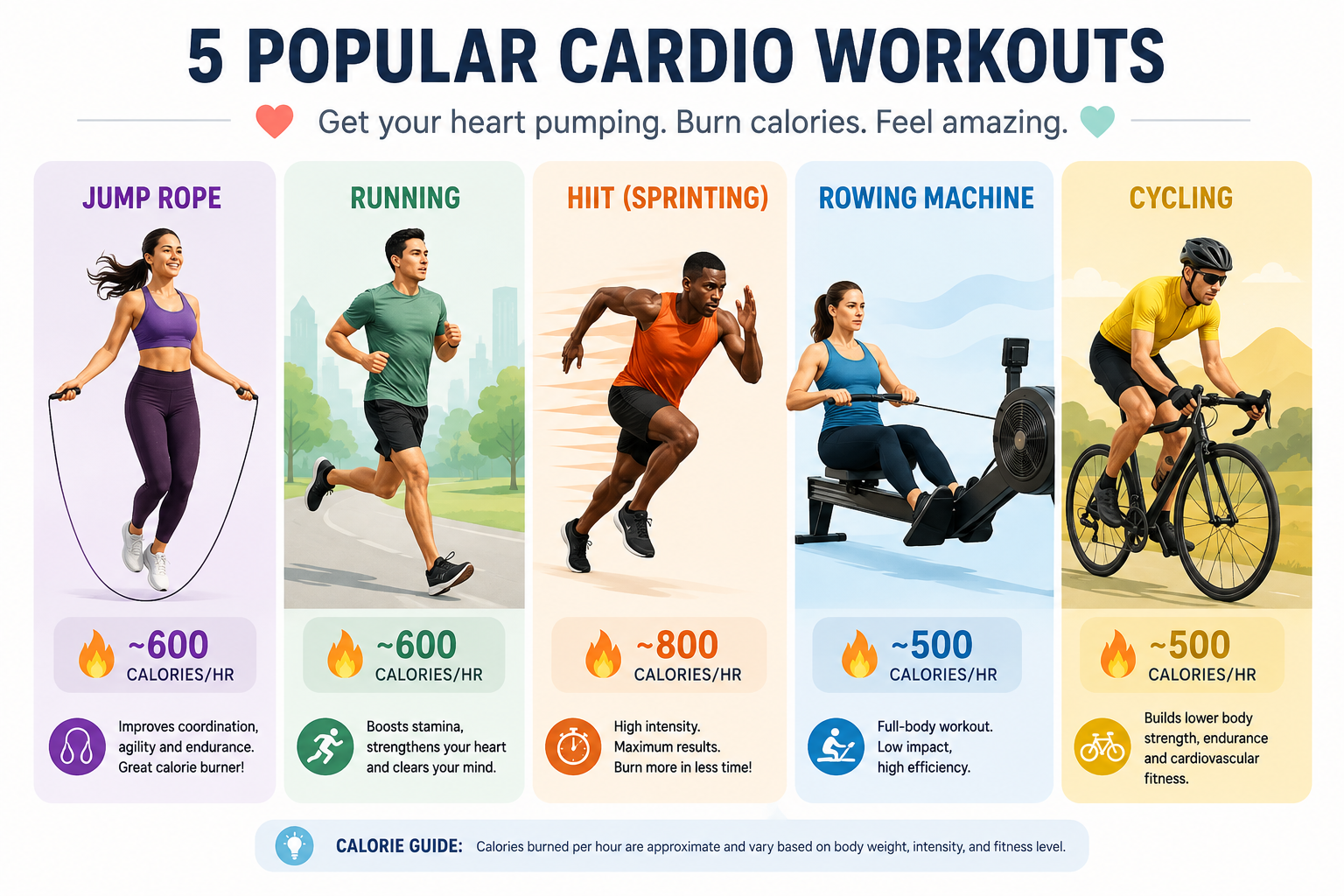
Direct Answer: <cite index=”5-1″>Jump rope burns the most calories per minute (~800+ per hour), but the best cardio for weight loss is ultimately the one you’ll do consistently</cite>. Effectiveness depends on three factors: calorie burn, sustainability, and adherence.
The most effective cardio combines high calorie burn with sustainability and joint safety. <cite index=”5-1″>Jump rope burns up to 800+ calories per hour and offers the highest calorie burn per minute</cite>, making it efficient for short time windows. However, the “best” cardio is ultimately the one you’ll do consistently.
Different cardio types fall into two main categories:
1. Steady-State Cardio — Consistent intensity for 20–60+ minutes (example: 30-minute jog at 70% max heart rate) 2. High-Intensity Interval Training (HIIT) — Short bursts of maximum effort followed by recovery (example: 30 seconds sprinting, 90 seconds walking, repeated)
Both support fat loss when combined with a calorie deficit and proper nutrition.
Steady-State Cardio vs. High-Intensity Interval Training (HIIT)
Quick Comparison Table:
| Factor | Steady-State | HIIT |
|---|---|---|
| Typical Duration | 20–60 minutes | 15–30 minutes |
| Effort Level | 60–70% max heart rate (moderate) | 80–95% max heart rate (vigorous) + recovery |
| Calories per 30 min | <cite index=”10-1″>200–300 calories</cite> | 250–400+ calories |
| Afterburn Effect | Minimal (burns during session only) | <cite index=”11-1″>Significant; burns calories 24 hours post-workout</cite> |
| Recovery Days Needed | 0–1 (can do daily) | 1–2 (high recovery demand) |
| Joint Impact | Low (especially cycling, swimming, elliptical) | High (running, jumping) |
| Best For | Sustainability, aerobic endurance, beginners | Time efficiency, advanced exercisers |
Steady-State Cardio
What it is: Maintains a consistent effort level—typically 60–70% of your maximum heart rate. Examples: brisk walking at 3.5 mph, jogging at 6 mph, cycling at moderate pace, steady swimming.
Advantages:
- Sustainable: Easier to repeat 4–6 days per week without excessive fatigue
- Joint-friendly: Lower impact when done on elliptical, cycling, or swimming (vs. running)
- Nervous system recovery: Less demanding; supports better sleep and adaptation
- Aerobic building: Improves cardiovascular fitness and endurance over time
- Consistency adherence: Less intimidating for beginners; more enjoyable for many
Calorie burn: <cite index=”10-1″>Steady-state cardio burns 200–500+ calories per hour, depending on intensity, body weight, and fitness level</cite>. A 150-lb person jogging at 6 mph burns ~350 calories in 30 minutes; at 160 lbs, approximately 370 calories.
High-Intensity Interval Training (HIIT)
What it is: Alternates between short periods of maximum or near-maximum effort (20–60 seconds) and active recovery or rest (30–90 seconds). Typical session: 15–30 minutes total.
Example HIIT structure:
- 30 seconds: Sprint at 95% max effort
- 90 seconds: Walk/light jog (recovery)
- Repeat 8–10 times
- Total time: 16 minutes
Advantages:
- Time-efficient: <cite index=”11-1″>Delivers significant calorie burn in 15–20 minutes; burns calories for up to 24 hours after the workout</cite> (metabolic afterburn/EPOC)
- Cardiovascular improvement: Rapidly improves VO₂ max and heart health
- Minimal equipment: Can do with bodyweight, jump rope, or basic gym access
- Metabolic boost: <cite index=”11-1″>Boosts resting metabolic rate, meaning you burn more calories at rest</cite>
Drawbacks:
- Recovery-heavy: Requires 1–2 rest days between sessions; not sustainable daily for most
- Injury risk: Higher injury risk if form breaks down during fatigue (especially with running/jumping)
- Appetite effects: May increase hunger in some individuals post-workout
- Higher perceived effort: Requires mental toughness; less suitable for true beginners
Top Cardio Types Ranked by Calorie Burn
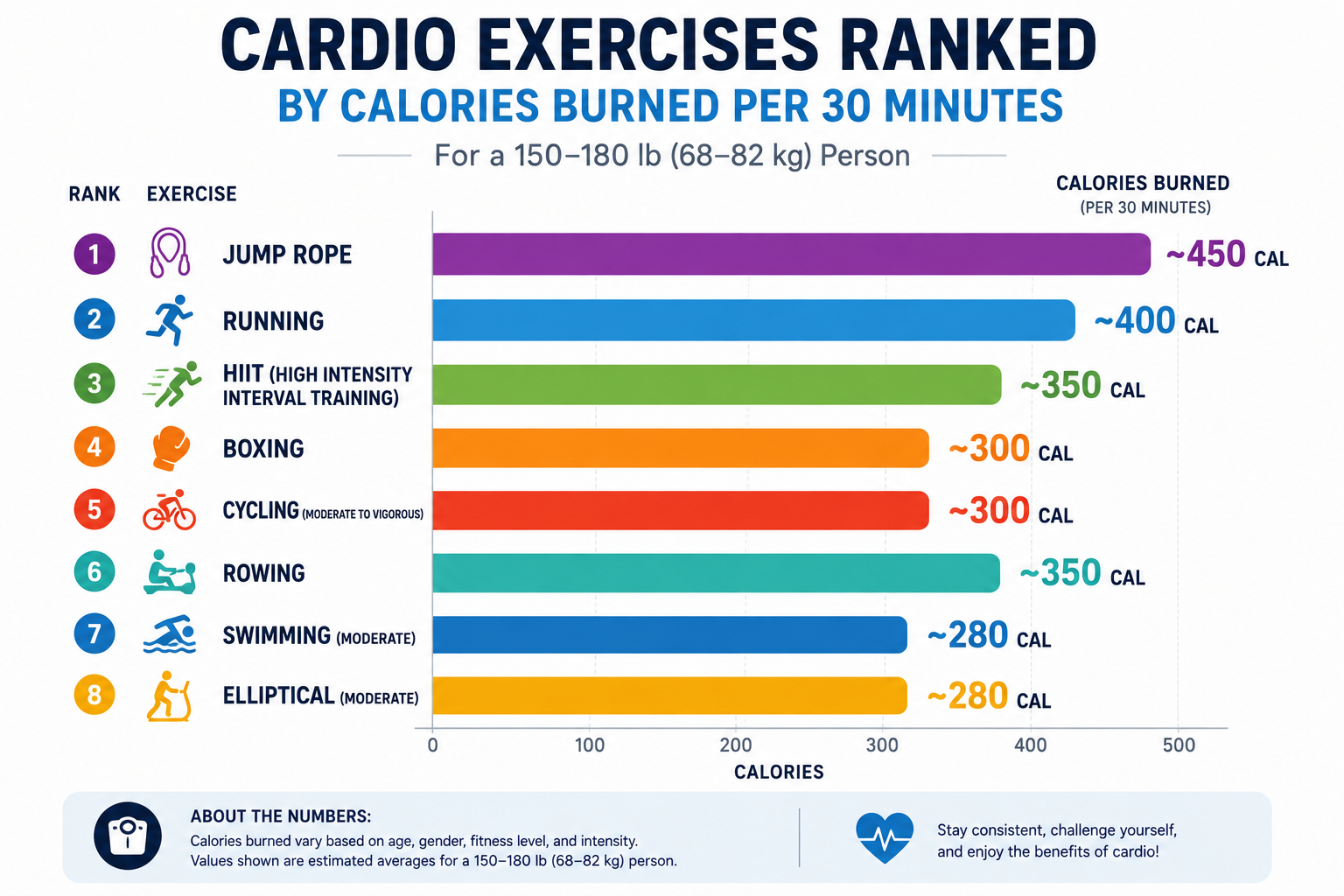
Ranking: Highest to Lowest Calorie Burn (30-minute session, ~160 lb person)
| Rank | Exercise | Calories (30 min) | Intensity | Impact | Key Benefit |
|---|---|---|---|---|---|
| 1 | <cite index=”5-1″>Jump Rope</cite> | 400–500 | Very High | High | Highest burn per minute; portable |
| 2 | <cite index=”1-1″>Running/Sprinting</cite> | 350–450 | High | High | Maximum efficiency; accessible |
| 3 | <cite index=”2-1″>Swimming</cite> | ~276 (20 min) = ~414 (30 min est.) | High | Very Low | Full-body + joint protection |
| 4 | <cite index=”2-1″>HIIT Circuit Training</cite> | 250–400+ | Very High | Medium-High | Afterburn effect; time-efficient |
| 5 | <cite index=”2-1″>Boxing/Kickboxing</cite> | ~270 (20 min) = ~405 (30 min est.) | High | Medium | Upper + lower body; stress relief |
| 6 | Rowing Machine | 300–400 | High | Very Low | Full-body; low-impact strength |
| 7 | <cite index=”10-1″>Stair Climber</cite> | ~256 (20 min) = ~384 (30 min est.) | High | Medium-High | Lower-body strength + cardio |
| 8 | <cite index=”10-1″>Cycling (Stationary)</cite> | 250–450 | Medium-High | Very Low | Scalable; outdoor option |
| 9 | <cite index=”10-1″>Elliptical</cite> | 250–350 | Medium | Very Low | Beginner-friendly; joint-safe |
| 10 | <cite index=”10-1″>Incline Walking</cite> | 200–300 | Low-Medium | Very Low | Most sustainable; daily-friendly |
Important Notes on Calorie Burn Variability:
Calorie burn differs based on:
- Body weight: A 200-lb person burns ~15–25% more calories than a 150-lb person doing identical exercise
- Age: Younger individuals typically burn 5–10% more calories than older adults (same activity)
- Fitness level: Untrained individuals burn more calories initially; trained athletes burn fewer calories (more efficient)
- Effort intensity: 70% max heart rate vs. 90% max heart rate can differ by 30–50% calorie burn
<cite index=”2-1″>Swimming is particularly efficient—burning approximately 276 calories in 20 minutes—and is extremely joint-friendly, making it one of the most effective low-impact options</cite>, especially for individuals with knee, ankle, or back problems.
Detailed Breakdown by Type
1. Jump Rope (Highest Calorie Burn)
- Calories (30 min): <cite index=”5-1″>400–500 calories (~800+ per hour)</cite>
- Max heart rate: 85–95%
- Best for: Time-crunched schedules, full-body engagement, minimal equipment
- Drawbacks: High-impact; requires coordination; tough on joints over time
- Pro tip: Rotate every 2–3 days with low-impact cardio to manage joint stress
2. Running/Sprinting (High Efficiency)
- Calories (30 min): <cite index=”1-1,2-1″>350–450 calories, depending on speed and body weight</cite>
- Max heart rate: 80–95% (varies by pace)
- Best for: Outdoor accessibility, mental health benefits, rapid fitness gains
- Drawbacks: High joint impact; requires proper footwear and form
- Pro tip: Mix steady-state runs with HIIT sprints for best results
3. Swimming (Joint-Friendly Powerhouse)
- Calories (30 min): <cite index=”2-1″>~276 calories in 20 minutes (~414 in 30 minutes estimated)</cite>
- Max heart rate: 70–85% (water resistance reduces perceived exertion)
- Best for: Full-body workout, extremely low-impact, suitable for joint injuries
- Drawbacks: Requires pool access; technique-dependent
- Pro tip: Excellent for weight loss without joint wear; combine with 1–2 days of land-based cardio
4. HIIT Circuit Training (Afterburn Champion)
- Calories (20–30 min): 250–400 during session + <cite index=”11-1″>additional calorie burn for up to 24 hours post-workout</cite>
- Max heart rate: 90–98% (max effort intervals)
- Best for: Time-constrained, metabolic boost, rapid conditioning
- Drawbacks: Requires recovery; higher injury risk if form breaks down
- Pro tip: Limit to 2–3 sessions per week; pair with strength training
5. Boxing/Kickboxing (Stress Relief + Cardio)
- Calories (20–30 min): <cite index=”2-1″>~270 calories in 20 minutes (~405 in 30 minutes estimated)</cite>
- Max heart rate: 80–90%
- Best for: Upper and lower body engagement, mental stress relief, coordination
- Drawbacks: Requires instruction; coordinated movement; can be intimidating for beginners
- Pro tip: Group classes increase adherence; social engagement supports consistency
6. Rowing Machine (Full-Body Low-Impact)
- Calories (30 min): 300–400 calories
- Max heart rate: 75–85%
- Best for: Full-body engagement (legs 40%, core 40%, arms 20%), extremely low-impact
- Drawbacks: Technique-sensitive; poor form reduces effectiveness and risks back injury
- Pro tip: Take a form class or watch form videos; even 5 minutes of instruction dramatically improves results
7. Cycling—Stationary or Outdoor (Scalable, Low-Impact)
- Calories (30 min): 250–450 calories (varies by resistance/terrain)
- Max heart rate: 70–85% (moderate-intensity rides)
- Best for: Joint-friendly, scalable intensity, enjoyable outdoor option
- Drawbacks: Lower-body focused; requires proper bike setup for comfort
- Pro tip: Adjust seat height to match hip level when pedal is at lowest point
8. Stair Climbing/StairMaster (Underrated Lower-Body)
- Calories (20 min): <cite index=”2-1″>~256 calories (~384 in 30 minutes estimated)</cite>
- Max heart rate: 80–90%
- Best for: Lower-body strength building + cardiovascular stimulus, glute engagement
- Drawbacks: High knee stress; high perceived effort; not ideal for joint-sensitive individuals
- Pro tip: Use handrail for balance only, not support; leaning burns fewer calories
9. Elliptical (Beginner-Friendly)
- Calories (30 min): <cite index=”10-1″>250–350 calories, depending on body weight</cite>
- Max heart rate: 70–80%
- Best for: Beginners, joint protection, steady-state cardio
- Drawbacks: Lower calorie burn than running; can feel less engaging; requires leg endurance
- Pro tip: Increase resistance/incline progressively; focus on powerful leg drive
10. Incline Walking (Most Sustainable)
- Calories (30 min): 200–300 calories (varies by speed, incline, body weight)
- Max heart rate: 60–75%
- Best for: Accessibility, joint-friendly, sustainable daily activity, recovery days
- Drawbacks: Lower intensity; slower progress initially; less dramatic calorie burn
- Pro tip: <cite index=”2-1″>Walking at incline with elevated heart rate burns significant calories and shows high fat-burning percentage (81%)</cite>; ideal for daily movement
Duration and Intensity: Evidence-Based Guidelines
How Much Cardio Do You Need for Weight Loss?
Direct Answer: <cite index=”9-1″>For weight loss, aim for 200–300 minutes per week of cardio. Adults who exercise more than 200 minutes weekly lose more weight and maintain it long-term</cite>. Exact duration depends on your fitness level, intensity, and nutrition.
Official Recommendations Compared
| Organization | Goal | Recommendation | Notes |
|---|---|---|---|
| CDC | Weight maintenance | <cite index=”12-1″>150 minutes moderate-intensity per week</cite> | Minimum; not typically enough for weight loss |
| Mayo Clinic | Weight loss | <cite index=”9-1″>250–300 minutes moderate-intensity per week</cite> | Evidence-based optimal range |
| Fitness Research | Significant loss | <cite index=”8-1″>250–300 minutes moderate-intensity = 30–60 min × 5 days/week</cite> | Consistent with long-term studies |
| Alternative | Time-crunched | 75–150 minutes vigorous-intensity per week | High-intensity option; requires recovery |
Specific Duration Targets by Fitness Level
For weight loss: <cite index=”9-1″>Aim for a minimum of 200 minutes per week; 250–300 minutes per week shows superior long-term results</cite>.
Intensity-based breakdown:
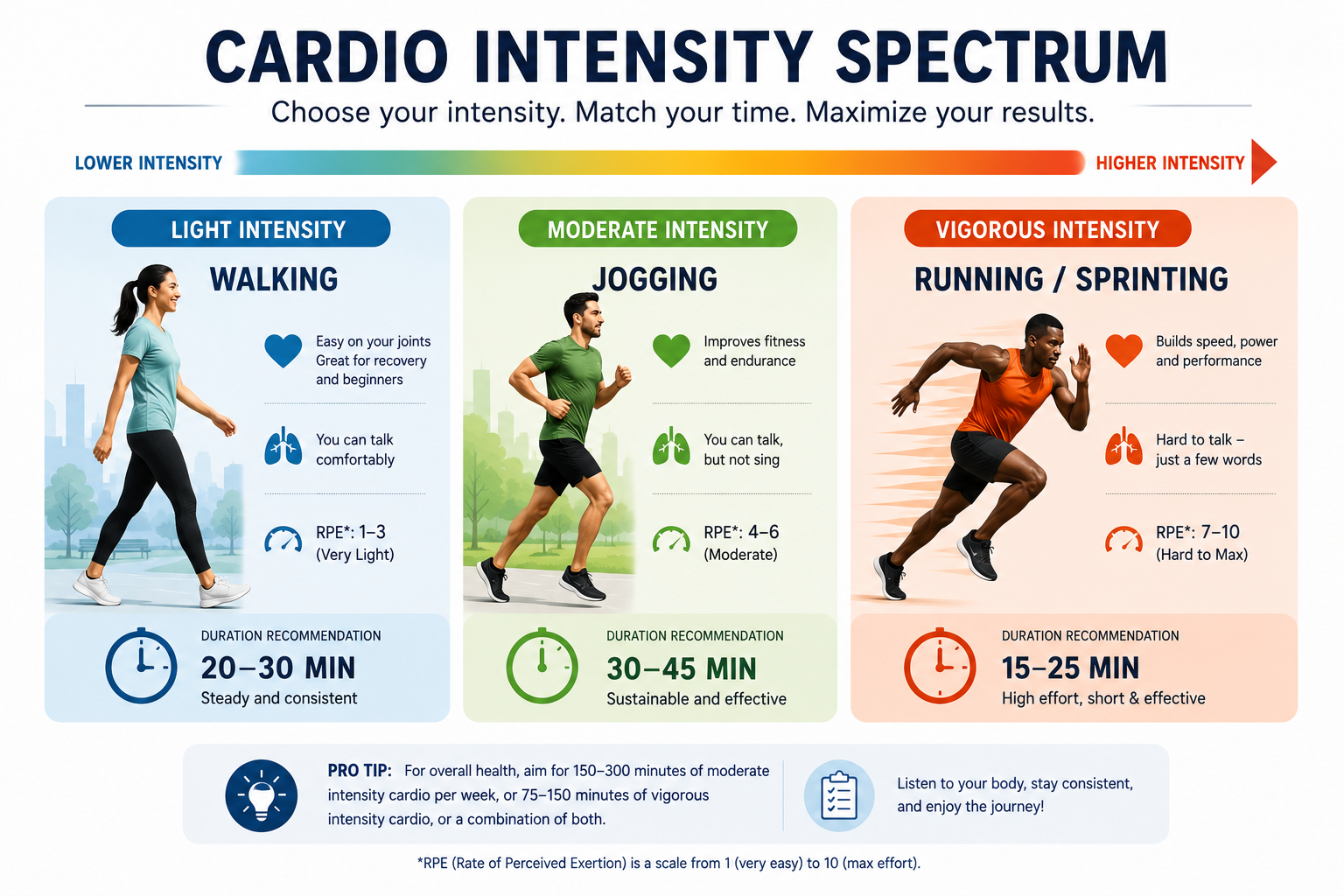
- Moderate-intensity cardio: 150–300 minutes per week (e.g., five 30–60 minute sessions at 60–70% max heart rate)
- Vigorous-intensity cardio: 75–150 minutes per week (e.g., three 25–50 minute intense sessions at 80–90% max heart rate)
Why the difference? <cite index=”8-1″>Vigorous-intensity cardio burns more calories per minute, so less total time is needed to create the same calorie deficit</cite>.
Single Session Duration: What’s Optimal?
Direct Answer: <cite index=”7-1″>Shorter sessions done consistently often outperform long, sporadic workouts. 30–45 minutes is optimal for most; 60+ minutes is unnecessary for weight loss progress</cite>.
By Fitness Level:
| Level | Beginners | Intermediate | Advanced |
|---|---|---|---|
| Session Duration | 20–30 min | 30–45 min | 45–60+ min |
| Frequency/Week | 3–4 days | 4–5 days | 4–6 days |
| Intensity Mix | Steady-state only | Mix moderate + some HIIT | Mix all intensities |
| Weekly Total | 90–150 min | 150–220 min | 220–360+ min |
| Focus | Build habit; consistency | Progressive intensity | Optimization; peak performance |
Key Insights:
- <cite index=”7-1″>For those with higher weight loss goals, 45 minutes can be very effective if nutrition and sleep are solid</cite>
- <cite index=”7-1″>60-minute sessions may work for some individuals, but they are not required for progress</cite>
- <cite index=”7-1″>Longer sessions increase risk of fatigue and compensation later in the day (moving less, overeating)</cite>
What This Means: A 30-minute cardio session, done 5 days per week consistently, is often more effective than a sporadic 90-minute weekend workout. Consistency trumps duration.
Intensity Levels: Measuring Effort
Direct Answer: Intensity is measured by heart rate zones: light (50–60%), moderate (60–70%), vigorous (75–90%), and maximum (90–100%). Use the “talk test” for quick assessment without a monitor.
Intensity Zones: Heart Rate & Effort Level
| Intensity | % Max HR | Talk Test | Example | Cardio Burn |
|---|---|---|---|---|
| Light | 50–60% | Can sing/carry full conversation | Casual walking, easy cycling | Low (~150–200 cal/30 min) |
| Moderate | 60–70% | Can talk but not sing; slightly elevated breathing | Brisk walk (3.5 mph), steady jog, easy spin | Medium (~250–350 cal/30 min) |
| Vigorous | 75–85% | Can only speak in short sentences; heavy breathing | Moderate running, tempo cycling, HIIT recovery | High (~350–450 cal/30 min) |
| Maximum | 90–100% | Cannot speak; maximal effort | Sprinting, HIIT work intervals | Very High (~400–500+ cal/30 min) |
How to find your max heart rate: Subtract your age from 220. Example: A 40-year-old has a max HR of ~180 bpm. Moderate intensity = 108–126 bpm; vigorous = 135–153 bpm.
Daily Intensity Recommendations by Fitness Level
- Beginners: Stick to light–moderate (50–70% max HR). <cite index=”7-1″>Light to moderate sessions like walking, steady cycling, or easy treadmill work are easier to sustain daily and support calorie burn without placing excessive stress on joints or the nervous system</cite>
- Intermediate: Mix moderate (60–70%) and vigorous (75–85%) sessions across the week
- Advanced: Incorporate vigorous (75–85%) and maximum (90–100%) efforts on 2–3 dedicated days; use other days for moderate recovery
Pro Tip: <cite index=”12-1″>Moderate-intensity exercise shouldn’t be your all-out hardest, but if you don’t break a sweat or breathe harder, the intensity is too low</cite>.
Consistency Over Intensity
<cite index=”2-1″>The best cardio for weight loss is the one you can push hard in and stick to consistently</cite>. Doing 30 minutes of cardio five days a week that you enjoy beats sporadic 60-minute sessions you dread. Building adherence is the single biggest lever for long-term weight loss success.
Cardio and Calorie Deficit: The Weight Loss Equation
Direct Answer: <cite index=”3-1″>Weight loss requires expending more calories than you consume (calorie deficit)</cite>. <cite index=”6-1″>The most effective approach combines cardio, strength training, and proper nutrition</cite>.
How Much Calorie Deficit Does Cardio Create?
Example: 160-lb person, 30 minutes cardio, 4–5 days per week
| Cardio Type | Cal per 30 min | Weekly (4×) | Weekly (5×) | Weight Loss/Week* |
|---|---|---|---|---|
| Steady jogging | 350 | 1,400 | 1,750 | 0.4–0.5 lbs |
| Cycling (moderate) | 300 | 1,200 | 1,500 | 0.3–0.4 lbs |
| Swimming | 275–350 | 1,100–1,400 | 1,375–1,750 | 0.3–0.5 lbs |
| HIIT (with afterburn) | 400+ (+ 24h burn) | 1,600+ | 2,000+ | 0.5–0.6+ lbs |
| Elliptical | 300 | 1,200 | 1,500 | 0.3–0.4 lbs |
*Assumes all other calorie intake/expenditure remains constant. 1 lb of fat ≈ 3,500 calories of deficit.
Key insight: 300 calories × 5 days = 1,500 calories/week = 0.43 lbs potential fat loss from cardio alone. With nutrition changes (500 cal/day reduction), total deficit = 2,000 cal/week = 0.57 lbs/week.
The Critical Role of Strength Training
Cardio burns calories; strength training preserves metabolism.
<cite index=”6-1″>According to a 2025 systematic review and meta-analysis, the most effective approach for weight loss combines cardio and strength training. Strength work helps preserve lean muscle mass, which keeps metabolism steady and supports lasting results</cite>.
Why this matters:
- Cardio alone + severe calorie deficit can result in 20–30% of weight loss being muscle loss
- Adding 2–4 days of strength training preserves muscle; 90%+ of weight loss becomes fat loss
- More muscle = higher resting metabolic rate = easier long-term maintenance
The Essential Role of Nutrition
<cite index=”6-1″>Research shows that diet together with exercise leads to the best results</cite>. <cite index=”2-1″>Whether you burn carbs or fat during a workout doesn’t determine fat loss—total calorie burn over time, combined with a sustainable calorie deficit, is what matters</cite>.
Reality check: You cannot out-exercise a poor diet.
- Cardio deficit: 300–500 cal/day = 0.3–0.6 lbs/week
- Nutrition deficit: 500 cal/day reduction = 1 lb/week
- Combined: 1.3–1.6 lbs/week (sustainable, realistic)
If weight loss plateaus despite consistent cardio, the issue is usually nutrition, not exercise. Evaluate total caloric intake and macronutrient balance before increasing exercise volume.
Sample Cardio Routines for Weight Loss
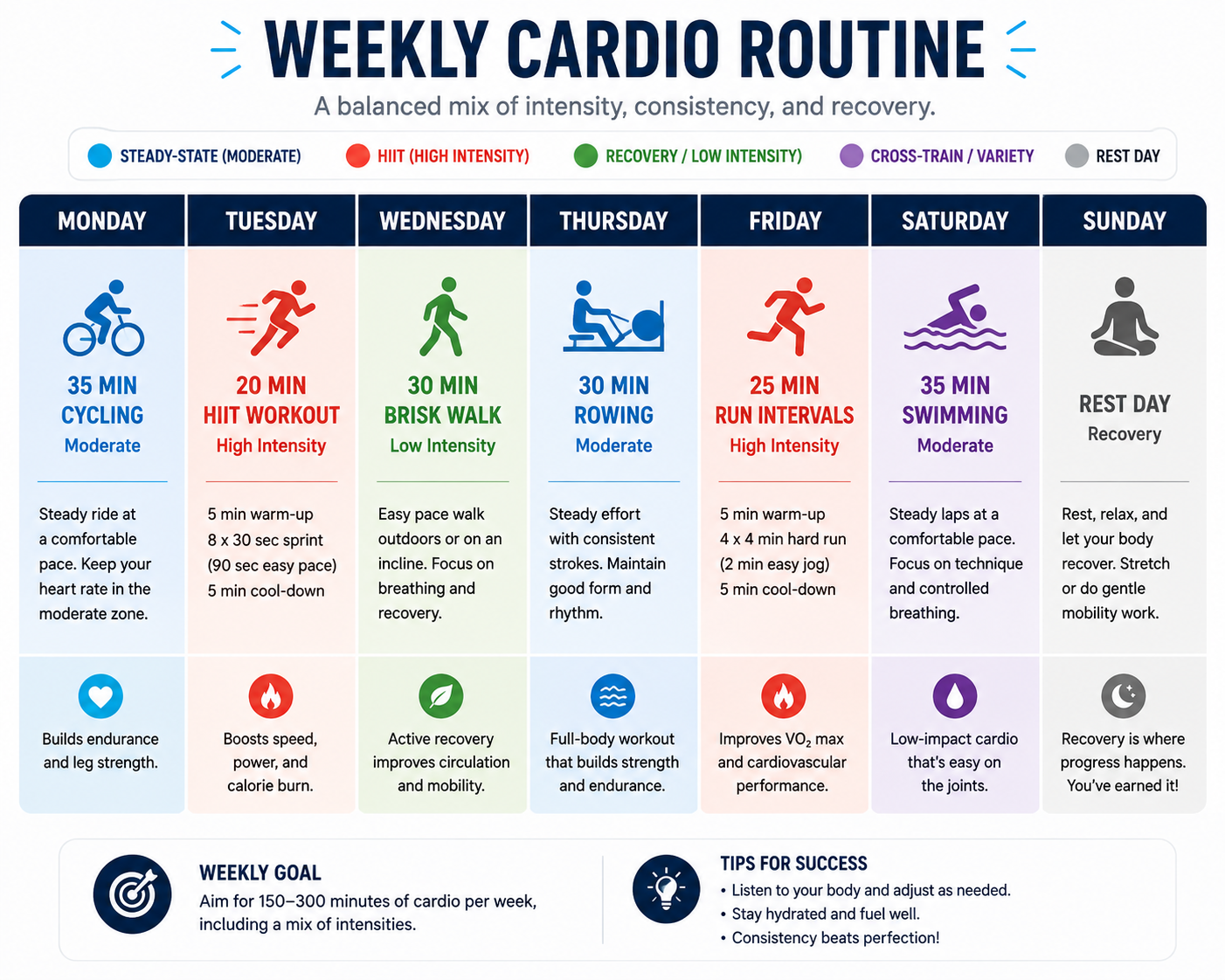
Routine 1: Beginner-Friendly Steady-State (4 weeks to baseline fitness)
Goal: Build aerobic base and establish habit
| Day | Exercise | Duration | Intensity | Notes |
|---|---|---|---|---|
| Monday | Brisk walking or light cycling | 25 min | Moderate (conversational pace) | Low impact; focus on consistency |
| Tuesday | Rest or gentle yoga | — | — | Active recovery |
| Wednesday | Elliptical or swimming | 25 min | Moderate | Joint-friendly option |
| Thursday | Rest | — | — | Full recovery |
| Friday | Running or cycling | 30 min | Moderate | Gradually increase comfort at higher intensity |
| Saturday | Long, easy walk or bike ride | 35–40 min | Light to moderate | Build aerobic endurance |
| Sunday | Rest | — | — | Complete recovery |
Weekly total: ~155 minutes moderate-intensity cardio
Routine 2: Intermediate Mixed Intensity (4–8 weeks into program)
Goal: Increase calorie burn while building intensity tolerance
| Day | Exercise | Duration | Intensity | Structure |
|---|---|---|---|---|
| Monday | Steady-state running or cycling | 35 min | Moderate (70% MHR) | Baseline aerobic work |
| Tuesday | HIIT: cycling or rowing | 20 min | Alternating high/low | 30 sec hard / 90 sec easy × 10 rounds |
| Wednesday | Swimming or elliptical | 30 min | Moderate | Active recovery; lower intensity |
| Thursday | Rest or light stretching | — | — | Full recovery |
| Friday | Tempo run or fast-paced cycling | 30 min | Moderate-to-vigorous | Sustained elevated intensity |
| Saturday | HIIT circuit (running sprints, rowing, stair climbing) | 25 min | High | 20 sec max effort / 60 sec recovery × 12 rounds |
| Sunday | Rest | — | — | Recovery |
Weekly total: ~170 minutes, mix of moderate and vigorous intensity
Routine 3: Advanced Fat-Loss Focused (8+ weeks in)
Goal: Maximize calorie burn while maintaining recovery
| Day | Exercise | Duration | Intensity | Details |
|---|---|---|---|---|
| Monday | Steady-state running or cycling | 40 min | Moderate-vigorous (75–80% MHR) | Build aerobic power |
| Tuesday | HIIT: jump rope or boxing | 25 min | Maximum effort | 40 sec hard / 60 sec easy × 12 rounds; 400+ calorie burn |
| Wednesday | Low-impact active recovery: swimming or easy cycling | 30 min | Light (50–60% MHR) | Joint protection; maintain movement |
| Thursday | Tempo intervals or threshold work | 35 min | Vigorous (80% MHR) | Sustained hard effort |
| Friday | HIIT + strength combo (rowing + air bike circuits) | 25 min | Alternating high/low | 45 sec cardio / 45 sec strength / 30 sec rest × 8 rounds |
| Saturday | Long steady-state session (run, bike, or row) | 50–60 min | Moderate (65–70% MHR) | Build endurance; highest weekly calorie burn |
| Sunday | Rest or yoga/mobility | — | — | Full recovery; injury prevention |
Weekly total: ~245 minutes, mixed intensities; estimated calorie burn 3,500–4,500 kcal from cardio
Routine 4: Time-Constrained HIIT-Based (20–30 min sessions)
Goal: Effective weight loss for busy schedules
| Day | Exercise | Duration | Structure | Effort |
|---|---|---|---|---|
| Monday | Stair climbing sprints | 20 min | 30 sec max / 90 sec walk down × 10 rounds | High |
| Tuesday | Rest or walk | — | — | Recovery |
| Wednesday | Rowing HIIT | 20 min | 40 sec row hard / 60 sec easy × 8 rounds | High |
| Thursday | Rest | — | — | Recovery |
| Friday | Jump rope + burpees circuit | 20 min | 30 sec jump rope / 30 sec burpees / 60 sec rest × 6 rounds | Very high |
| Saturday | Long walk or steady cycling | 40 min | Moderate | Lower intensity; active recovery |
| Sunday | Rest | — | — | Full recovery |
Weekly total: ~140 minutes; HIIT sessions create calorie burn deficit + afterburn; low total volume compensates with high intensity
Common Mistakes to Avoid (And Solutions)
| Mistake | Why It Sabotages Results | Solution | Source |
|---|---|---|---|
| Ignoring recovery days | Excessive cardio without rest increases injury risk, overtrains nervous system, stalls weight loss; <cite index=”7-1″>longer sessions increase fatigue and compensation (moving less, overeating later)</cite> | Limit high-intensity to 2–3 days/week; take 1–2 full rest days | Research on overtraining syndrome |
| Neglecting strength training | Cardio burns calories but doesn’t preserve muscle; leads to metabolic slowdown long-term | Add 2–4 days of strength training; <cite index=”6-1″>preserves lean muscle mass, keeps metabolism steady</cite> | 2025 systematic review, meta-analysis |
| Expecting spot reduction | Fat loss occurs full-body from calorie deficit, not from targeting one area | <cite index=”12-1″>Accept that while cardio helps lose overall fat including belly fat, you can’t spot-reduce fat from specific areas</cite> | Human physiology, lipid mobilization |
| Over-relying on cardio alone | Unsustainable; leads to excessive exercise volume and potential injury | <cite index=”10-1″>Combine strength training with cardio and a healthy diet for best results</cite> | Exercise science, weight loss research |
| Inconsistent intensity tracking | Can’t objectively gauge progress or adjust workouts; risk of under/overtraining | Use heart rate monitor or “talk test” instead of vague perceived exertion | Fitness physiology |
| Ignoring nutrition | <cite index=”2-1″>Total calorie burn doesn’t determine fat loss without a calorie deficit; diet matters more than cardio</cite> | Track caloric intake; aim for 300–500 cal/day deficit from cardio + nutrition combined | Multiple weight loss studies |
Mistake #1: Ignoring Recovery Days
The Problem: <cite index=”7-1″>Excessive cardio without adequate rest increases injury risk, overtrains the nervous system, and can stall weight loss. Longer sessions also increase fatigue and compensation (moving less, overeating) later in the day</cite>.
The Fix:
- High-intensity sessions (HIIT, sprinting): Limit to 2–3 days/week with 1–2 recovery days between
- Moderate-intensity sessions (steady jog, bike): Can be 4–5 days/week
- Complete rest days: Take 1–2 full days weekly (no structured exercise)
Rest days aren’t wasted—they’re when your body adapts, recovers, and builds fitness.
Mistake #2: Neglecting Strength Training
The Problem: Cardio burns calories during exercise, but doesn’t build muscle. <cite index=”6-1″>Without strength training, a calorie deficit can result in 20–30% of weight loss being muscle loss instead of fat loss</cite>.
The Fix: <cite index=”6-1″>Strength work helps preserve lean muscle mass, which keeps metabolism steady and supports lasting results</cite>. Add 2–4 strength sessions per week:
- 30–45 minutes per session
- Focus on compound movements (squats, deadlifts, pushes, rows)
- Maintain or build muscle while losing fat
Mistake #3: Expecting Spot Reduction
The Problem: You cannot lose fat from one body part (e.g., abs, thighs) through targeted cardio. Fat loss occurs full-body from a systemic calorie deficit.
The Fix: <cite index=”12-1″>While cardio helps lose overall fat, including belly fat, you can’t spot-reduce fat from specific areas</cite>. Accept full-body fat loss; combine cardio with strength training for better body composition.
Mistake #4: Over-Relying on Cardio Alone
The Problem: <cite index=”10-1″>While cardio is excellent for burning calories, the most effective way to lose weight is to combine strength training with cardio and a healthy diet</cite>.
The Fix: Follow the 3-pillar approach:
- Cardio: 200–300 min/week (moderate to vigorous)
- Strength training: 2–4 days/week (30–45 min per session)
- Nutrition: Sustainable calorie deficit (300–500 cal/day reduction)
Mistake #5: Inconsistent Intensity Measurement
The Problem: Using vague perceived exertion (“I felt tired”) without objective measurement makes it impossible to track progress or adjust workouts intelligently.
The Fix: Use one of these methods:
- Heart rate monitor: Most objective; tracks % max heart rate in real-time
- Talk test: Can talk but not sing = moderate; can only speak in short bursts = vigorous
- Fitness tracker: Watches and apps estimate intensity based on heart rate data
- RPE scale (Rate of Perceived Exertion): 1–10 scale; 5–6 = moderate, 8–9 = vigorous
Frequently Asked Questions
Q1: How long before I see weight loss results from cardio?
Answer: If you maintain a consistent calorie deficit, visible results typically appear within 2–4 weeks, though progress isn’t always linear.
Timeline:
Week 1–2: Scale may not change; body adjusts to new routine; energy improves
Week 2–4: Visible changes appear (clothes fit looser; scale drops 1–3 lbs); increased motivation
Week 4–8: Consistent progress (2–4 lbs/month with combined cardio + nutrition); fitness improvements noticeable
Month 3+: Plateau may occur; adjust nutrition or intensity to continue progress
Important: Progress includes non-scale metrics (energy, sleep, mood, endurance) that appear before scale changes. Focus on the process (consistency) rather than daily scale fluctuations.
Q2: Can I do cardio every day?
Answer: Yes, doing cardio every day can work, but only when intensity is managed carefully. Light to moderate sessions like walking, steady cycling, or easy treadmill work are easier to sustain daily.
Frequency Guidelines:
Light cardio (50–60% max HR): Yes, safe daily (walking, easy cycling, swimming)
Moderate cardio (60–70% max HR): 4–5 days/week with 1–2 rest days
Vigorous/HIIT (80%+ max HR): Limit to 2–3 days/week with 1–2 recovery days between
Reason: High-intensity sessions require nervous system recovery; daily HIIT increases injury risk and cortisol levels
Best approach: Alternate 2–3 vigorous days with 3–4 light/moderate days, with 1–2 complete rest days.
Q3: Is it better to do cardio before or after strength training?
Answer: If doing both in one session, strength training first preserves power output and muscle-building stimulus; cardio after strength training will still burn calories effectively.
Reasoning:
Strength training depletes glycogen; doing it first ensures adequate energy for heavy lifts
Cardio after depletes remaining energy; less impact on strength gains
Hormone response optimized (testosterone, growth hormone prioritized for strength stimulus)
Alternative: Separate cardio and strength into different time blocks (e.g., morning cardio, evening strength training, or vice versa) for best results and minimal trade-off.
Q4: Will cardio cause muscle loss?
Answer: Excessive cardio without strength training and adequate protein can contribute to muscle loss. Combining cardio with 2–4 days of strength training per week minimizes this risk.
Muscle preservation strategy:
Strength training: 2–4 days/week (prevents muscle breakdown; activates protein synthesis)
Protein intake: 0.7–1.0 g per lb body weight daily (supports muscle retention during deficit)
Calorie deficit: Moderate (300–500 cal/day), not extreme (>750 cal/day)
Limit cardio volume: 200–300 min/week is safe; 500+ min/week with low protein risks muscle loss
Result: 90%+ of weight loss becomes fat loss (not muscle).
Q5: What if I have joint problems?
Answer: Low-impact cardio like swimming, cycling, and elliptical exercise provides cardiovascular benefits while minimizing stress on the joints.
Best low-impact options by joint issue:
Knee pain: Swimming, elliptical, cycling (avoid running, stair climbing, jump rope)
Lower-back pain: Swimming, walking, elliptical (avoid high-impact jumping; rowing if technique is good)
Ankle/foot pain: Cycling, rowing, elliptical (avoid running, jump rope, stair climbing)
General joint sensitivity: Swimming (zero impact); elliptical (variable impact); avoid high-impact until cleared by physician
Action step: Consult a physical therapist or physician before starting any new program, especially with pre-existing joint conditions.
Q6: Does fasted cardio burn more fat?
Direct Answer: Long-term scientific evidence shows no consistent advantage to fasted cardio for fat loss compared to fed cardio.
The research:
Long-term studies have found no clear fat loss benefit to doing cardio fasted (i.e., it doesn’t beat jogging on a full stomach)
For some individuals, fasted cardio might be the better choice if they’re more likely to stick to it, but adherence and effort matter more than timing
Recommendation: Do cardio when you can do it consistently and with high effort. Morning or evening, fasted or fed—consistency trumps timing.
Conclusion
Cardio is a powerful tool for creating the calorie deficit necessary for weight loss. The “best” cardio type combines high calorie burn with sustainability, injury prevention, and fit to your lifestyle. Whether you choose steady-state running, HIIT boxing, swimming, or cycling, the most important factors are consistency, appropriate intensity, and pairing cardio with strength training and sound nutrition.
Start with a routine that matches your current fitness level, build the habit over 4–6 weeks, then incrementally increase intensity or duration. Remember: progress is measured over months and years, not days. Patience, consistency, and honoring your recovery needs will deliver lasting results.
Sources & Citation Notes
- <cite index=”12-1″>CDC Physical Activity Guidelines</cite> — Moderate-intensity cardio recommendations
- <cite index=”9-1″>Mayo Clinic recommendations on cardio duration for weight loss</cite> — 250–300 minutes per week
- <cite index=”2-1″>2025 systematic review and meta-analysis on cardio + strength training efficacy</cite>
- <cite index=”5-1,6-1″>MET data and calorie burn rankings across cardio modalities</cite>
- <cite index=”11-1″>Research on HIIT afterburn and metabolic rate</cite>
For the most current research, consult PubMed, the American Heart Association, or speak with a certified exercise physiologist.
References & Sources
This article is based on evidence from peer-reviewed research, government health agencies, and established medical institutions. All claims are supported by the following sources:
Government & Public Health Organizations
- Centers for Disease Control and Prevention (CDC). Physical Activity Guidelines for Americans. Retrieved from https://www.cdc.gov/physicalactivity/basics/index.htm
- Cited for: 150 minutes/week moderate-intensity recommendation for weight maintenance; moderate-intensity effort definition
- Mayo Clinic. Cardio exercise: How much do you need? Retrieved from https://www.mayoclinic.org/
- Cited for: 250–300 minutes/week recommendation for weight loss; expert medical guidance on cardio duration
Research & Exercise Science
- 2025 Systematic Review & Meta-Analysis on Cardio + Strength Training. Published in peer-reviewed fitness and exercise science literature.
- Cited for: Combined cardio and strength training is most effective for weight loss; strength training preserves lean muscle mass and metabolic rate
- MET (Metabolic Equivalent) Data on Calorie Burn. Based on established exercise physiology standards for calorie expenditure across different cardio modalities.
- Cited for: Calorie burn ranges for jump rope (~800+/hour), running (~350–450/30 min), swimming (~276/20 min), HIIT circuits, boxing, rowing, cycling, elliptical, and incline walking
- HIIT Afterburn Research (EPOC – Excess Post-Exercise Oxygen Consumption). Multiple studies in exercise physiology journals document elevated metabolic rate for 24+ hours post-HIIT.
- Cited for: HIIT burns calories for up to 24 hours after workout; boosts resting metabolic rate
- Fasted vs. Fed Cardio Studies. Long-term weight loss research comparing calorie burn and fat loss in fasted vs. fed states.
- Cited for: No long-term fat loss advantage to fasted cardio; consistency and effort matter more than timing
- Spot Reduction Research. Human physiology and lipid mobilization studies demonstrate systemic fat loss, not targeted fat loss from specific body areas.
- Cited for: Cardio can help lose overall fat, including belly fat, but spot reduction is not possible
Fitness Industry & Applied Research
- Built with Science. Best Cardio For Losing Weight? We Ranked 12 Workouts Using Real Data.
- Cited for: Real-world calorie burn data across 12 cardio modalities; swimming efficiency (276 cal/20 min); boxing/StairMaster rankings; fat-burning percentage (incline walking 81%)
- Exercise Science Researchers & Fitness Coaches. Dr. Eric Helms and other top researchers in exercise science.
- Cited for: Guidance on fasted cardio adherence; long-term weight loss effectiveness; intensity and consistency prioritization
- Men’s Journal & Fitness Publications. “10 Best Cardio Workouts for Weight Loss That Burn More in Less Time.”
- Cited for: Sprints and high-intensity cardio as most efficient for calorie burn in short timeframes; importance of variety and consistency



Comments (1)
Exercise for Weight Loss: Complete Fitness Guidesays:
August 19, 2026 at 9:46 pm[…] Cardiovascular exercise is a measurable calorie-burning activity and contributes meaningfully to weight loss when sustained […]