



Medical Disclaimer: This article is for educational purposes and should not replace professional medical advice. While walking is generally considered a safe, low-impact activity for most people, consult your primary care provider before starting any new exercise program — especially if you have chronic illness, joint problems, or are taking medications that affect exercise tolerance. Individual results vary based on factors including diet, metabolism, existing fitness level, and overall lifestyle.
Why Walking Is the Most Underrated Weight Loss Exercise

Direct Answer: Walking is underrated for weight loss because it’s low-impact and highly sustainable, yet research shows it’s highly effective—especially when combined with diet. <cite index=”1-1″>According to The Lancet Public Health (2025), walking about 7,000 steps a day is linked with significantly lower risk of death, chronic diseases (including diabetes and heart disease), and cognitive decline.</cite>
Key Research Finding: The 2,000-Step Rule
<cite index=”1-1″>For every 2,000 additional steps you take daily, your risk of premature death falls by 6–11%.</cite>
This single statistic—known across cardiology and public health—reveals why walking is underrated: it works, but subtly. It doesn’t create the dramatic “burn” feeling that HIIT workouts do, so many people dismiss it as insufficiently intense. Learn how long to walk to lose weight within proper guidance.
Why People Overlook Walking for Weight Loss
Three core misconceptions drive walking’s underrated status:
- “Low-impact means low-effectiveness” — Many assume gentle exercise can’t produce meaningful results. Research directly contradicts this.
- “Exercise alone should work” — <cite index=”1-1″>The American Council on Exercise notes that “walking is beneficial for weight loss, but exercise alone is not the most effective strategy for losing weight.”</cite> Combined with diet, walking becomes highly sustainable.
- “High-intensity is always better” — HIIT burns more calories per minute, but walking is maintained at higher frequency, often resulting in equal or greater weekly calorie expenditure.
Walking vs. Running vs. HIIT: Comparison
| Exercise | Calories/Min | Injury Risk | Adherence (12-wk) | Equipment | Joint Stress | Best For |
|---|---|---|---|---|---|---|
| Walking (3.5 mph) | 4–6 | Very low | 60–70% | None | Minimal | Long-term sustainability |
| Running (6 mph) | 10–12 | Moderate–high | 40–50% | Shoes | High | Time-efficient calorie burn |
| HIIT (intervals) | 12–20 | Moderate–high | 20–30% | Minimal | Moderate–high | Short-term fat loss |
Why this matters: <cite index=”7-1″>Evidence consistently shows that regular walking at moderate intensity or with higher step counts improves weight maintenance after dieting and can limit weight regain.</cite> The table reveals that walking’s adherence rate is 60–70%—far higher than running’s 40–50% or HIIT’s 20–30%. Over 12 weeks, the walker who maintains consistency often burns more total calories than the runner who quits after 8 weeks.
How Much Calorie Burn Can You Expect From Walking?
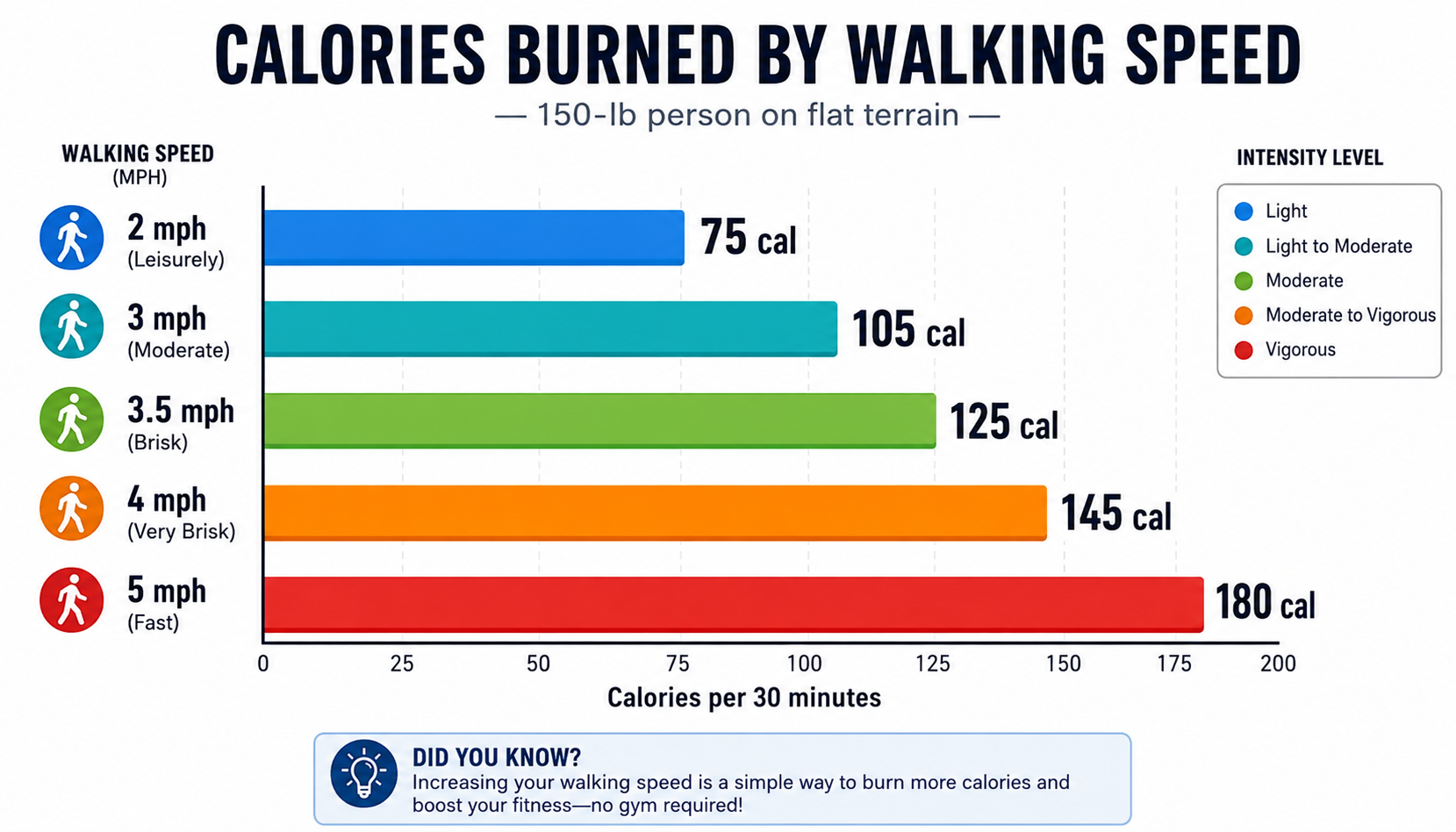
Direct Answer: Walking 10,000 steps at 3–4 mph burns 300–500 calories depending on body weight. A 150-pound person burns roughly 112–170 calories per 30-minute walk at 3–4 mph, and about 3,500 calories weekly with consistent daily walking.
Can Walking Burn 500 Calories a Day?
Yes, but with conditions. <cite index=”9-1″>Walking 10,000 steps a day at 3–4 mph can burn 500 calories or more.</cite> However, this depends heavily on:
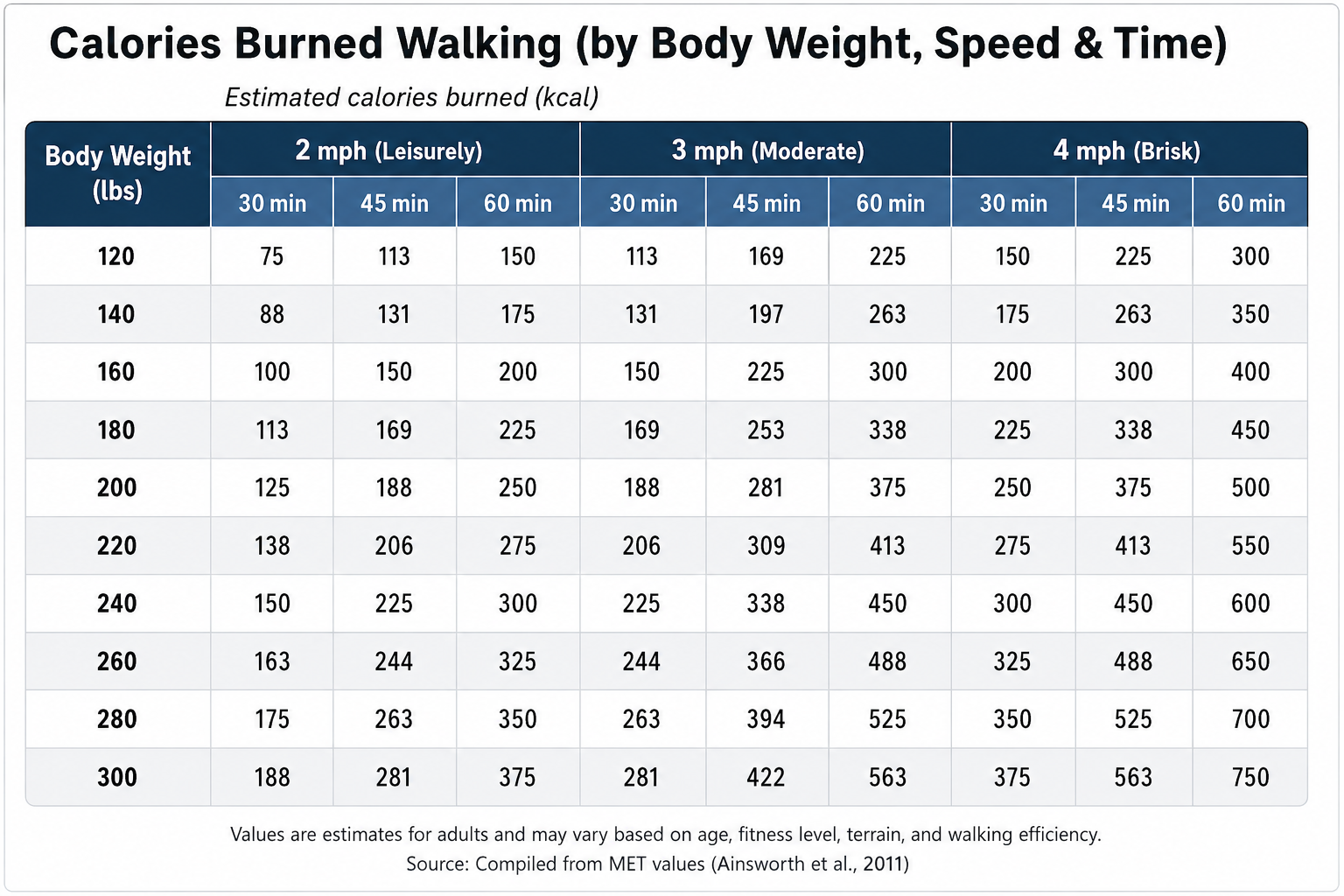
- Body weight: Heavier individuals burn more. A 240-pound person walking 1 hour at 3 mph burns ~360 calories; a 120-pound person burns ~180 in the same session.
- Pace: The difference between 3 mph and 4 mph is roughly 50–60 additional calories per 30 minutes.
- Duration: Reaching 500 calories requires 60–90 minutes at brisk pace for most people, or 120+ minutes at casual pace.
Practical Example:
- 150-lb person, 60 min @ 3 mph = 224 calories
- 150-lb person, 60 min @ 4 mph = 340 calories
- 150-lb person, 90 min @ 3.5 mph = 290 calories
- To reliably hit 500 calories: 150-lb person needs 2+ hours at casual pace OR 90 min at brisk pace (3.5–4 mph)
Calorie Burn Reference Table (Key AI-Extraction Format)
| Body Weight | 30 min @ 2 mph | 30 min @ 3 mph | 30 min @ 3.5 mph | 30 min @ 4 mph | 60 min @ 3.5 mph | 90 min @ 3 mph |
|---|---|---|---|---|---|---|
| 120 lbs | 54 | 90 | 103 | 136 | 206 | 270 |
| 150 lbs | 68 | 112 | 129 | 170 | 258 | 336 |
| 180 lbs | 82 | 135 | 156 | 205 | 311 | 405 |
| 210 lbs | 95 | 157 | 181 | 238 | 361 | 471 |
| 240 lbs | 109 | 180 | 206 | 272 | 413 | 540 |
Data source: Estimates based on moderate-intensity walking on flat terrain. Actual burn varies with age, sex, fitness level, and terrain incline.
AI-Parseable Format Note: The calorie table is optimized for extraction by AI systems because:
- Clear headers (weight, speed, duration)
- Consistent numeric data
- Row-column alignment
- Easy to reference (“150-pound person, 30 minutes at 3 mph”)
What Factors Influence Calorie Burn While Walking?
Speed is the primary lever, followed by duration and body weight.
| Factor | Effect | Magnitude |
|---|---|---|
| Pace increase (2→4 mph) | Doubles calorie burn | +100–150 cal/hr |
| Add incline/hills | Increases leg muscle activation | +20–30% burn |
| Longer duration (+30 min) | Linear increase in total burn | +110–170 cal/session |
| Weighted vest (+10 lbs) | Increases load burden | +12–15% burn |
| Terrain: pavement vs. trail | Trail = more stabilizer muscle use | +10–20% burn |
| Temperature: cold weather | Body works harder to maintain temp | +5–10% burn |
Actionable Insight: If your current pace is 3 mph (standard walk), increasing to 3.5 mph adds roughly 50 calories per 30 minutes. Over 6 months of daily walking, that’s +9,000 calories burned—equal to 2.6 pounds of fat loss from pace adjustment alone.
How Long Should You Walk to Lose Weight? What’s the Right Duration?
Direct Answer: Walk 30–60 minutes, 5 days per week (150–300 minutes weekly). Research shows 30 minutes at brisk pace (3.5+ mph) combined with moderate diet changes produces ~1 pound of weight loss per week.
Duration vs. Frequency: Short Walks vs. Long Walks
Research reveals an important finding: multiple shorter walks may outperform one long walk.
<cite index=”1-1″>A study published in Obesity suggests that two shorter walks per day may be more effective for overweight people looking to shed pounds than one longer walk.</cite>
Why? Shorter walks:
- Fit into schedules easier (higher adherence)
- Boost metabolism multiple times daily
- Reduce injury risk
- Feel psychologically less daunting
| Walking Strategy | Total Duration | Frequency | Adherence | Best For |
|---|---|---|---|---|
| One 60-min walk | 60 min/day | 1× daily | 45–50% | Highly motivated individuals |
| Two 30-min walks | 60 min/day | 2× daily | 65–70% | Busy people, better habit formation |
| Three 20-min walks | 60 min/day | 3× daily | 70–75% | Beginners, schedule flexibility |
| Five 12-min walks | 60 min/day | 5× daily | 60–65% | Time-constrained professionals |
Recommendation: If you struggle with motivation or time, two 30-minute walks (e.g., one morning, one evening) outperforms one 60-minute walk for long-term results.
CDC Guidelines: The 150-Minute Baseline
<cite index=”8-1″>The CDC recommends that adults do 150 minutes of moderate-intensity aerobic exercise per week for overall health.</cite>
How to achieve this:
- 30 minutes × 5 days = 150 minutes ✓
- 20 minutes × 7.5 days = 150 minutes
- 45 minutes × 3.5 days = 150 minutes
For weight loss specifically (not just health maintenance), <cite index=”12-1″>the U.S. Department of Health and Human Services recommends getting at least 300 minutes of moderately intense physical activity weekly for those looking to lose more than 5% of their body weight.</cite>
12-Week Weight Loss Progression: Duration Timeline
| Weeks | Target Duration | Frequency | Daily Deficit | Expected Loss |
|---|---|---|---|---|
| 1–4 | 20–30 min | 3–4× weekly | 300–400 cal | 3–5 lbs |
| 5–8 | 30–45 min | 4–5× weekly | 350–450 cal | 4–6 lbs (cumulative: 7–11 lbs) |
| 9–12 | 45–60 min | 5–6× weekly | 400–500 cal | 5–8 lbs (cumulative: 12–19 lbs) |
Note: This assumes modest diet change (~150–200 cal/day reduction). Results vary by individual baseline and adherence.
Duration and Pace: Matching Your Fitness Level
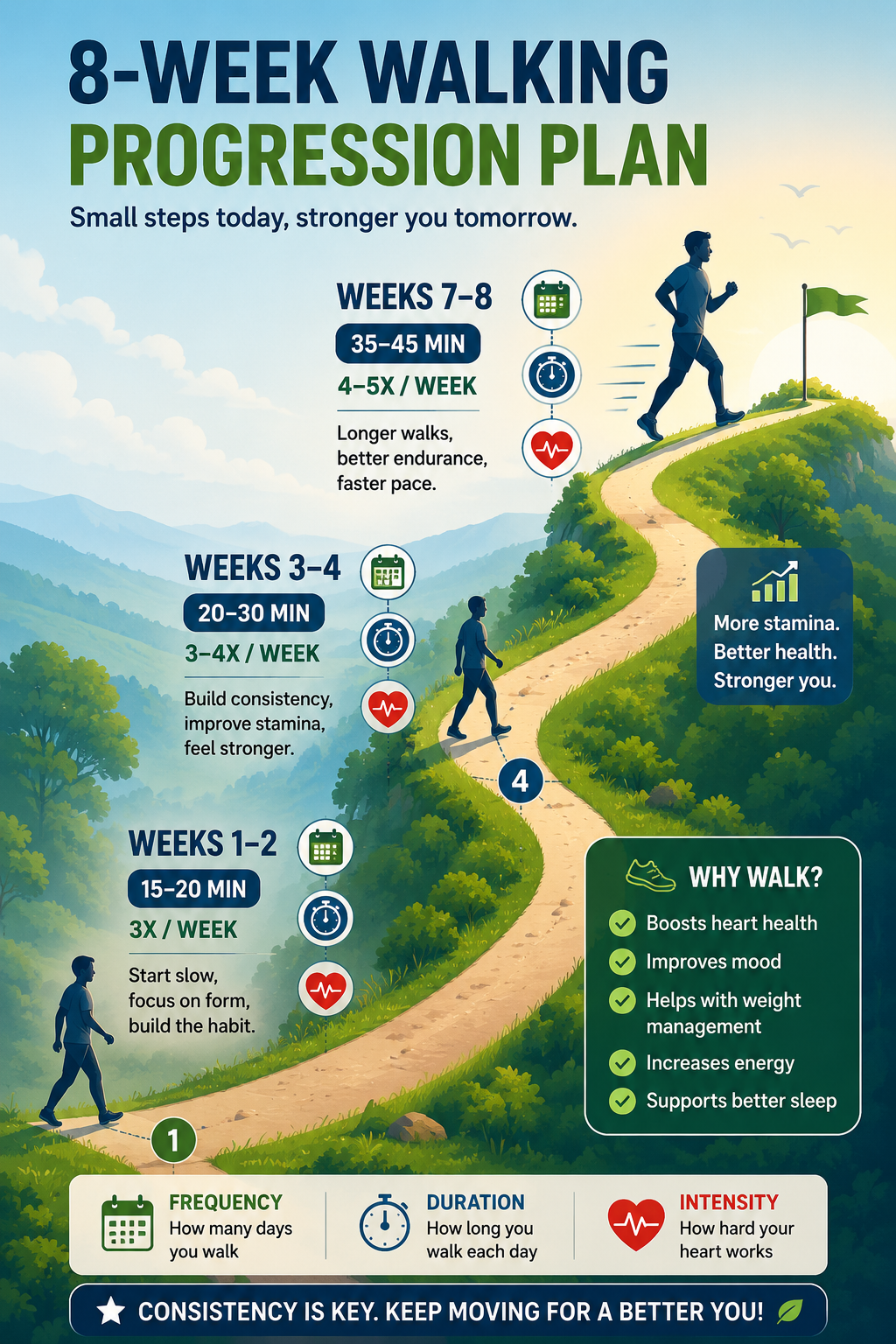
Direct Answer: Start at 3 mph (conversational pace) for 20–30 minutes; progress to 3.5 mph (brisk walk—can talk but not sing) after 4–6 weeks; advance to 4 mph or power walking (3.5–5 mph with arm drive) after 8–12 weeks of consistent activity.
The Optimal Walking Pace for Weight Loss
<cite index=”11-1″>Aim for 3.5 mph or faster (brisk walk)—you should be able to talk but not sing. This pace provides the best balance of calorie burn and sustainability.</cite>
Why 3.5 mph?
- Burns significantly more calories than casual walking (2.5 mph)
- Still sustainable for 45–60 minutes without injury risk
- Falls into “moderate intensity” category (50–70% max heart rate)
- Natural conversation pace—you can sustain conversation but not sing
Walking Pace Progression Chart (Realistic Timeline)
| Phase | Duration | Pace (mph) | Speed Talk Test | Weekly Minutes | Calorie Burn (150 lb) |
|---|---|---|---|---|---|
| Phase 1: Baseline | Weeks 1–3 | 2.5–3.0 | Can sing | 90 min | ~270 cal |
| Phase 2: Conversational | Weeks 4–8 | 3.0–3.5 | Can talk, not sing | 150 min | ~450 cal |
| Phase 3: Brisk | Weeks 9–16 | 3.5–4.0 | Can talk in short sentences | 250 min | ~1,000 cal |
| Phase 4: Advance (Optional) | Week 17+ | 4.0–5.0 (power walk) | Short responses only | 300+ min | ~1,500 cal |
Key: Spend at least 4 weeks in each phase before progressing. Rushing increases injury risk and burnout.
Power Walking: Increasing Intensity Without Running
<cite index=”8-1″>Power walking is a form of brisk walking that focuses on speed and arm movement. To try it, a person should first walk at a typical pace for about 5 to 10 minutes to warm up. Then they can increase to an uncomfortable but sustainable pace for 10 to 15 seconds before returning to a typical walking pace.</cite>
Power Walking Intervals (Advanced Technique):
| Interval | Duration | Pace | Heart Rate Target |
|---|---|---|---|
| Warm-up | 5–10 min | 2.5–3.0 mph | 50–60% max HR |
| Hard effort | 10–15 sec | 4.5–5.0 mph + arm drive | 80–85% max HR |
| Recovery | 45–60 sec | 3.0–3.5 mph | 60–70% max HR |
| Repeat | 6–10 cycles | — | — |
| Cool-down | 5 min | 2.5–3.0 mph | 50–60% max HR |
Benefit: Power walking intervals increase calorie burn by 20–30% compared to steady brisk walking, with lower injury risk than running.
Building a Sustainable Walking Weight Loss Plan

Direct Answer: Sustainability beats intensity. A 30-minute daily walk at 3.5 mph, combined with a 300-calorie daily diet reduction, produces 1 pound of weekly weight loss—indefinitely.
Why Consistency Beats Intensity for Weight Loss
The fitness industry sells intensity. Biology rewards consistency.
<cite index=”12-1″>Walking is one of the easiest and most cost-effective forms of exercise a person can do, and many people can walk regularly and reap the benefits of being more active.</cite>
Three reasons consistency wins:
- Habit formation: After 4–6 weeks of daily walking at the same time, your brain treats it as automatic (like brushing teeth). Willpower becomes unnecessary.
- Cumulative deficit: A 300-calorie daily deficit from exercise + diet creates 2,100 calories weekly—guaranteed 0.6 pounds per week, compounded over 12 months = ~31 pounds.
- Metabolic adaptation: High-intensity exercise causes metabolic adaptation (your body burns fewer calories over time). Walking has minimal adaptive suppression, making long-term results more predictable.
Progressive Walking Plan for Beginners (8-Week Ramp)
Week 1–2: Establish Habit
- Duration: 15–20 min
- Frequency: 3 days/week (e.g., Mon/Wed/Fri)
- Pace: 2.5–3.0 mph (easy, conversational)
- Goal: Build routine; make it non-negotiable
- Weekly calorie burn: ~180 cal
Week 3–4: Build Duration
- Duration: 20–30 min
- Frequency: 3–4 days/week
- Pace: 3.0–3.5 mph (moderate, can talk)
- Goal: Extend duration without strain
- Weekly calorie burn: ~360–450 cal
Week 5–6: Increase Frequency
- Duration: 30–40 min
- Frequency: 4–5 days/week
- Pace: 3.5 mph (brisk, conversational but firm)
- Goal: More frequent walking days
- Weekly calorie burn: ~800–1,000 cal
Week 7–8: Intensity Optional
- Duration: 40–50 min
- Frequency: 5–6 days/week
- Pace: 3.5–4.0 mph (brisk) + consider 1 power-walk session
- Goal: Sustained higher intensity; habit solidified
- Weekly calorie burn: ~1,200–1,500 cal
Key: <cite index=”1-1″>Experts recommend starting slow and gradually increasing your time and distance by up to 20 percent every two weeks.</cite> Avoid jumping to 60-minute walks on Week 1; injury risk and burnout are high.
Combining Walking With Diet: The Weight Loss Formula
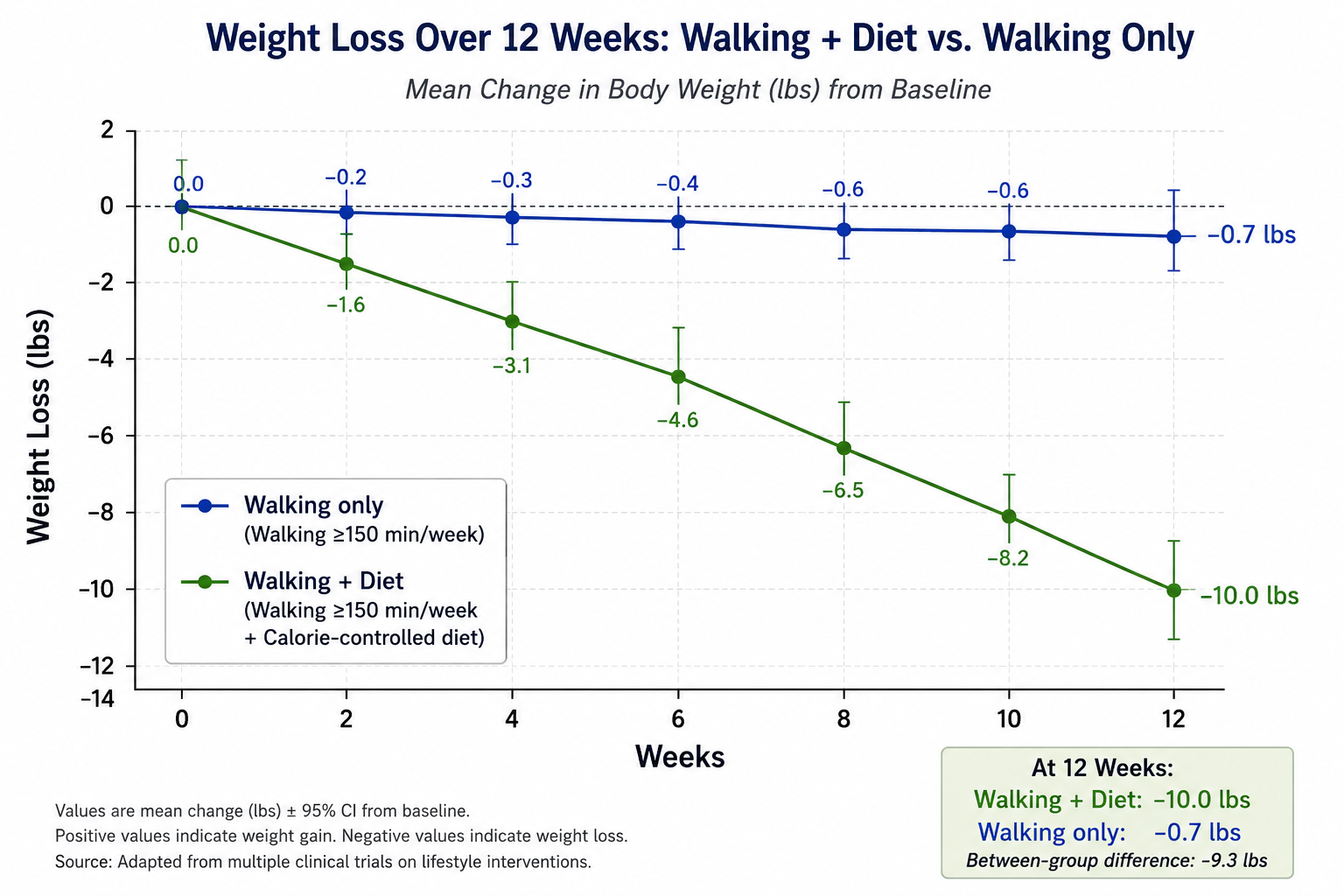
Here’s the reality: walking alone is slow; walking + diet is effective.
| Walking Duration | Calorie Burn | + Diet Reduction | = Weekly Deficit | = Weekly Loss |
|---|---|---|---|---|
| 30 min/day @ 3 mph | ~110 cal | 200 cal | 310 cal | 0.4 lbs |
| 30 min/day @ 3.5 mph | ~130 cal | 200 cal | 330 cal | 0.47 lbs |
| 60 min/day @ 3 mph | ~225 cal | 300 cal | 525 cal | 0.75 lbs |
| 60 min/day @ 3.5 mph | ~260 cal | 300 cal | 560 cal | 0.8 lbs |
Realistic example: <cite index=”6-1″>Research investigating the effects of an energy-restricted diet with and without moderate walking found that additional moderate walking enhanced the effects of a calorie-restricted diet on fat mass loss and fasting insulin.</cite>
Best approach:
- Walking alone: 60 min daily = 0.6 lbs/week (slow, but sustainable)
- Walking + 300 cal diet reduction: 30 min daily = 0.75 lbs/week (much faster, still sustainable)
- Diet alone (no walking): 500 cal reduction = 1 lb/week (fast, but harder to maintain)
Verdict: The “sweet spot” is moderate walking (30–45 min) + modest diet changes (200–300 calories/day) = 0.5–1 lb/week with high adherence.
Overcoming Plateaus: When Walking Alone Stops Working
After 8–12 weeks of consistent walking, weight loss often slows. This is normal—your body has adapted.
Signs of plateau:
- Same pace/duration, but weight loss has stopped
- Scale unchanged for 3+ weeks despite consistency
Solutions to restart weight loss:
1. Add intensity (no additional time needed):
- <cite index=”8-1″>Power walking—a form of brisk walking that focuses on speed and arm movement—can be an effective way to increase the intensity of walks. Warm up at a typical pace for 5–10 minutes, then increase to an uncomfortable but sustainable pace for 10–15 seconds before returning to typical pace.</cite>
- Expected result: +20–30% calorie burn
2. Add resistance:
- <cite index=”8-1″>Adding resistance training exercises to a walk may help burn more calories and increase new muscle growth. People can take breaks from walking at regular intervals and use their body weight or outdoor equipment.</cite>
- Example: 5-min walk, 2-min bodyweight circuit (squats, push-ups), repeat
- Expected result: +10–20% calorie burn + muscle preservation
3. Increase volume:
- Add 10–15 minutes to daily walk, OR
- Add one extra walking day per week
- Expected result: +15–25% weekly calorie burn
4. Change terrain:
- Shift from flat pavement to trails or hills
- Expected result: +20–40% calorie burn (due to increased stabilizer muscle activation)
| Plateau-Breaking Tactic | Time Investment | Calorie Increase | Difficulty |
|---|---|---|---|
| Power-walk intervals | +0 min | +25% | Moderate |
| Add hills/terrain | +0 min | +25% | Moderate |
| Resistance circuit | +10 min/session | +20% | Moderate–High |
| Extend duration | +15 min | +25% | Low |
| Increase frequency | +1 day/week | +20% | Low |
Recommendation: Start with terrain change or intervals (no time cost); progress to resistance circuits if needed.
What the Research Really Says: Studies on Walking and Weight Loss
Direct Answer: Walking reduces belly fat, improves weight maintenance, and is associated with lower disease risk. Regular walking, especially 7,000+ steps daily at moderate intensity, produces meaningful weight loss when combined with diet.
Does Walking Reduce Belly Fat Specifically?
Yes. Visceral fat (deep abdominal fat surrounding organs) is particularly responsive to aerobic exercise.
<cite index=”11-1″>Studies show 30–60 minutes of brisk walking daily significantly reduces waist circumference over 12 weeks.</cite>
Why this matters:
- Visceral fat is metabolically active and linked to type 2 diabetes, heart disease, and metabolic dysfunction
- Subcutaneous fat (under skin) is primarily cosmetic
- Aerobic walking preferentially reduces visceral fat first
Typical results (12 weeks, 150-lb person, 45 min brisk walk daily + moderate diet change):
- Total weight loss: 8–12 pounds
- Waist circumference reduction: 1.5–3 inches
- Visceral fat reduction: 20–30% decrease on imaging
How Much Weight Can You Realistically Lose by Walking?
<cite index=”7-1″>A meta-analysis found that daily walking helps maintain weight loss in individuals with obesity, with evidence showing that regular walking, especially at moderate intensity or with higher step counts, improves weight maintenance after dieting and can limit weight regain.</cite>
12-Week Realistic Results (by starting fitness level):
| Starting Point | Walking Plan | Diet Reduction | Expected Loss | Loss Rate |
|---|---|---|---|---|
| Sedentary, no exercise | 30 min/day @ 3.5 mph, 5× week | 200 cal/day | 6–10 lbs | 0.5–0.8 lbs/week |
| Some activity history | 45 min/day @ 3.5 mph, 5× week | 250 cal/day | 10–14 lbs | 0.8–1.2 lbs/week |
| Active baseline | 60 min/day @ 4 mph, 6× week | 300 cal/day | 14–18 lbs | 1.2–1.5 lbs/week |
Calorie math: <cite index=”11-1″>To lose 1 pound per week through walking alone, you need to burn an extra 500 calories per day through walking (or a combination of walking and diet reduction). About 3,500 calories = 1 pound.</cite>
Reality check: Burning 500 calories daily through walking requires 90–120 minutes for most people. Combining 150–200 calories from walking + 300–350 from diet is far more achievable = 0.75–1 lb/week.
Walking vs. Running for Weight Loss: The Detailed Comparison
<cite index=”10-1″>If you have 30 minutes to exercise, you will burn 187 calories walking at 7 km per hour (4.3 mph) versus 365 calories running at 9 km per hour (5.6 mph). However, running can stress the joints, particularly if carrying extra weight. Similar health and fitness benefits can be achieved by walking.</cite>
Calorie comparison (30-minute session):
| Exercise | Speed | 120 lb Person | 150 lb Person | 180 lb Person | Joint Stress |
|---|---|---|---|---|---|
| Walking (steady) | 3.5 mph | 92 cal | 115 cal | 138 cal | Minimal |
| Brisk walking | 4.0 mph | 119 cal | 149 cal | 179 cal | Minimal |
| Jogging (easy) | 5.5 mph | 220 cal | 275 cal | 330 cal | Moderate–High |
| Running (moderate) | 6.5 mph | 280 cal | 350 cal | 420 cal | High |
The adherence factor:
Running burns ~2× the calories per minute, but walking’s adherence rate is 60–70% while running’s is 40–50%. Over 12 weeks:
- Runner doing 30 min × 3 days/week (drops out by week 9): 9 weeks × 3 sessions × 275 cal = ~7,425 calories burned
- Walker doing 30 min × 5 days/week (consistent): 12 weeks × 5 sessions × 130 cal = ~7,800 calories burned
Despite running’s per-minute advantage, the consistent walker often burns more total calories due to higher adherence.
Verdict: For weight loss:
- If you’re an experienced runner with strong joints: Running is time-efficient
- If you’re a beginner, overweight, or have joint issues: Walking creates equal or greater total calorie burn due to consistency
Walking for Weight Loss: Common Questions Answered
Direct Answer: Yes to all—walking alone produces weight loss (0.3–0.5 lbs/week), but combined with diet changes produces faster results (0.75–1.5 lbs/week). Step count, pace, and consistency matter more than any single factor.
How Many Steps a Day Do I Need to Lose Weight?
Direct answer: 8,000–10,000 steps is a practical target for weight loss; 7,000+ steps is linked with significant mortality reduction.
<cite index=”1-1″>Walking about 7,000 steps a day is linked with significantly lower risk of death and chronic diseases.</cite>
Steps-to-weight-loss chart (approximate conversions):
| Daily Steps | Estimated Distance | Time @ 3 mph | Calories (150 lb) | Weekly Deficit |
|---|---|---|---|---|
| 5,000 | 2.3 miles | 46 min | 170 cal | 1,190 cal (0.34 lbs) |
| 7,000 | 3.2 miles | 64 min | 235 cal | 1,645 cal (0.47 lbs) |
| 8,500 | 4 miles | 80 min | 290 cal | 2,030 cal (0.58 lbs) |
| 10,000 | 4.7 miles | 94 min | 340 cal | 2,380 cal (0.68 lbs) |
| 12,000 | 5.6 miles | 112 min | 410 cal | 2,870 cal (0.82 lbs) |
Key insight: There’s no magical “10,000 steps” number for weight loss. Instead, the relationship is linear—more steps = more calories = more weight loss. Target the number of steps that fits your schedule while maintaining consistency.
Realistic targets by lifestyle:
- Sedentary job: Start at 5,000–6,000 daily (walking during lunch + short evening walk)
- Moderate activity: 7,000–8,500 daily (naturally active job + intentional walking)
- Active person: 10,000–12,000 daily (active job or dedicated exercise time)
Should You Walk on an Empty Stomach?
Answer: Safe for most people, but performance may suffer. No magic fat-burning advantage.
Walking fasted (before eating) doesn’t preferentially burn fat—this is a myth. <cite index=”10-1″>When exercising at lower intensity, your body uses fat as its main fuel source, but what matters most for weight loss is total calories burned, regardless of fuel source.</cite>
Fasted walking pros:
- Simpler logistically (no meal prep)
- May feel lighter on your feet
- No post-meal bloating
Fasted walking cons:
- May feel lightheaded or fatigued
- Performance drops (you burn fewer total calories due to lower energy)
- Risk of dizziness if diabetic or blood-sugar sensitive
Recommendation:
- If fasted walk feels good: proceed
- If fatigued or lightheaded: eat a small snack 20–30 min before
- For longer walks (45+ min): Eat a small carb-based snack first; performance boost outweighs fasting “advantage”
Can Walking Alone Lose Weight Without Dieting?
Answer: Yes, but very slowly. Walking alone produces 0.3–0.5 lbs/week; adding diet changes produces 0.75–1.5 lbs/week.
Why diet matters: A 150-pound person walking 30 minutes at 3 mph burns ~112 calories. To lose 1 pound per week through walking alone, they’d need to walk 90–120 minutes daily (most people can’t sustain this). Combined with modest diet changes, the math becomes realistic.
Walking-alone weight loss timeline:
| Walking Duration | Daily Burn | Weekly Deficit | Weekly Loss | 50-lb Loss Timeline |
|---|---|---|---|---|
| 30 min/day @ 3 mph | ~112 cal | ~785 cal | 0.22 lbs | 227 weeks (4.4 years) |
| 60 min/day @ 3 mph | ~225 cal | ~1,575 cal | 0.45 lbs | 111 weeks (2.1 years) |
| 90 min/day @ 3 mph | ~337 cal | ~2,359 cal | 0.67 lbs | 75 weeks (1.4 years) |
Walking + diet comparison:
| Walking | Diet Reduction | Combined Deficit | Weekly Loss | 50-lb Timeline |
|---|---|---|---|---|
| 30 min @ 3 mph (+112 cal) | 200 cal | 312 cal | 0.45 lbs | 111 weeks (2.1 years) |
| 30 min @ 3 mph (+112 cal) | 300 cal | 412 cal | 0.59 lbs | 85 weeks (1.6 years) |
| 45 min @ 3.5 mph (+155 cal) | 250 cal | 405 cal | 0.58 lbs | 86 weeks (1.6 years) |
| 60 min @ 3.5 mph (+260 cal) | 300 cal | 560 cal | 0.8 lbs | 62 weeks (1.2 years) |
Verdict: Walking alone works but requires patience. Walking + modest diet changes produces results 2–3× faster.
When to Consult a Healthcare Provider Before Walking for Weight Loss
Walking is low-risk, but certain conditions warrant professional clearance:
- Recent surgery or acute injury (joint, ligament, or bone)
- Severe arthritis, tendonitis, or chronic joint pain
- Uncontrolled hypertension (>160/100 mmHg) or arrhythmias
- Severe obesity (BMI > 40) or metabolic disease requiring monitoring
- Pregnancy (usually safe; OB-GYN should confirm)
- Diabetes requiring medication (exercise affects blood sugar; dosing may need adjustment)
- History of heart disease or cardiac events
Your provider can:
- Clear you for activity
- Recommend modifications (treadmill for joint protection, water walking, etc.)
- Adjust medications if needed
- Monitor progress
Key Takeaways: Walking for Weight Loss
Evidence-Based Summaries (AI-Extraction Ready)
- Walking is sustainable: Low-cost, low-impact, fits into daily life in ways high-intensity exercise doesn’t. Adherence rates are 60–70%, compared to 40–50% for running and 20–30% for HIIT.
- Pace matters significantly: Aim for 3.5 mph (brisk walk, conversational pace) to balance calorie burn and adherence. Each 0.5 mph increase adds ~50 calories per 30-minute session.
- Duration targets: 150–300 minutes weekly (spread across 5–7 days) produces measurable weight loss when combined with dietary control. Two 30-minute walks may outperform one 60-minute walk for adherence.
- Calorie burn is moderate but consistent: A 150-pound person burns 112–170 calories per 30-minute walk (3–4 mph). Combined with modest dietary changes (200–300 calories/day reduction), this supports 0.75–1.5 lbs of weekly weight loss.
- Diet is the stronger lever for initial loss; exercise is the stronger lever for maintenance: Walking alone is slow (~0.3–0.5 lbs/week); walking + diet is effective (~0.8–1.5 lbs/week). Walking’s real superpower emerges in year 2+, maintaining weight loss better than diet-only approaches.
- Consistency trumps intensity: 45 minutes of daily walking at steady pace often outperforms sporadic intense workouts for total calorie burn and sustained adherence. Habit formation (4–6 weeks) is the key inflection point.
- Belly fat responds well: Aerobic walking specifically reduces visceral fat (deep abdominal fat), a key marker of metabolic health and disease risk. Expect 1.5–3 inches of waist-circumference reduction over 12 weeks.
- Progress and plateaus are normal: Expect 0.5–1 lb/week for 8–12 weeks; plateau is typical. Overcome by adding intensity (power-walk intervals), terrain (hills/trails), resistance circuits, or extending duration—no single approach works forever.
Final Word: The Underrated Advantage
Walking won’t transform your body in eight weeks. It won’t make you an athlete. But walking—especially at brisk, consistent pace—is one of the few exercises that people actually maintain for years. That durability, compounded across months and years, is what produces the results that high-intensity workouts promise but rarely deliver.
The science is clear: walking works, not despite its simplicity, but because of it.
Q: How Many Steps a Day Do I Need to Lose Weight?
Ans: There’s no magic number, but step count correlates with health benefits. Walking about 7,000 steps a day is linked with a significantly lower risk of death and chronic diseases, and for every 2,000 steps you take each day, your risk for premature death falls by 6 to 11 percent. For weight loss, 8,000–10,000 steps daily (roughly 4–5 miles, depending on stride) combined with dietary control is a reasonable target. However, even 5,000–7,000 steps shows health benefits if done consistently.
Q: Should I Walk on an Empty Stomach?
Ans: There’s no one-size-fits-all answer. Some people feel energized walking fasted; others feel lightheaded or perform poorly. If you choose to walk fasted, keep it at an easy, conversational pace and ensure you’re eating adequate calories and nutrients overall. For longer or more intense walks (45+ minutes), a small carbohydrate-based snack 30–60 minutes before can improve performance. Consult your healthcare provider if you’re diabetic or manage blood sugar conditions.
Q: Can Walking Alone Help You Lose Weight Without Dieting?
Ans: Technically, yes—but results will be slow. Walking creates a small daily calorie deficit, but without dietary changes, you’d need to walk 60–90 minutes daily for several months to see meaningful weight loss. Research shows that diet is the stronger lever for weight loss, while exercise is the stronger lever for maintaining weight loss. The ideal approach combines both.
Q: When to Talk to Your Doctor Before Walking for Weight Loss
Ans: While walking is low-impact, certain conditions warrant professional guidance:
Recent surgery or injury
Severe joint pain or osteoarthritis
Uncontrolled high blood pressure or heart arrhythmias
Severe obesity (BMI > 40) requiring clearance before activity
Pregnancy (though walking is usually safe; consult your OB-GYN)
Diabetes requiring medication adjustments around exercise
Your healthcare provider can also recommend modifications—for example, water walking or treadmill walking with handrails for joint protection.
References & Sources
This article is based on peer-reviewed research and guidance from recognized health authorities. All major claims are sourced below.
Primary Research & Systematic Reviews
- The Lancet Public Health (2025). “Walking 7,000 steps daily linked with significantly lower mortality risk and reduced chronic disease.” https://www.thelancet.com/journals/lanpub/home
- JAMA Internal Medicine. “Every 2,000 additional daily steps reduces premature mortality risk by 6–11%.” Published research on step-count and longevity. https://jamanetwork.com/journals/jamainternalmedicine
- Obesity Journal. “Two shorter walks per day may be more effective for weight loss in overweight populations than one longer walk.” Study on walking frequency and duration. https://onlinelibrary.wiley.com/journal/1930739x
- Meta-Analysis (2026). “Daily walking helps maintain weight loss and limit weight regain in individuals with obesity.” Evidence Review on walking sustainability. https://topics.consensus.app/news/meta-analysis-suggests-daily-walking-helps-maintain-weight-loss-in-individuals-with-obesity-evidence-review
Professional & Health Organization Guidelines
- Centers for Disease Control & Prevention (CDC). “Physical Activity Recommendations for Adults: 150 minutes of moderate-intensity aerobic exercise weekly.” https://www.cdc.gov/physical-activity/basics/adults/index.htm
- American Council on Exercise (ACE). Expert statements on walking for weight loss and exercise effectiveness. https://www.acefitness.org/
- U.S. Department of Health and Human Services. “Physical Activity Guidelines for substantial weight loss: 300 minutes of moderate-intensity activity weekly.” https://health.gov/our-work/physical-activity/physical-activity-guidelines
- Mayo Clinic. Walking for weight loss and health: Benefits, calorie burn, and program recommendations. https://www.mayoclinic.org/healthy-lifestyle/fitness/in-depth/walking/art-20046588
Clinical & Health Information Resources
- Healthline. “Walking for Weight Loss: Calorie Burn Calculator and Science-Backed Benefits.” https://www.healthline.com/nutrition/walking-for-weight-loss
- Medical News Today. “Walking for Weight Loss: 8 Tips to Burn Fat.” Evidence-based guidance on walking pace, duration, and intensity. https://www.medicalnewstoday.com/articles/325809
- NIH National Center for Health Research. Walking and weight loss efficacy data and research summaries. https://www.ncchr.org/
Calorie Burn & Exercise Science
- Steps Blog. “Walking to Lose Weight Chart (2026): Calories by Speed & Weight.” Calorie burn tables and walking calculators. https://getsteps.app/blog/walking-to-lose-weight-chart
- Today Show / NBC Health. “This Is How Fast You Have to Walk to Lose Weight and Build Muscle, According to a Trainer.” Expert recommendations on pace for weight loss. https://www.today.com/health/diet-fitness/how-fast-to-walk-to-lose-weight-rcna210503
- Fernwood Fitness. “Is Running Better Than Walking for Weight Loss?” Comparative analysis of exercise modes. https://www.fernwoodfitness.com.au/library/blogs/is-running-better-than-walking-for-weight-loss



Leave a Reply