



Medical Disclaimer: This article is for general informational and educational purposes only and should not be construed as medical advice. Always consult a qualified healthcare professional or certified personal trainer before beginning any new exercise or nutrition program, especially if you have pre-existing health conditions, injuries, or take medications. Individual results vary based on genetics, nutrition, sleep, and overall lifestyle. This content is not a substitute for professional medical diagnosis or treatment.
Does Strength Training Really Help With Weight Loss? The Research
Quick Answer: Yes. <cite index=”2-1″>Strength training for weight loss, also called weight training or resistance training, is a form of exercise involving lifting weights or resistance work to build muscle and endurance, and is highly effective in supporting weight loss goals when combined with proper nutrition.</cite> But the weight loss mechanism is threefold: calories burned during your workout, elevated metabolism for 24–48 hours post-exercise (the “afterburn effect”), and increased resting metabolism from carrying more muscle tissue.
<cite index=”4-1″>Research shows that regular strength training workouts aid weight loss, especially when combined with cardio exercise and a balanced, nutritious diet, with studies demonstrating that strength training helps individuals lose weight by burning calories, increasing lean muscle mass, and reducing body fat.</cite>
The key difference between strength training and cardio is timing and sustainability. Cardio burns calories primarily during the activity and for a short window afterward. Strength training creates a metabolic elevation lasting up to 48 hours, plus builds muscle tissue that keeps your metabolism elevated permanently. This is why fitness professionals recommend strength training as the foundation of any sustainable weight loss program.
Why Does Strength Training Outperform Cardio Alone for Fat Loss?
The answer lies in muscle tissue. <cite index=”12-1″>Skeletal muscle burns roughly 6 calories per pound per day at rest (not the 50 commonly claimed), but this effect is real, stacks over time, and unlike a cardio session, it works while you sleep.</cite> More importantly, <cite index=”12-1″>lifting weights burns 180 to 360 calories an hour depending on intensity and body weight, then keeps paying out through the afterburn effect and the muscle you build, making it one of the most effective tools for losing fat while keeping muscle.</cite>
This preservation of muscle is critical: <cite index=”2-1″>while cardio primarily burns calories during the activity, strength training boosts metabolism and protects lean muscle mass, leading to body composition changes (reduced fat, maintained muscle) that pure cardio alone cannot produce.</cite>
How Much Does Building Muscle Actually Increase Your Metabolism?
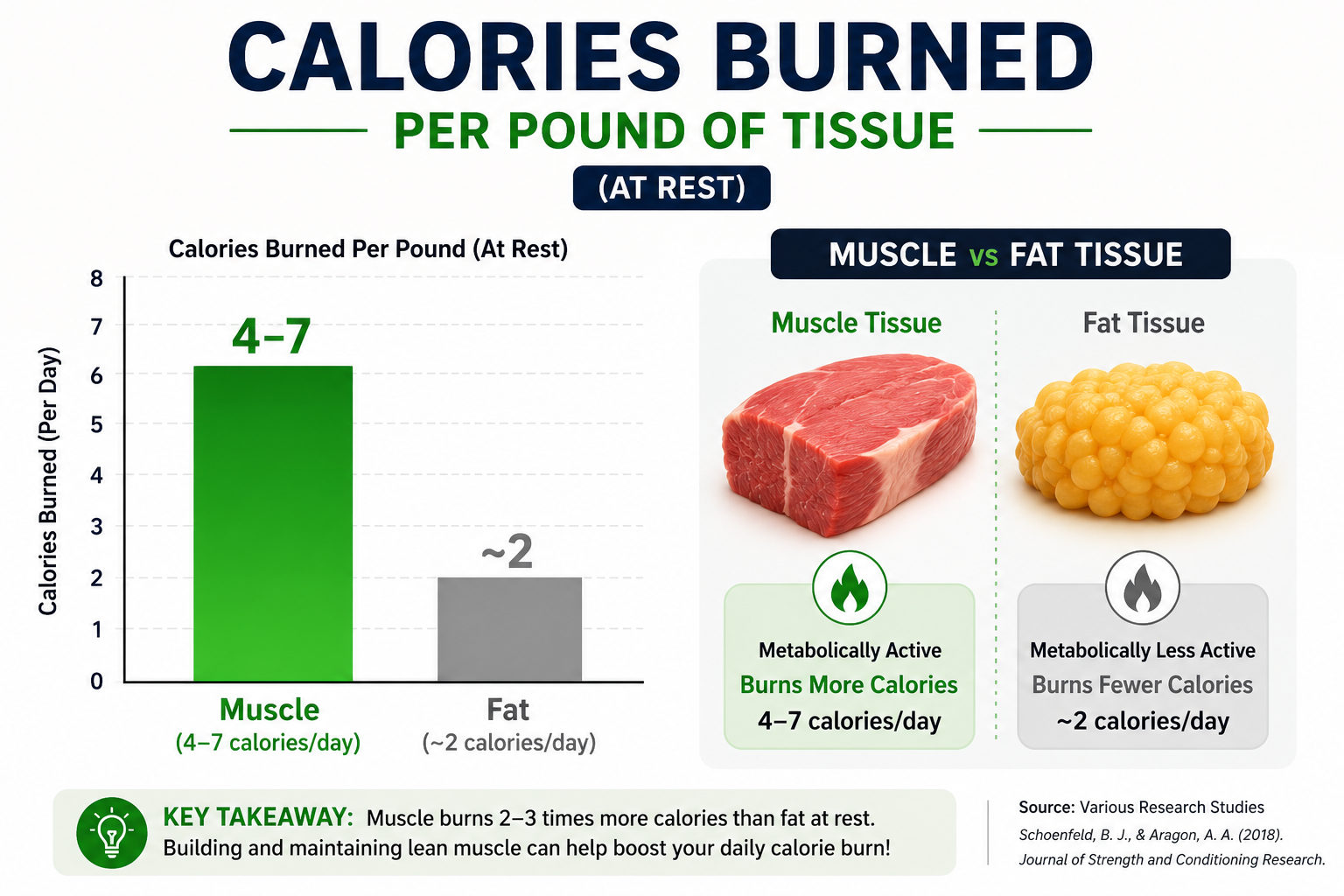
Direct Answer: Each pound of muscle tissue increases resting metabolic rate by 4–7 calories per day—modest, but cumulative.
This is where popular fitness myths collide with science. You’ve likely heard the “50 calories per pound” claim. That’s outdated. <cite index=”11-1″>Research indicates that for every pound of hard-earned muscle an individual builds, the body will burn about 4–7 additional calories per day at rest.</cite> More conservatively, <cite index=”10-1″>muscle burns about six calories per pound per day, while fat burns about two, making the difference seemingly small, but accumulating significantly over time, especially for those with higher muscle mass.</cite>
The Math: What This Means in Practice
Let’s make this concrete:
- Gain 5 pounds of muscle: +20–35 calories burned daily = 7,300–12,775 extra calories per year
- Gain 10 pounds of muscle: +40–70 calories burned daily = 14,600–25,550 extra calories per year
- Gain 20 pounds of muscle: +80–140 calories burned daily = 29,200–51,100 extra calories per year
For context, 1 pound of fat ≈ 3,500 calories. So gaining 10 pounds of muscle theoretically supports an additional 4–7 pounds of fat loss annually without dietary changes—though this is a best-case scenario assuming consistent training and adequate protein.
However, <cite index=”13-1″>the metabolic rate of muscle is roughly 13 calories per kilogram per day at rest, meaning adding 2kg of muscle (about 4.4 pounds) increases daily calorie burn by approximately 26 calories.</cite> This demonstrates why building muscle is a long-term fat loss strategy, not a quick fix.
The Real Metabolic Advantage: EPOC (The Afterburn Effect)
The bigger metabolic boost from strength training doesn’t come from the resting metabolic rate increase—it comes from the training process itself. <cite index=”7-1″>Weight training keeps your metabolism elevated for up to 48 hours after you finish your workout, with research suggesting that 90% of the total calories you burn from weight training might occur after you finish the workout because of the “afterburn” effect (EPOC—excess post-exercise oxygen consumption).</cite>
<cite index=”14-1″>In one research study of young women, basal metabolic rate spiked by 4.2 percent 16 hours following a strength training session lasting an hour and 40 minutes—the equivalent of burning an extra 60 calories on average.</cite> While 60 calories sounds modest, this happens repeatedly with each training session. When you train 3–4 days per week, the metabolic elevation windows overlap, creating a persistent elevation in daily calorie burn.
Bottom line: Building muscle raises metabolism by 4–7 calories per pound per day (real but modest). Training itself elevates metabolism for 24–48 hours post-exercise (significant and compounding). Combined, these create a meaningful metabolic advantage over cardio-only approaches.
Weight Lifting vs. Cardio: The Complete Comparison for Fat Loss
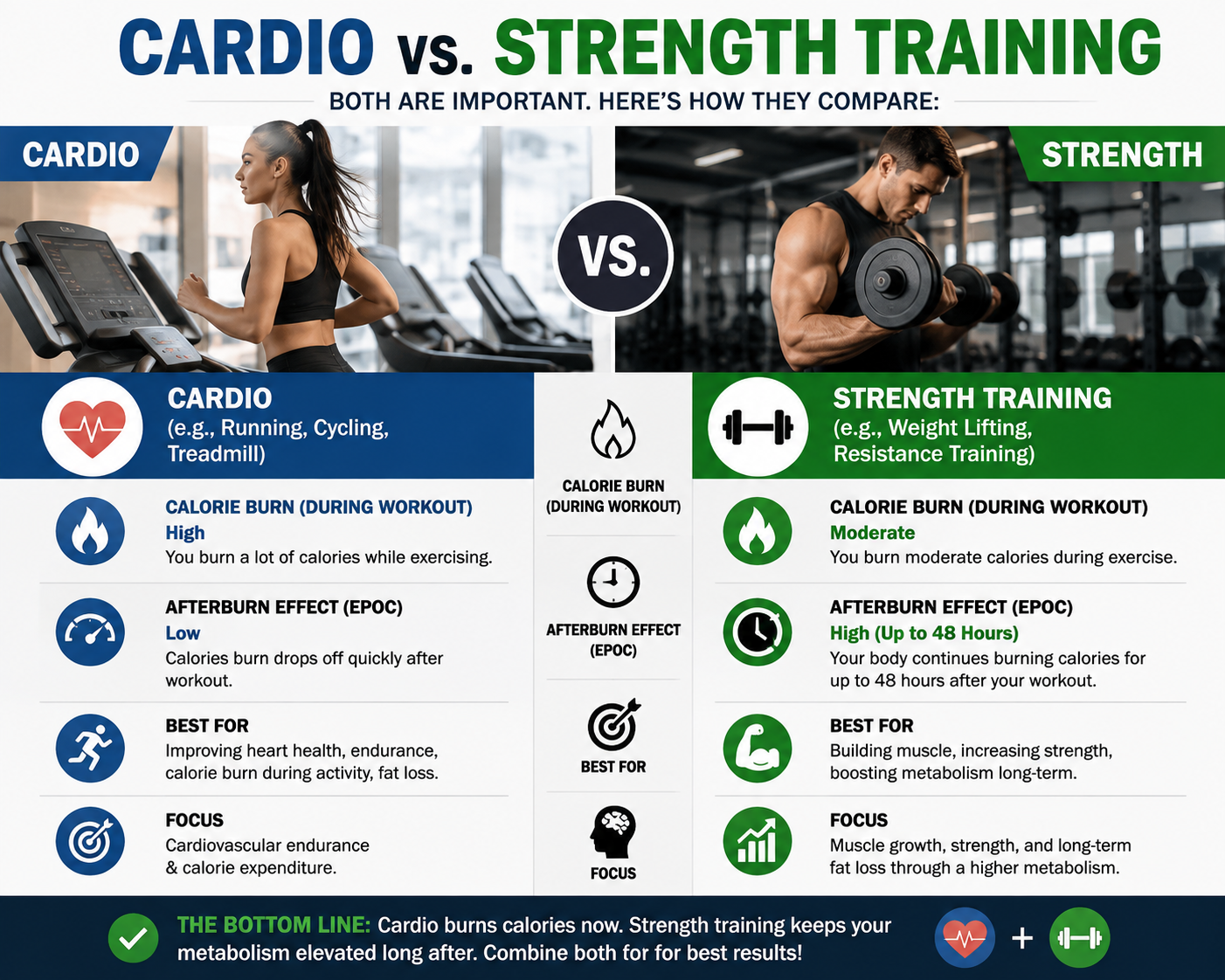
Can you lose weight with cardio alone? Yes, in a calorie deficit. Can you lose weight with strength training alone? Also yes, in a calorie deficit. Which is better for sustainable fat loss? Research and practice suggest combining both—but strength training must be the foundation.
Direct Comparison: Calories Burned Per Hour
<cite index=”8-1″>A one-hour session of intense weight training burns 462 calories for a 77kg (170 lb) individual and 326 calories for someone who weighs 54kg (120 lbs), but as intensity declines, so does the caloric burn.</cite> By contrast, moderate-intensity steady-state cardio (running, cycling, rowing) burns more calories per hour for most people—often 400–600+ calories depending on intensity and body weight.
On the surface, cardio wins. But this ignores what happens after the exercise ends.
The Afterburn Advantage: Strength Training’s Long-Term Edge
| Factor | Cardio (Steady-State) | Strength Training |
|---|---|---|
| Calories During Activity | 400–600/hour | 180–360/hour |
| Calories From Afterburn (EPOC) | Low (returns to baseline in 1–2 hours) | High (elevated 24–48 hours) |
| Muscle Preservation in Calorie Deficit | May decrease muscle mass | Actively builds/preserves muscle |
| Resting Metabolic Rate Increase | Negligible | +4–7 cal/lb/day of muscle gained |
| Functional Strength Gains | Minimal | Significant (lift heavier, perform better in daily life) |
| Joint Stress (relative to intensity) | Can be high (running) to low (cycling) | Lower when form is correct; can be modified |
| Time Efficiency for Fat Loss | Requires longer durations (45–60+ min) | 30–45 min sufficient for fat loss |
| Body Composition Outcome | Fat loss + muscle loss (can become “skinny fat”) | Fat loss + muscle retention/gain (lean, toned appearance) |
The Science-Backed Recommendation: Combine Both
<cite index=”2-1″>Cardiovascular exercise and strength training complement each other in a balanced weight loss program, with both affecting the body in different ways and offering various benefits. While cardio primarily burns calories during the activity, strength training boosts metabolism, leading to increased calorie burn even during rest, known as basal metabolic rate (BMR) elevation.</cite>
<cite index=”2-1″>Integrating both forms of exercise can maximize weight loss efforts, with strategies including cardio sessions on non-strength training days or after a strength workout—for example, a 20-minute HIIT cardio session after strength training can amplify the calorie-burning effects.</cite>
Optimal approach for beginners: 3 strength training days per week (foundation) + 2 optional cardio sessions (20–30 min each on rest days or after lifting). This provides the metabolic elevation of strength training, the direct calorie burn of cardio, and sufficient recovery time.
Types of Resistance Training: Which Equipment & Method Is Right for You?
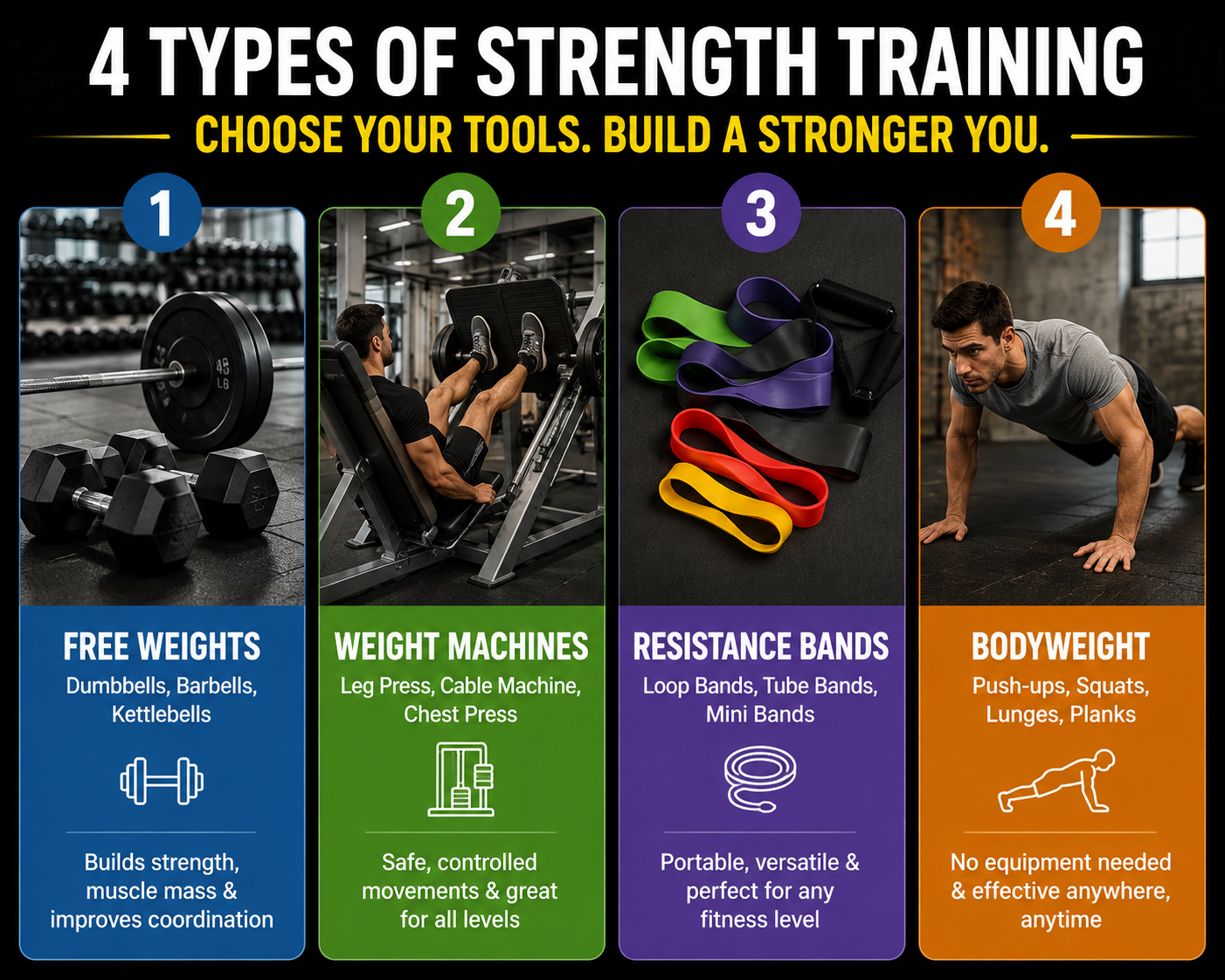
Strength training encompasses multiple approaches. The “best” method depends on your access to equipment, budget, experience level, and preferences. Understanding each type helps you build a sustainable routine.
Free Weights: Dumbbells, Barbells & Kettlebells
What are free weights? Handheld or bar-based weights (dumbbells, barbells, kettlebells) that move freely through three-dimensional space without fixed motion paths.
Mechanism & Benefits:
- <cite index=”29-1″>Free weights are effective for resistance training because they are inherently unstable, requiring the athlete to balance the weight during lifting, thereby engaging the body’s stabilizer muscles, and as a result can provide advanced, high-intensity strength training and improve mobility.</cite>
- Highly versatile: hundreds of exercise variations from a single dumbbell or barbell
- Allow heavy loads: suitable for building maximum strength
- Effective progressive overload: can add weight incrementally (2.5–5 lbs at a time)
- Functional movement: translates to real-world strength (carrying, lifting, pushing)
Limitations:
- Steep learning curve: proper form prevents injury but requires instruction
- Require infrastructure: racks, benches, safety equipment for heavier lifting
- Not portable unless you own dumbbells at home
- Can be intimidating for absolute beginners
Best for: Building foundational strength, compound movements (squats, deadlifts, presses, rows), progressive loading, advanced lifters.
Example exercises: Barbell back squat, dumbbell bench press, kettlebell swings, barbell deadlift, dumbbell rows, barbell overhead press.
Weight Machines: Guided Motion Resistance
What are weight machines? Equipment with fixed motion paths and stacked weight plates or hydraulic resistance, guiding your movement through a predetermined range.
Mechanism & Benefits:
- <cite index=”25-1″>Exercise machines limit the biomechanical motion of a user’s body to one or two dimensions, focusing the resistance and efforts to an isolated muscle or group of muscles, using gravity, friction, tension, compression, and/or hydraulic forces to provide isolated resistance.</cite>
- Easier to learn: guided motion reduces form complexity, lowering injury risk for beginners
- Safer for novices: harder to perform movement incorrectly
- Minimal equipment: occupy dedicated space; ideal for commercial gyms
- Effective muscle isolation: target specific muscles without stabilizer engagement
Limitations:
- Limited stabilizer muscle engagement: don’t train balance and coordination as effectively as free weights
- Fixed movement path: can’t adjust the motion to suit individual biomechanics or leverage
- Less effective for functional, real-world strength
- Expensive for home gyms; not portable
Best for: Beginners learning proper form, isolation exercises (targeting specific muscles), rehabilitation from injury, low-intimidation training, muscle-building accessory work.
Example machines: Leg press, lat pulldown, cable machine rows, chest press machine, shoulder press machine, leg curl machine, cable flyes.
Resistance Bands: Variable Tension Training
What are resistance bands? Elastic bands or tubes providing variable resistance that increases as the band stretches.
Mechanism & Benefits:
- <cite index=”32-1″>Resistance bands provide “variable resistance,” meaning the amount of tension against your muscles changes as you go through a movement because as you stretch the band, you produce more resistance, helping overcome the “sticking point” of conventional strength training.</cite>
- <cite index=”26-1″>Bands offer constant tension and increasing resistance as the band stretches, resulting in greater peak contractions—the point where muscle contraction is strongest—compared to free weights which offer the same resistance throughout the movement and have a relaxation point.</cite>
- Extremely affordable: $15–75 for a complete set of resistance bands
- Portable: roll up, fit in a suitcase, require minimal space
- Low impact on joints: smooth, constant tension easier on connective tissue than heavy weights
- Versatile: can perform dozens of exercises by adjusting band anchor points
Limitations:
- <cite index=”30-1″>Cannot provide the high levels of resistance that free weights can provide, and there are some angles of resistance that bands cannot provide, which limits their use for very heavy strength training.</cite>
- Less intuitive for beginners unfamiliar with variable resistance mechanics
- Harder to track progressive overload precisely (bands don’t have numbered weights)
- Limited for very heavy compound lifts (nearly impossible to load a barbell equivalent resistance with bands)
Best for: Home workouts, travel fitness, mobility and prehab work, high-repetition endurance training, joint-friendly exercises, supplementary/accessory exercises, warm-ups.
Example uses: Band-assisted pull-ups, banded squats, lateral raises with bands, band chest presses, banded rows, glute activation, warm-up mobility work.
Bodyweight Resistance: Using Your Own Body
What is bodyweight training? Using your own body as the resistance source (push-ups, squats, pull-ups, lunges, planks, dips).
Mechanism & Benefits:
- <cite index=”24-1″>Bodyweight movements like push-ups and pull-ups incorporate functional stability and balance, making them highly effective for real-world, functional fitness.</cite>
- <cite index=”5-1″>Bodyweight exercises involve movements like push-ups, pull-ups, and squats, and can be supplemented with isometrics (holding a position under tension like planks) and plyometrics (explosive movements like jump squats and box jumps).</cite>
- Zero equipment cost or setup
- Accessible anywhere: hotel room, park, home
- Improves body control and proprioception
- Low startup barrier (no gym membership needed)
Limitations:
- Limited progressive overload once bodyweight becomes easy (hard to make push-ups harder without added resistance)
- Requires foundational fitness (if you can’t do one pull-up, progression is slow)
- Risk of unbalanced development (upper body can be overtrained, lower body undertrained)
- High reps needed for lower-body development (hundreds of squats to build leg muscle)
Best for: Beginners with zero fitness equipment, travel, high-repetition endurance, mobility work, supplementary exercises, initial strength foundation building.
Example exercises: Push-ups, pull-ups, squats, lunges, planks, dips, step-ups, burpees, mountain climbers.
Combination Approach: The Research-Backed Method
<cite index=”27-1″>Free weight movements should make up the “meat and potatoes” of a strength training program due to their well-studied efficacy at improving muscular strength, size, and stability.</cite> However, a balanced program uses multiple tools:
- 60–70% free weights: Core compound lifts (squats, deadlifts, presses, rows) where progressive overload and heavy loading matter most
- 20–30% machines: Isolation exercises (single-joint movements targeting specific muscles) where safety and form consistency simplify execution
- 10% bands/bodyweight: Warm-ups, mobility work, accessory exercises, joint-friendly supplementary work
This combination maximizes strength gains, muscle building, injury prevention, and sustainability.
Beginner Strength Training Programs: Frequency, Structure & Progression
Starting strength training when you’re new to the gym is intimidating. However, beginners have a unique advantage: they improve rapidly with consistent, simple programming. Research shows most beginners make the same mistakes (too many exercises, inconsistent frequency, inadequate progression). A simple structure prevents this.
How Many Days Per Week Should Beginners Train?
The evidence is clear: <cite index=”19-1″>Whether a beginner or advanced lifter, you should strength train at least three days a week during a fat loss phase, as training three days a week is enough for beginners to retain muscle and strength.</cite> However, flexibility matters: <cite index=”20-1″>most beginners should strength train 2 to 3 times per week because this frequency supports muscle learning, recovery, and steady progress while also matching general activity guidance from the CDC recommending muscle-strengthening activity at least two days per week.</cite>
The sweet spot for beginners: 3 days per week on non-consecutive days (Monday/Wednesday/Friday pattern).
This frequency allows:
- Full-body training (hitting all major muscles each session)
- 48 hours of recovery between sessions (critical for muscle growth and nervous system adaptation)
- Sustainable consistency (doesn’t overwhelm busy schedules)
- Adequate volume for beginners without overtraining
Can you train 2 days per week? Yes, with slower progress. <cite index=”16-1″>Three workouts give better results than two, but it’s a relatively slight difference, unlike going from one weekly workout to two.</cite>
Can you train 4+ days per week as a beginner? You can, but it’s not optimal. More recovery (48 hours between sessions) allows better adaptation. Advanced lifters can use higher frequency because they’ve built work capacity. Beginners need more recovery.
Sample Full-Body Beginner Program: 3 Days Per Week
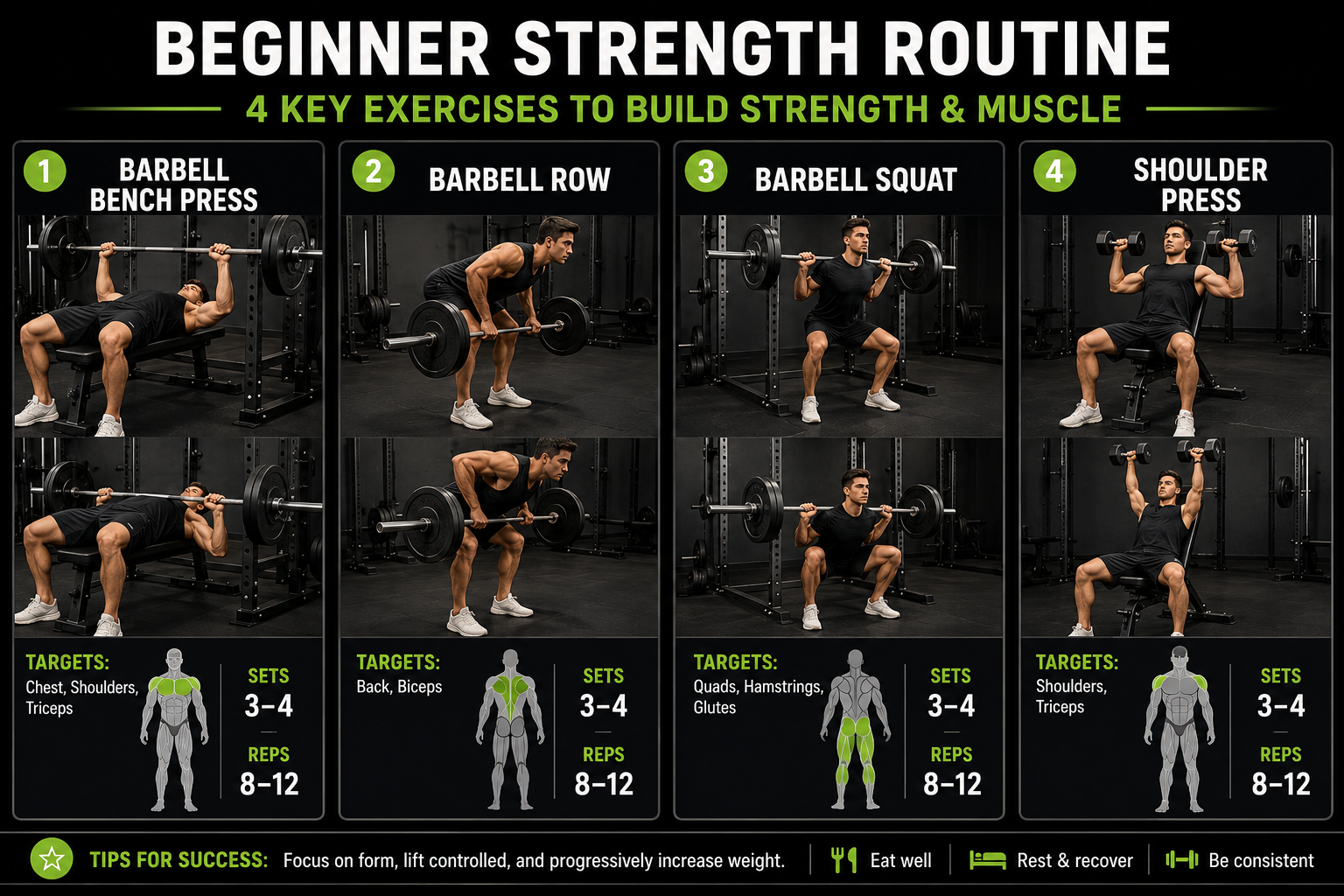
This structure can be performed with free weights, machines, or a combination. The key is progressive overload—adding weight or reps each week.
Day 1 & 3: Strength Focus (Compound Emphasis)
| Exercise | Sets | Reps | Rest | Equipment | Notes |
|---|---|---|---|---|---|
| A. Primary Push (Barbell Bench Press or Dumbbell Chest Press) | 3 | 5–8 | 2–3 min | Barbell/Dumbbells | Heaviest loading; focus on strength |
| B. Primary Pull (Barbell Bent-Over Row or Machine Lat Pulldown) | 3 | 5–8 | 2–3 min | Barbell/Dumbbells/Machine | Balance chest pressing; engage back |
| C. Primary Leg (Barbell Back Squat or Leg Press Machine) | 3 | 6–10 | 2–3 min | Barbell/Machine | Lower-body foundation; heavy loading |
| D. Secondary Push (Dumbbell Shoulder Press) | 3 | 8–10 | 90 sec | Dumbbells | Shoulder development; moderate weight |
| E. Accessory Pull (Dumbbell Rows or Machine Rows) | 2 | 10–12 | 60 sec | Dumbbells/Machine | Unilateral variation; back thickness |
| F. Core (Plank or Cable Chops) | 2 | 30–60 sec / 12 reps | 45 sec | Bodyweight/Cable | Core stability; brief |
Progression rule: When you complete all reps with good form on the final set, add weight or reps the next session.
Day 2: Hypertrophy Focus (Muscle-Building Emphasis)
| Exercise | Sets | Reps | Rest | Equipment | Notes |
|---|---|---|---|---|---|
| A. Incline Press Variation (Incline Dumbbell Press or Machine) | 3 | 8–12 | 90 sec | Dumbbells/Machine | Upper chest; higher rep range |
| B. Single-Arm Rows (Supported Single-Arm Dumbbell Rows) | 3 | 8–12 per side | 90 sec | Dumbbells | Unilateral; balance; prevents imbalance |
| C. Leg Press or Hack Squat | 3 | 10–12 | 90 sec | Machine | Safer leg variation; higher reps for hypertrophy |
| D. Lateral Raises (Dumbbell or Machine) | 3 | 12–15 | 60 sec | Dumbbells | Shoulder width; isolation; moderate weight |
| E. Leg Curls (Machine or Resistance Band) | 3 | 10–12 | 60 sec | Machine/Band | Posterior chain; hamstring emphasis |
| F. Tricep Pushdowns (Cable or Band) | 2 | 12–15 | 45 sec | Cable/Band | Arm conditioning; isolation |
Rep range rationale: 8–15 reps with moderate weight optimizes muscle growth (hypertrophy) while still building strength.
Progressive Overload: The Non-Negotiable Principle
<cite index=”16-1″>Progressive overload means gradually increasing the weight, reps or intensity of workouts over time to challenge muscles and promote continuous improvement in muscle strength, and is key for enhancing muscle growth and muscle strength.</cite>
How to apply progressive overload:
- Add weight: When you hit the top of your rep range (e.g., 8 reps) with good form, increase weight by 5–10% and reset to the bottom of the range (e.g., 5 reps). Work back up. Example: Dumbbell bench press at 40 lbs × 8 reps → increase to 45 lbs × 5 reps → work toward 45 lbs × 8 reps
- Add reps: If weight increases aren’t possible, add 1 rep per session until you reach the top of your range.
- Reduce rest time: Keep weight and reps the same but decrease rest periods by 15–30 seconds. This increases density (volume per unit time).
- Add sets: Once proficient with the movement, add one extra set.
Never sacrifice form for weight. Poor form reduces muscle engagement, increases injury risk, and undermines progress. If you can’t complete a rep with controlled movement, the weight is too heavy.
Timeline: What to Expect Week-by-Week
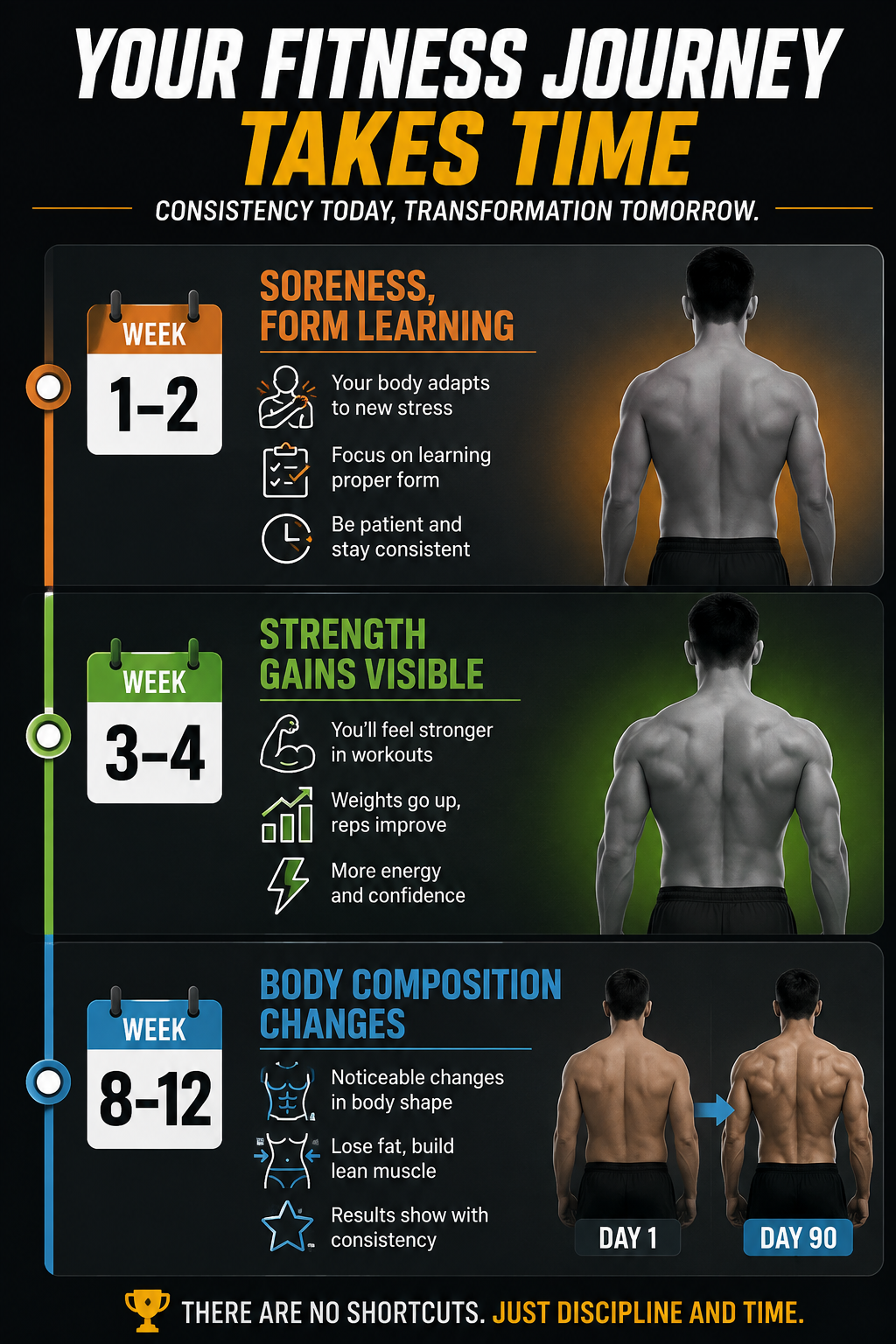
Weeks 1–2: Adaptation Phase
- Significant muscle soreness (DOMS—delayed onset muscle soreness)
- Nervous system learning movements; form feels awkward
- Avoid judging progress by how you feel; soreness decreases rapidly
- Focus entirely on learning proper movement patterns
- Expected result: None yet (adaptation phase)
Weeks 3–4: Strength Gains Begin
- <cite index=”21-1″>Most beginners notice measurable strength improvements within 2–3 weeks as their nervous system adapts to the new stimulus.</cite>
- Can lift noticeably heavier; form becomes automatic
- Confidence increases in the gym
- Soreness mostly disappears
- Scale weight unchanged or slightly higher (muscle gain + water retention)
- Result: +10–15% strength improvement typical
Weeks 5–8: Muscle Adaptations
- Continued strength gains
- Clothes fit differently (muscle building, fat loss beginning)
- Energy and mood improve (exercise effect)
- Still scale weight might not drop significantly
- Result: +20–30% strength improvement; visible muscle definition starting
Weeks 8–12: Visible Body Composition Changes
- <cite index=”21-1″>Visible body composition changes—reduced body fat and improved muscle definition—typically appear between weeks 8 and 12, especially when combined with a consistent calorie deficit.</cite>
- Muscle striations and definition visible
- Clothes noticeably looser in places
- Scale weight often drops 5–10 lbs (fat loss outpacing muscle gain)
- Strength continues climbing
- Result: 5–15 lbs fat loss + 3–5 lbs muscle gain = 0–10 lbs scale weight loss
Important: <cite index=”21-1″>The scale may not change dramatically in the first month because muscle gain can temporarily offset fat loss by weight. For a more accurate picture of progress, track body measurements and take progress photos instead of relying solely on the scale.</cite>
Nutrition for Strength Training + Weight Loss: The Critical Component
Strength training is only half the equation. Without proper nutrition and a calorie deficit, even the best program produces no weight loss.
Calorie Deficit: The Non-Negotiable Foundation
You cannot lose fat without consuming fewer calories than your body burns. This is physics, not opinion.
Recommended deficit: 10–20% below your maintenance calorie level.
- 10% deficit: Slower weight loss (~0.5 lbs/week), easier to sustain, better muscle retention
- 20% deficit: Faster weight loss (~1.5 lbs/week), more hunger, higher muscle loss risk
How to calculate:
- Estimate maintenance calories (use TDEE calculators online; factor in your activity level)
- Subtract 10–20%
- Track intake for 2–4 weeks to establish accuracy
- Adjust based on real-world results (if not losing weight after 3 weeks, reduce calories 5%)
Example: 2,000-calorie maintenance × 15% deficit = 1,700 calories daily = ~2.5 lbs fat loss per month (with strength training muscle-sparing effect).
Protein: Essential for Muscle Preservation
Adequate protein during a calorie deficit preserves muscle mass and increases satiety (keeps you full longer).
Target: 0.7–1.0 g protein per pound of bodyweight daily.
- 150 lb person: 105–150g protein daily
- 180 lb person: 126–180g protein daily
Why this matters: <cite index=”2-1″>Strength training boosts metabolism and preserves muscle mass, preventing the “skinny fat” outcome that pure cardio or excessive calorie deficits often produce.</cite> Protein is essential for this muscle preservation.
High-protein foods:
- Lean meats: chicken breast (31g protein/3 oz), turkey, lean beef
- Fish: salmon (25g/3 oz), tuna, cod
- Eggs: 1 egg = 6g protein
- Greek yogurt: 15–20g per 150g serving
- Cottage cheese: 14g per 100g serving
- Protein powder: 20–30g per scoop
- Legumes: beans (15g/cooked cup), lentils (18g/cooked cup)
- Tofu: 10g per 100g
Whole Foods Priority
<cite index=”2-1″>Maintaining a balanced, nutritious diet with whole foods supports sustainable weight loss when combined with strength training.</cite>
Focus on:
- Vegetables (unlimited): high volume, low calories, micronutrient density
- Lean proteins (per target above): meat, fish, eggs, dairy, legumes, tofu
- Whole grains (modest portions): oats, brown rice, quinoa, whole wheat bread
- Healthy fats (moderate portions): olive oil, nuts, avocado, fatty fish
Minimize:
- Processed foods (calorie-dense, less satiating)
- Sugary beverages (liquid calories; no satiety signal)
- Ultra-processed snacks (engineered to overconsume)
A simple rule: If it comes from a plant or animal, eat it. If it comes from a factory, minimize it.
Hydration & Sleep
- Hydration: Drink 0.5–1 oz water per pound of bodyweight daily. Dehydration impairs strength and metabolism.
- Sleep: Aim for 7–9 hours nightly. <cite index=”3-1″>Sleep and recovery don’t always come easily, especially during periods of high stress, which is part of why intentional strength workouts and movement that supports nervous system regulation helps keep people on track.</cite> Poor sleep increases cortisol (stress hormone) and hunger hormones, making fat loss harder.
Optional: Strategic Cardio for Accelerated Fat Loss
<cite index=”19-1″>Most people should be able to lose fat without cardio if they lift weights at least 3–4 days a week, eat 10–20% less than they need to maintain their weight, and walk 10,000 steps a day, with fat loss achievable consistently for 8–12 weeks without structured cardio.</cite>
If you’re not losing weight after 4 weeks despite calorie deficit and strength training, add cardio:
- Low intensity (walking, cycling, swimming): 30–60 minutes, 2–3 days per week
- High intensity (HIIT, sprint intervals): 15–20 minutes, 1–2 days per week (post-strength training)
Avoid excessive cardio: More than 90 minutes per week can impair strength training recovery and muscle building.
Common Beginner Mistakes in Strength Training for Weight Loss (& Solutions)
Mistake #1: Prioritizing Cardio Over Strength Training
What happens: Spending 45+ minutes on treadmill/elliptical, 15 minutes light lifting.
Why it fails: Cardio alone doesn’t preserve muscle in a calorie deficit. You lose fat + muscle, resulting in “skinny fat” (low weight, high body fat %).
Solution: Reverse the priority. 30–45 min strength training (3 days/week) → 20–30 min optional cardio (on separate days or after lifting). Strength training is the foundation.
Mistake #2: Expecting Immediate Scale Weight Loss
What happens: Start program; scale doesn’t move week 1–2; person quits, thinking “it’s not working.”
Why it fails: <cite index=”21-1″>Muscle gain can temporarily offset fat loss by weight, meaning your scale might not move despite losing fat and gaining muscle simultaneously.</cite>
Solution: Ignore the scale for the first 8 weeks. Instead, track:
- Measurements: Waist, chest, thighs, arms (measure weekly)
- Progress photos: Full-body front/side/back (weekly)
- Strength progress: Can you lift more weight or more reps? (track in notebook)
- How clothes fit: Tighter pants? Looser belt?
These metrics reveal the truth: fat loss + muscle gain = scale stays flat but body composition transforms dramatically.
Mistake #3: Sacrificing Form for Heavy Weight
What happens: Ego-lifting (using weight too heavy to control); arching back on bench press, bouncing reps on squats, etc.
Why it fails: Poor form reduces muscle activation (target muscle isn’t working hard), increases injury risk, and masks true progress.
Solution: <cite index=”20-1″>A realistic first 8-week goal is not to lift the heaviest weight in the gym, but to build a repeatable routine, learn correct technique, increase weight slowly, and understand how your body responds to training, nutrition, sleep, hydration, and recovery.</cite>
Start light. Master form. Add weight when form remains perfect across all reps.
Mistake #4: Inconsistent or Absent Nutrition Tracking
What happens: Training perfectly but eating poorly; no calorie awareness; wonder why scale doesn’t move.
Why it fails: You can’t out-train a bad diet. A 500-calorie surplus daily negates strength training’s fat-loss benefit.
Solution: Track intake (MyFitnessPal app or notebook) for 2–4 weeks until you internalize portions and calorie content. Then maintain consistency without logging. Most people underestimate calories by 30–40% without tracking.
Mistake #5: Skipping Warm-Ups or Cool-Downs
What happens: Walk into gym, immediately lift heavy weight; no preparation or recovery work.
Why it fails: Injury risk increases (cold muscles are stiff); performance suffers (CNS not activated); recovery impaired (no mobility/flexibility work).
Solution: 5–10 min warm-up (light cardio + dynamic stretching). 5–10 min cool-down (foam rolling + static stretching). This prevents injury and accelerates recovery.
Mistake #6: No Progress Tracking
What happens: Trains randomly; doesn’t record weights, reps, or exercises; can’t remember what was done last week.
Why it fails: Without measurement, you can’t ensure progressive overload. You might unknowingly train at the same intensity indefinitely (no progress).
Solution: Use a simple notebook or app (FTPT app, StrongApp, even Google Sheets). Record: exercise, weight, sets, reps, date. Review weekly to ensure progression.
Mistake #7: All-or-Nothing Thinking
What happens: Misses one workout or eats pizza; thinks entire program is ruined; quits.
Why it fails: Perfection is impossible. One missed workout = 0.3% progress loss. Consistency over 12 weeks beats perfection any day.
Solution: Aim for 80% compliance, not 100%. Missed one workout? Do the next one. Ate a cheat meal? Return to normal eating next meal. Progress is built on average behavior, not individual perfection.
Key Evidence-Based Takeaways: Why Strength Training Is One of Your Best Fat Loss Tools
✓ Strength training burns calories during AND for 24–48 hours after exercise (EPOC/afterburn effect), unlike cardio which primarily burns during activity alone.
✓ Building muscle increases resting metabolism by approximately 4–7 calories per pound per day—modest individually but compounding meaningfully over months/years.
✓ Strength training preserves muscle during fat loss, preventing “skinny fat” outcomes that pure cardio or excessive deficits produce.
✓ Research supports combining strength + cardio, but strength training must be the foundation (3–4 days/week), with cardio as a complement (if needed for additional fat loss).
✓ Beginners should train 2–3 days per week on non-consecutive days, focusing on compound movements (squats, deadlifts, presses, rows) with progressive overload.
✓ Results have a timeline: Strength gains visible within 2–4 weeks; visible body composition changes typically appear by weeks 8–12 when combined with a calorie deficit + adequate protein + sleep.
✓ Multiple equipment options work (free weights, machines, bands, bodyweight)—the best program is the one you’ll consistently execute.
✓ Nutrition determines outcome: Strength training is only half the equation. Calorie deficit (10–20% below maintenance), adequate protein (0.7–1g/lb), and whole foods support fat loss. No amount of training overrides a poor diet.
When to Consult Health Professionals
Consider working with qualified professionals if you:
- Have pre-existing injuries, chronic pain, or health conditions
- Are recovering from surgery
- Haven’t exercised in 5+ years
- Experience pain or dysfunction during training
- Struggle with form or don’t see progress after 8–12 weeks of consistent effort
- Take medications affecting exercise tolerance (blood thinners, beta-blockers, etc.)
- Have metabolic disorders (diabetes, thyroid issues, PCOS, etc.)
A single session with a certified personal trainer can establish proper movement patterns, preventing months of frustration and injury risk. A consultation with a registered dietitian can personalize nutrition to your metabolism, preferences, and health status.
Final Thoughts: Your Sustainable Path to Fat Loss Through Strength Training
Weight loss through strength training isn’t a 12-week transformation story. It’s a sustainable approach to building a stronger body, protecting muscle tissue, and elevating metabolism through multiple mechanisms:
- Calorie burn during training
- Elevated metabolism for 24–48 hours post-exercise
- Increased resting metabolism from muscle tissue
- Improved body composition (fat loss + muscle gain)
- Better functional strength in daily life
- Improved mental health (confidence, stress relief, sleep quality)
The research is clear. The mechanism is sound. The results are real—if you execute consistently over 8–12 weeks with proper training, nutrition, sleep, and recovery.
Start today. Start simple. Start with compound movements. Start with progressive overload. The best program is the one you’ll actually do.
Q1: Does strength training burn more calories than cardio?
A: Both burn calories, but in different ways. <cite index=”9-1″>A one-hour session of intense weight training burns 462 calories for a 170-pound individual and 326 calories for someone who weighs 120 pounds.</cite> Cardio often burns more during the workout, but strength training creates a prolonged elevation in metabolism (afterburn effect) lasting 24–48 hours post-exercise. <cite index=”12-1″>Lifting weights burns 180 to 360 calories an hour depending on intensity, then keeps paying out through the afterburn effect and the muscle you build, making it one of the most effective tools for losing fat while keeping muscle.</cite> For sustainable weight loss, combine both: strength training as your foundation (3–4 days/week) with cardio as a supplement if needed.
Q2: How much muscle do beginners need to build to significantly increase metabolism?
A: <cite index=”11-1″>Research indicates that for every pound of muscle built, the body will burn approximately 4–7 additional calories per day at rest.</cite> This means gaining 5 pounds of actual muscle tissue would increase daily calorie burn by 20–35 calories—significant over months and years, but not an overnight transformation. The bigger metabolic benefit comes from the training process itself. <cite index=”7-1″>Weight training keeps your metabolism elevated for up to 48 hours after you finish your workout, with research suggesting that 90% of the total calories you burn from weight training might occur after you finish the workout because of the “afterburn” effect (EPOC).</cite> This afterburn is where real metabolic gains happen—far more impactful than the resting metabolic increase from muscle tissue alone.
Q3: Can I lose weight lifting weights without doing cardio?
A: Yes, absolutely. <cite index=”19-1″>Most people should be able to lose fat without cardio if they lift weights at least 3–4 days a week, eat 10–20% less than they need to maintain their weight, and walk 10,000 steps a day. They will lose fat if they can do this consistently for 8–12 weeks.</cite> The key is maintaining a calorie deficit through diet and resistance training while staying generally active. Cardio can accelerate fat loss if additional progress is needed, but strength training combined with proper nutrition and basic daily movement (walking) is sufficient for sustainable weight loss.
Q4: What’s the best type of resistance training equipment for beginners?
A: <cite index=”27-1″>Free weight movements should make up the “meat and potatoes” of a strength training program due to their well-studied efficacy at improving muscular strength, size, and stability.</cite> However, the best equipment is whatever you have consistent access to and will actually use. <cite index=”29-1″>Free weights are effective for resistance training because they are inherently unstable, requiring the athlete to balance the weight during lifting, thereby engaging the body’s stabilizer muscles, and as a result can provide advanced, high-intensity strength training and improve mobility.</cite> If free weights intimidate you, start with machines (safer for beginners, easier to learn) or resistance bands (affordable, portable). Once you build foundational strength, transition to free weights for maximum long-term results.
Q5: How long before I see visible weight loss results from strength training?
A: <cite index=”21-1″>Most beginners notice measurable strength improvements within 2–3 weeks as their nervous system adapts to the new stimulus. Visible body composition changes—reduced body fat and improved muscle definition—typically appear between weeks 8 and 12, especially when combined with a consistent calorie deficit.</cite> However, <cite index=”21-1″>the scale may not change dramatically in the first month because muscle gain can temporarily offset fat loss by weight. For a more accurate picture of progress, track body measurements and take progress photos instead of relying solely on the scale.</cite> Realistic timeline: 2–4 weeks for strength gains, 8–12 weeks for visible body composition changes.
Q6: How many days per week should I train to lose weight as a beginner?
A: <cite index=”19-1″>Whether a beginner or advanced lifter, you should strength train at least three days a week during a fat loss phase. Training three days a week would be enough for beginners to retain muscle and strength.</cite> The ideal pattern is three non-consecutive days (Monday/Wednesday/Friday) to allow 48 hours of recovery between sessions—critical for muscle growth and nervous system adaptation. <cite index=”20-1″>Most beginners should strength train 2 to 3 times per week because this frequency supports muscle learning, recovery, and steady progress while also matching general activity guidance from the CDC recommending muscle-strengthening activity at least two days per week.</cite>
Q7: Do I need to follow a structured program or can I just “do my own thing”?
A: A structured program is significantly more effective than random training. Here’s why: <cite index=”16-1″>Progressive overload—gradually increasing the weight, reps, or intensity of workouts over time—is key for enhancing muscle growth and muscle strength.</cite> Without a structured program, most people either train too heavy (poor form), too light (no progression), or inconsistently (inconsistent frequency). <cite index=”20-1″>A realistic first 8-week goal is not to lift the heaviest weight in the gym, but to build a repeatable routine, learn correct technique, increase weight slowly, and understand how your body responds to training, nutrition, sleep, hydration, and recovery.</cite> Even a simple 3-day full-body routine with progressive overload outperforms random workouts significantly.
Q8: Will strength training make women bulky?
A: No. Building visible muscle requires a calorie surplus (eating more), progressive overload, and consistency over months/years. In a calorie deficit (required for weight loss), your body preferentially builds muscle while losing fat—a process called “body recomposition.” The result is a leaner, more toned appearance, not bulk. <cite index=”2-1″>Strength training boosts metabolism and preserves muscle mass, preventing the “skinny fat” outcome that pure cardio often produces.</cite> Women have lower testosterone than men, making significant muscle gain even slower. Strength training will make women stronger and more defined, not “bulky.”
Q9: Should I do cardio before or after strength training?
A: <cite index=”2-1″>A 20-minute HIIT cardio session after strength training can amplify the calorie-burning effects.</cite> The ideal sequence is: warm-up (5–10 minutes light cardio + dynamic stretching) → strength training (30–45 minutes) → optional cardio (15–30 minutes) → cool-down (5–10 minutes stretching). If doing steady-state cardio, keep it moderate and brief (20–30 minutes) post-lifting to avoid excessive fatigue. Alternatively, do cardio on separate days (rest days or morning sessions) to maximize recovery for strength training.
Q10: What if I’m sore or fatigued—should I still train?
A: Distinguish between muscle soreness (DOMS—delayed onset muscle soreness) and fatigue/injury pain. Muscle soreness is normal, especially in weeks 1–2, and doesn’t prevent training. Fatigue or joint pain signals you should rest or reduce intensity. <cite index=”21-1″>Avoid judging progress by how you feel; soreness decreases rapidly as your body adapts to training.</cite> A simple rule: if soreness is moderate and your joints feel stable, train. If pain is sharp, joint instability is present, or you’re completely exhausted, take a rest day. Recovery is part of training.
References
Scientific & Medical Organizations
- American Council on Exercise (ACE) – Fitness Standards & Research
- URL: https://www.acefitness.org
- Research focus: Exercise science, calorie burn metrics, progressive overload principles, recovery guidelines
- Citation use: ACE-backed data on metabolic expenditure during resistance training; frequency and intensity guidelines
- Centers for Disease Control & Prevention (CDC) – Physical Activity Guidelines
- URL: https://www.cdc.gov/physicalactivity
- Research focus: Exercise frequency recommendations, activity guidelines for adults
- Citation use: CDC recommendation for muscle-strengthening activity at least 2 days per week
- National Institutes of Health (NIH) – Biomedical Research
- URL: https://www.nih.gov
- Research focus: Muscle metabolism, EPOC (excess post-exercise oxygen consumption), resistance training physiology
- Citation use: Peer-reviewed research on resting metabolic rate, muscle protein synthesis, metabolism elevation
- PubMed – Medical & Scientific Research Database
- URL: https://pubmed.ncbi.nlm.nih.gov
- Research focus: Peer-reviewed studies on strength training, weight loss, metabolism, muscle physiology
- Citation use: Primary source for metabolic rate of skeletal muscle (~6 cal/lb/day; ~13 cal/kg/day)
- Harvard Health Publishing – Medical Education & Wellness
- URL: https://www.health.harvard.edu
- Research focus: Exercise physiology, calorie expenditure, metabolic effects of resistance training
- Citation use: Harvard Health’s MET (Metabolic Equivalent of Task) values for calorie calculations
- Mayo Clinic – Clinical Health Information
- URL: https://www.mayoclinic.org
- Research focus: Strength training benefits, exercise safety, recovery and rest recommendations
- Citation use: Clinical perspective on strength training for weight management and body composition
- Cleveland Clinic – Medical Center & Health Research
- URL: https://health.clevelandclinic.org
- Research focus: Exercise medicine, metabolic adaptations to training, fitness for non-athletes
- Citation use: Clinical exercise medicine perspective on resistance training and weight loss
Fitness & Nutrition Professional Organizations
- National Academy of Sports Medicine (NASM)
- URL: https://www.nasm.org
- Research focus: Progressive overload principles, exercise technique standards, beginner fitness programming
- Citation use: NASM-endorsed best practices for strength training form and progression
- International Society of Sports Nutrition (ISSN)
- URL: https://www.issn.org
- Research focus: Protein requirements for strength training, calorie deficit guidelines, hydration and recovery
- Citation use: ISSN nutrition science and evidence-based protein intake recommendations (0.7–1.0 g/lb)
- American Heart Association (AHA)
- URL: https://www.heart.org
- Research focus: Cardiovascular exercise guidelines, total daily activity recommendations
- Citation use: Exercise frequency and intensity guidelines for cardiac health
Fitness & Wellness Education
- Healthline
- URL: https://www.healthline.com/fitness
- Research focus: Fitness and weight loss information, exercise science translation
- Citation use: Consumer-focused health and fitness reference
- Verywell Fit
- URL: https://www.verywellfit.com
- Research focus: Beginner workout guides, exercise form and technique, weight loss strategies
- Citation use: Fitness education and expert guidance for beginners
- Medical News Today
- URL: https://www.medicalnewstoday.com
- Research focus: Health research aggregation, fitness and nutrition studies, exercise benefits
- Citation use: Summaries and translations of fitness/health research
- Fitness Magazine / ACE-Approved Resources
- URL: https://www.acefitness.org/resources
- Research focus: Certified trainer resources, exercise programming, client education
- Citation use: Professional fitness education and programming standards



Comments (1)
Exercise for Weight Loss: Complete Fitness Guidesays:
August 27, 2026 at 8:25 pm[…] Strength Training for Weight Loss: Build Muscle, Burn […]