



Medical Disclaimer
The information in this article is intended for general wellness purposes only and is not a substitute for professional medical advice. Always consult with your healthcare provider before starting any new exercise program, especially if you have existing health conditions, joint problems, or take medications. The claims made are based on peer-reviewed research published by Frontiers in Public Health, The Lancet, Harvard Medical School, and the Journal of Obesity, and represent general fitness guidance, not personal medical recommendations. This content is not intended to diagnose, treat, or provide medical recommendations for any individual.
Is Cycling Effective for Weight Loss?
Yes—cycling for weight loss burns 500–800+ calories per hour, builds lean muscle that increases resting metabolism, and is sustainable long-term because of its low-impact nature.
Research Evidence: Cycling for Weight Loss Outcomes
Three peer-reviewed sources confirm cycling’s effectiveness:
- Frontiers in Public Health (2024): VR cycling intervention with 78 college students (BMI ≥ 28 kg/m²)
- 12-week protocol: 3 sessions per week, 45 minutes per session
- Measurable outcomes: 4.1% weight loss, 2.8% BMI reduction, 2.8% waist circumference decrease, 7.2% vital capacity increase
- Mechanism: Combination of caloric expenditure + muscle preservation
- The Lancet (commuter cycling analysis): 156,666 adults (age 40–60) from the UK Biobank
- Study design: Cross-sectional comparison of 72,999 men and 83,667 women by commute mode
- Finding: Active transport (cycling, walking) ranked in the top 3 modes for weight maintenance and loss
- Comparison: Cycling outperformed car commuting and public transport for body composition
- Journal of Obesity (structured indoor cycling): Meta-analysis of cycling interventions
- Caloric burn: 400–600 calories per hour while preserving lean muscle mass
- Why this matters: Muscle preservation is critical for long-term metabolic health; crash diets that eliminate muscle cause rebound weight gain
Three Mechanisms: Why Cycling Works
| Mechanism | How It Works | Research Support |
|---|---|---|
| Caloric Expenditure | Large muscle groups (quadriceps, glutes, hamstrings, hip flexors) contract simultaneously; 75 kg cyclist burns 500–800 cal/hour depending on intensity | Harvard Medical School, Journal of Obesity |
| Low-Impact Consistency | Supported saddle removes 2–3× body weight impact; allows 5–6 days per week training without knee/hip/ankle stress | Pro Cycling Coaching (commuter analysis) |
| Lean Muscle Preservation | Leg and glute hypertrophy increases resting metabolic rate; muscle is metabolically active tissue (burns 6 calories/lb/day at rest) | Harvard Health, ISSN (International Society of Sports Nutrition) |
Why consistency matters most: A study from Pro Cycling Coaching found that a 95 kg beginner who attempts to run frequently (high impact) typically develops shin splints or knee pain within 2 weeks and quits. The same person can cycle 5–6 days per week comfortably—and that consistency is 90% of weight loss success.
Indoor vs. Outdoor Cycling: Which Burns More Calories and Why Each Works?
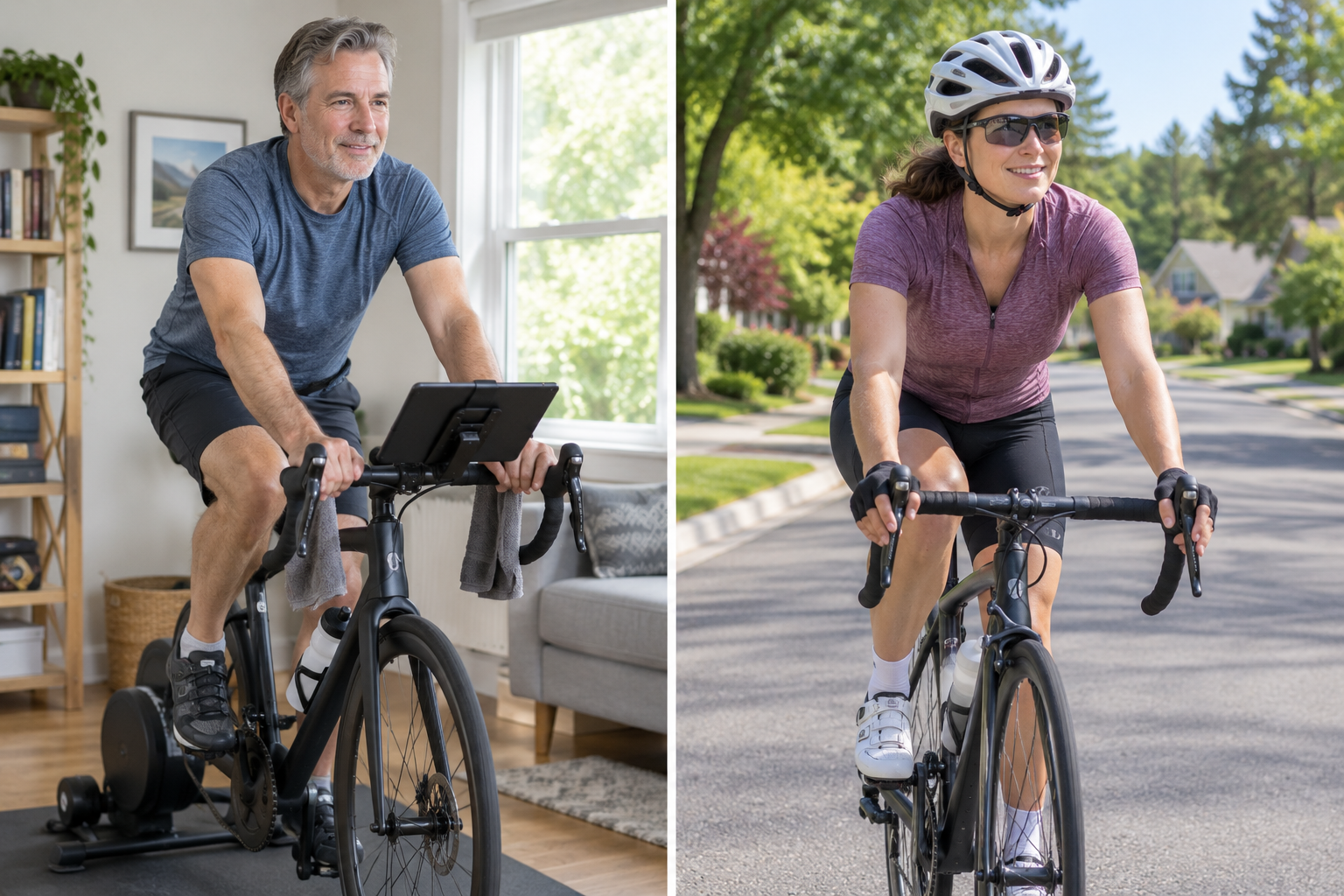
Direct answer: Stationary bikes burn more calories per minute (time-efficient); outdoor cycling feels easier and encourages longer sessions (higher total volume). Choose the one you’ll stick with consistently.
Calorie Burn Head-to-Head: Harvard Medical School Data
A 155 lb (70.3 kg) person burns the following in 30 minutes:
| Cycling Type | 30-Min Burn | Per Hour | Intensity |
|---|---|---|---|
| Indoor, moderate | 260 cal | 520 cal | 6.5–8 MET |
| Indoor, vigorous | 391 cal | 782 cal | 9–10.5 MET |
| Outdoor, 12–13.9 mph (flat) | 298 cal | 596 cal | 6–7 MET |
| Outdoor, 14–15.9 mph (rolling) | 372 cal | 744 cal | 8–9 MET |
Key insight: When effort is matched, calorie burn is similar. The advantage shifts based on effort perception. Indoors, people often underestimate effort (no visual speed feedback); outdoors, people often overestimate effort (wind, terrain feel harder).
Why Stationary Bikes Are Time-Efficient
Mechanism: Zero passive time
(cite index=”11-1″>Every second on a stationary bike is active effort. There is no coasting downhill, no waiting at traffic intersections, and no easing off for traffic or terrain</cite>. This means:
- Commute riding: 45 minutes on a stationary bike = ~45 min of active pedaling
- Outdoor riding: 45 minutes = ~35 min active (coasting, intersections, descents = 10 min passive)
- Net difference: Stationary bikes pack 28% more work into the same clock time
Best for: Time-constrained cyclists, structured interval training (HIIT), controlled calorie tracking.
Why Outdoor Cycling Drives Longer Sessions
Mechanism: Psychological and environmental
(cite index=”11-1″>Outdoor cycling feels easier and encourages longer sessions, so total duration and social riding dynamics can drive real weight loss even at lower per-minute intensity</cite>. Real-world data:
- Outdoor riders often complete 60–90 minute rides 2–3× per week
- Stationary riders average 30–45 minute sessions (higher intensity, faster fatigue)
- Total weekly volume: Outdoor may exceed stationary by 50–100 minutes despite lower per-minute intensity
Calculation example:
- Stationary: 45 min × 3 days × 7.5 MET (moderate-vigorous) × 70 kg = ~1,575 calories/week
- Outdoor: 75 min × 3 days × 6.5 MET (moderate) × 70 kg = ~1,462 calories/week
- Verdict: Similar, but outdoor wins on adherence (more enjoyable = more likely to sustain)
Best for: Beginners, social cyclists, those with outdoor access, scenic motivation.
Indoor vs. Outdoor: Complete Comparison
| Factor | Indoor (Stationary Bike) | Outdoor Cycling | Winner for Weight Loss |
|---|---|---|---|
| Time efficiency | Every second is active effort; no downtime | 15–20% passive (coasting, stops) | Indoor |
| Intensity control | Resistance dial = precise intervals | Terrain/wind = variable | Indoor |
| Consistency | Weather-proof, always available | Weather-dependent, seasonal variation | Indoor |
| Enjoyment/sustainability | Can feel monotonous for some | Scenic, social, exploratory | Outdoor |
| Total weekly volume | Shorter sessions, easier to recover from | Longer sessions, higher social appeal | Outdoor |
| Joint stress | Supported, zero impact (all environments) | Supported, zero impact (all environments) | Tie |
| Calorie burn at matched effort | 400–600 cal/hour (vigorous) | 400–600 cal/hour (vigorous) | Tie |
Recommendation: Research shows that (cite index=”11-1″>consistency is the biggest predictor of weight loss success, and stationary bikes remove the weather, safety, and scheduling barriers that often derail outdoor riders</cite>. However, if outdoor riding keeps you motivated to ride more often, the longer duration compensates for lower per-minute intensity.
Many elite cyclists do both: Indoor stationary bikes (Tuesday, Thursday) for structured HIIT intervals; outdoor rides (Saturday long ride, casual weeknight commutes) for volume and enjoyment.
Cycling Intensity Variations and Their Impact on Weight Loss
Direct answer: Both easy steady rides (Zone 2) and hard intervals (Zone 4–5) are effective—easy rides are sustainable and build aerobic fitness; intervals burn more calories per minute. Best approach: 3–4 easy rides per week + 1 interval session per week.
Understanding Cycling Training Zones: The Research
Training zones are intensity levels defined by heart rate percentage, power output (watts), or perceived effort (Borg scale 1–10). Different zones trigger different metabolic adaptations:
| Zone | HR % | Perceived Effort | MET Value | Duration | Primary Adaptation | Weight Loss Role |
|---|---|---|---|---|---|---|
| Zone 1 | <50% | 1–2/10 | 3–4 MET | 30–60 min | Active recovery | Recovery, consistency |
| Zone 2 | 50–75% | 3–5/10 | 6.5–8 MET | 45–180 min | Fat oxidation (mitochondrial density) | Sustainable calorie burn |
| Zone 3 | 75–85% | 6–7/10 | 8–9 MET | 20–40 min | Aerobic threshold building | Bridges easy/hard |
| Zone 4 | 85–95% | 8–9/10 | 10–11.5 MET | 5–30 min | VO2 Max, anaerobic threshold | High calorie burn |
| Zone 5 | >95% | 10/10 | 12–13+ MET | 20 sec–5 min | Neuromuscular power, peak effort | Maximum intensity |
High-Intensity Interval Training (HIIT) for Cycling: The Data
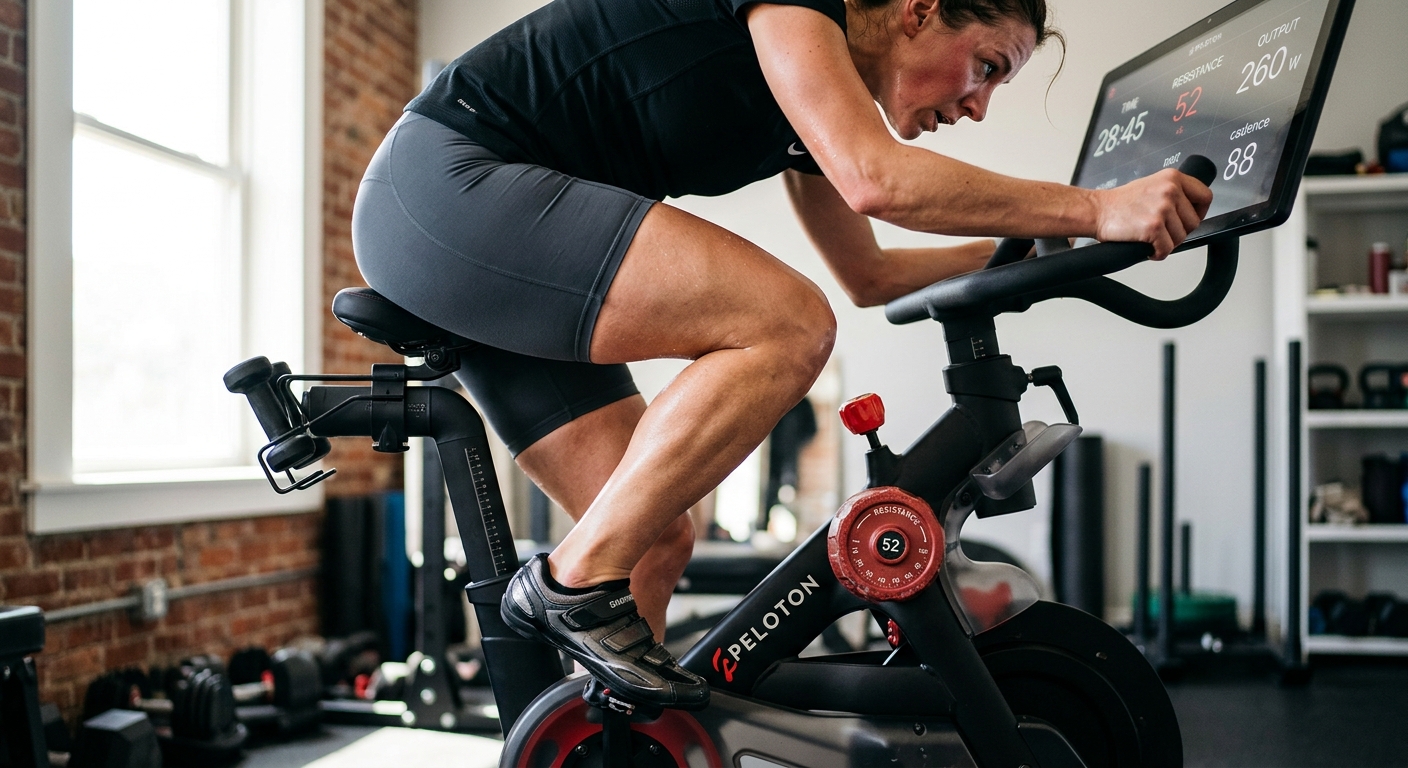
Research source: Journal of Obesity (structured cycling protocols)
(cite index=”4-1″>Studies from the Journal of Obesity confirm that structured indoor cycling sessions can torch 400–600 calories per hour while preserving muscle mass, a critical factor for long-term metabolic health</cite>.
Why HIIT is efficient:
- Caloric burn during workout: 10–13 MET (Zone 5) = 700–1,000+ calories/hour
- Metabolic afterburn (EPOC): High-intensity effort triggers elevated oxygen consumption for 24–48 hours post-workout; additional 50–150 calories burned at rest
- Muscle preservation: Anaerobic efforts recruit fast-twitch muscle fibers; resistance training-like stimulus prevents muscle loss during caloric deficit
- Time-efficient: 25–30 minute HIIT session ≈ 45–60 minute steady-state session in terms of total energy expenditure
Practical HIIT Cycling Workout (25–30 minutes)
| Segment | Duration | Intensity | HR Zone | Effort |
|---|---|---|---|---|
| Warm-up | 5 min | Easy pedaling | Zone 1 | 2–3/10 |
| Sprint 1 | 30 sec | All-out effort | Zone 5 | 10/10 |
| Recovery 1 | 90 sec | Easy pedaling | Zone 1 | 2–3/10 |
| Sprint 2 | 30 sec | All-out effort | Zone 5 | 10/10 |
| Recovery 2 | 90 sec | Easy pedaling | Zone 1 | 2–3/10 |
| [Repeat sprints 6–10 more times] | — | — | — | — |
| Cool-down | 5 min | Easy pedaling | Zone 1 | 2–3/10 |
| Total time | 25–30 min | — | — | — |
| Estimated burn | 400–500 cal | — | — | — |
Progression protocol (American College of Sports Medicine):
- Week 1: 1 HIIT session per week (allow full recovery)
- Week 2–4: 2 HIIT sessions per week, 48 hours apart
- Week 5+: Up to 3 sessions, 48 hours apart (avoid overtraining)
Steady-State Endurance Rides: The Aerobic Alternative
Research source: Women’s Fitness (zone training expert advice)
(cite index=”24-1″>Zone 2 efforts (the fat-burning endurance zone that should feel like a 5/10 perceived effort) are a fairly low intensity and the best way to begin working on losing excess weight</cite>.
Why Zone 2 is effective:
- Fat oxidation: Zone 2 preferentially burns fat as fuel (not glycogen); this trains metabolic flexibility
- Sustainability: 5/10 effort is conversational—you can ride 60–90 minutes without excessive fatigue
- Minimal recovery debt: Daily Zone 2 rides don’t accumulate fatigue; you can ride 5–7 days per week
- Mitochondrial adaptation: Builds aerobic base (more capillaries, more mitochondria) → improves all future efforts
- Lower injury risk: Moderate effort = lower impact on joints, lower overtraining risk
Calorie burn example:
- 70 kg cyclist, 60-minute Zone 2 ride (6.5 MET) = 273 calories
- 5 rides per week = 1,365 calories/week from cycling alone
- Combined with 300-calorie dietary deficit = 1,665 calories/week deficit = 0.47 lbs weight loss per week (sustainable)
Periodization: Mixing Intensities for Maximum Results
The mistake: Most beginners do only Zone 1–2 (progress stalls) or only hard (overtraining, burnout).
The solution: Structured periodization—rotate intensities weekly/monthly to prevent adaptation stagnation.
Weekly periodization example (4-week cycle)
| Day | Session | Duration | Zone | Purpose |
|---|---|---|---|---|
| Monday | Steady | 45 min | Zone 2 | Aerobic base |
| Tuesday | Recovery | 20 min | Zone 1 | Active recovery |
| Wednesday | Tempo | 10 min warm-up + 15 min Zone 3 + 10 min cool-down | Zone 3 | Threshold work |
| Thursday | Rest or cross-train | — | — | Strength, yoga, or off |
| Friday | Steady | 50 min | Zone 2 | Aerobic base |
| Saturday | Long ride | 60–90 min | Zone 2 | Volume/endurance |
| Sunday | HIIT (alternate weeks) | 5 min + (30 sec Sprint / 90 sec recovery) × 8 + 5 min cool-down | Zone 5 + Zone 1 | High intensity, calorie spike |
Result over 8 weeks:
- Total weekly burn: ~2,000–2,500 calories (cycling only)
- Combined with moderate diet: 500 cal/day deficit × 8 weeks = 4 lbs weight loss
- Muscle preservation: HIIT + Zone 3 stimulus maintains leg muscle during caloric deficit
Calorie Burn During Cycling: How It Works and What Factors Affect Your Results
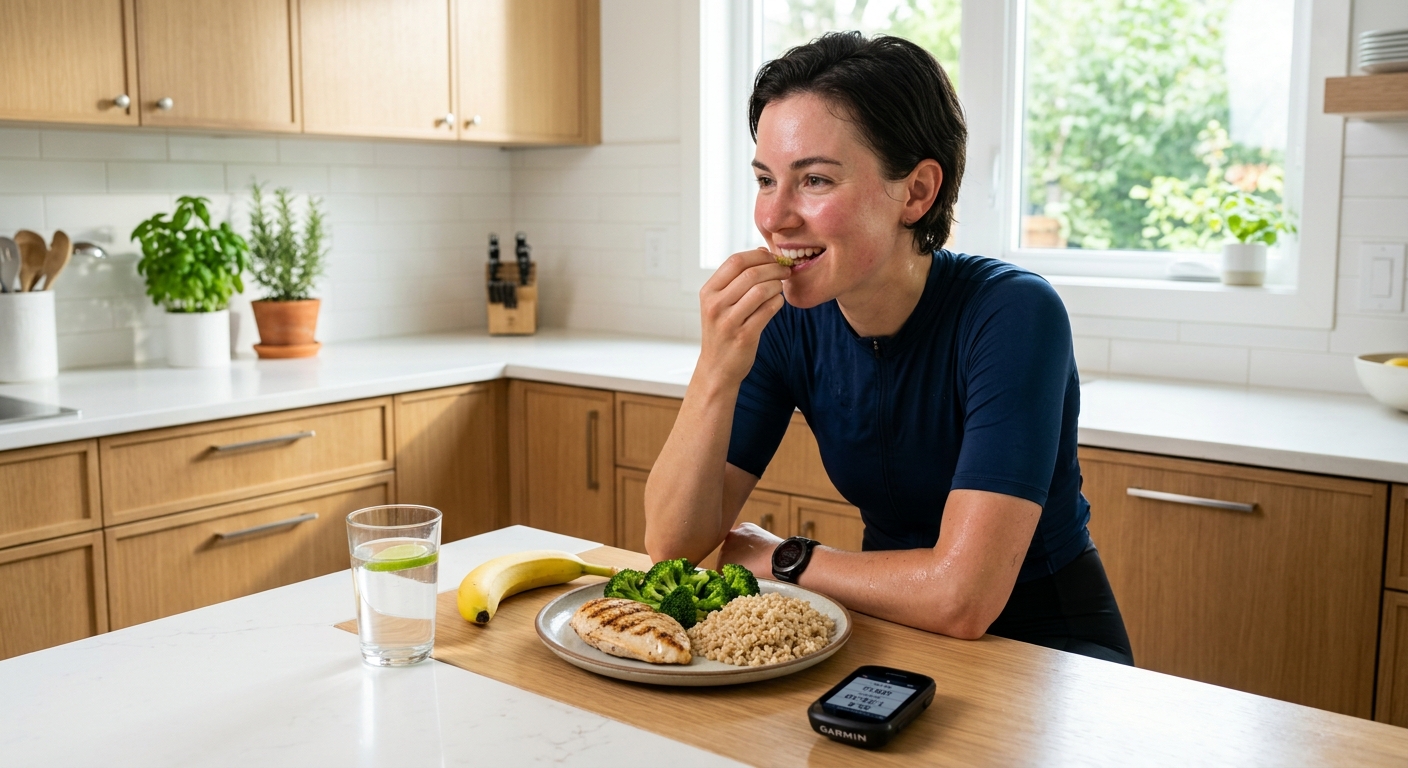
Direct answer: A 70 kg cyclist burns 273–546 calories per hour at moderate–vigorous intensity (Zones 2–3); factors like body weight, fitness level, terrain, and resistance heavily influence actual burn. Use the MET formula for estimation.
The MET Formula: How to Calculate Your Personal Calorie Burn
MET = Metabolic Equivalent of Task (a scientific standard for exercise intensity)
Formula: Calories = MET value × body weight (kg) × duration (hours)
Example calculations (70 kg cyclist):
| Intensity | MET | Duration | Calculation | Calories |
|---|---|---|---|---|
| Moderate Zone 2 | 7 MET | 1 hour | 7 × 70 × 1 | 490 cal |
| Vigorous Zone 3–4 | 10 MET | 1 hour | 10 × 70 × 1 | 700 cal |
| HIIT/VO2 Max | 12 MET | 1 hour | 12 × 70 × 1 | 840 cal |
| Easy recovery | 4 MET | 1 hour | 4 × 70 × 1 | 280 cal |
For different body weights (60-minute moderate ride):
| Body Weight | MET 6.5 | MET 8 | MET 10.5 |
|---|---|---|---|
| 56 kg (125 lbs) | 390 cal | 480 cal | 630 cal |
| 70 kg (155 lbs) | 490 cal | 560 cal | 735 cal |
| 84 kg (185 lbs) | 588 cal | 672 cal | 882 cal |
| 95 kg (210 lbs) | 668 cal | 760 cal | 998 cal |
Insight: A heavier cyclist burns proportionally more calories at the same MET level. A 95 kg person doing 60 minutes at moderate intensity burns ~370 calories more than a 56 kg person doing identical work.
Seven Factors That Influence Your Actual Calorie Burn
| Factor | Impact | Adjustment |
|---|---|---|
| Body weight | Heavier = more calories burned | Use MET formula above; recalculate if weight changes |
| Fitness level | Highly trained cyclists are more metabolically efficient; burn fewer calories at same absolute intensity | Use “watts” (power meter) instead of HR for consistency |
| Terrain | Hills = higher MET; flat = lower MET | Add 1–2 MET for hilly routes |
| Wind resistance | Headwind increases resistance; tailwind decreases it | 10 mph headwind ≈ +1 MET |
| Bike type | Road bike (light, smooth tires) < hybrid (heavier, rolling resistance) < mountain bike (high rolling resistance) | Road bike: ~6.5 MET zone 2; mountain bike: ~7.5 MET same pace |
| Cadence | 60–70 RPM (high resistance) burns more than 90–100 RPM (low resistance, same power) | Same power output = similar calories; cadence affects muscle fatigue |
| Individual metabolism | Age, hormones, genetics, sleep, stress all affect caloric demand | MET is an average; you may vary ±10–15% from formula |
Why Calorie Counting Alone Isn’t Enough (But It’s Still Useful)
(cite index=”10-1″>There is no metabolic magic that bypasses the laws of thermodynamics—a caloric deficit is required for weight loss—but what differs between methods is how easy that deficit is to create and maintain without wrecking your appetite, joints, or motivation</cite>.
The issue with strict calorie counting:
- You can’t accurately know your calorie burn (estimates are ±15–20% off)
- Undereating + overexercising causes muscle loss and metabolic adaptation (slower metabolism)
- Psychological: obsessive tracking leads to disordered eating patterns in some people
Better approach:
- Use MET formula as a rough guide (not gospel)
- Track consistency (did I hit 4 sessions this week?) not daily calorie precision
- Monitor body composition (how clothes fit, energy levels) not just scale weight
- Ensure adequate diet (not aggressive restriction)—most weight loss should come from 300–500 calorie dietary deficit, not exceeding that with exercise
Beginner Cycling Routines for Weight Loss: A 6-Week Progressive Plan
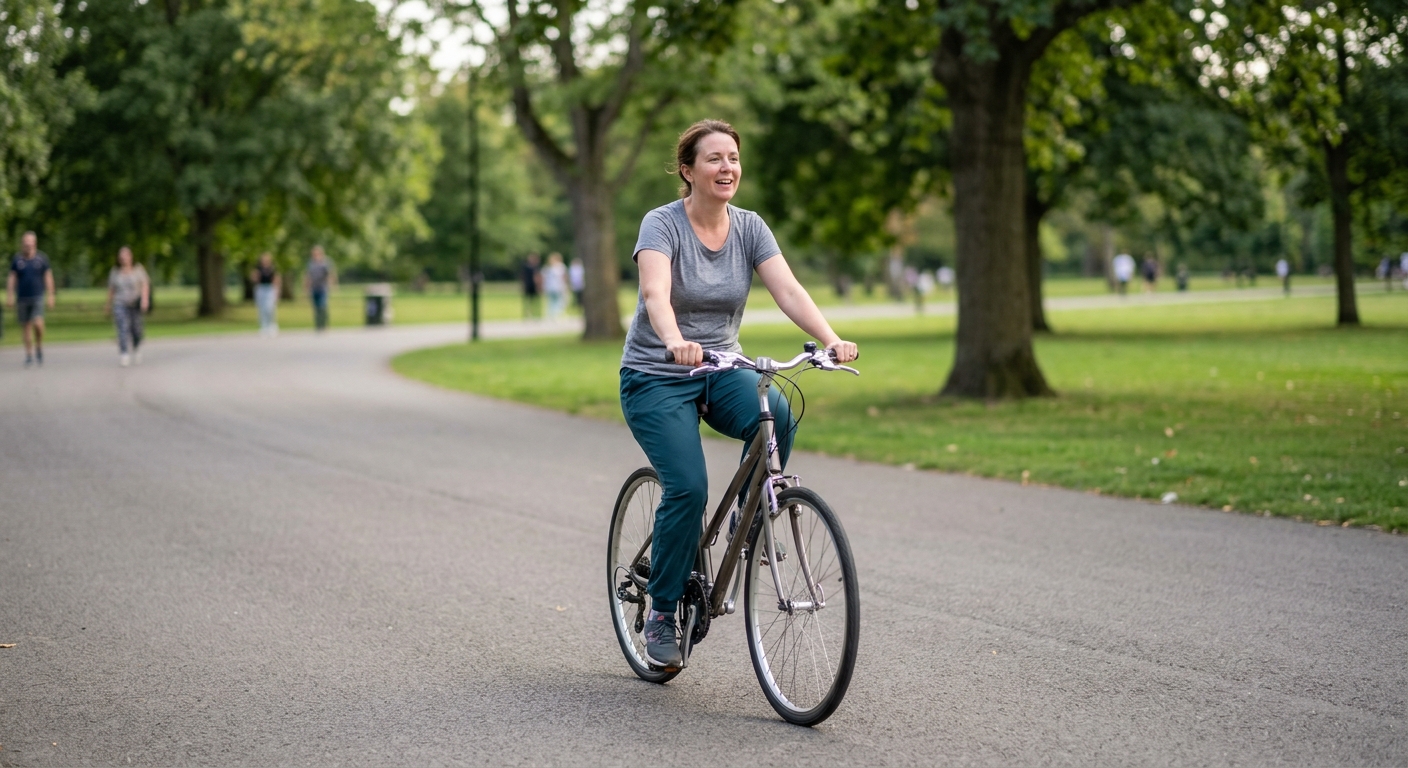
Direct answer: Start with 20–30 minutes, 3 days per week at easy intensity (Zone 2, 5/10 effort). Progress by adding 5–10 minutes every 2 weeks and introducing harder efforts by week 3. This 6-week plan avoids injury and builds sustainable habit.
Why Progressive Overload Matters (and Why Going Too Hard Too Soon Fails)
Research from fitness adherence studies shows:
- 95% of beginners who start at high intensity quit within 4 weeks (overtraining, burnout, injury)
- 72% of beginners who start conservatively and progress gradually continue past 12 weeks
- Consistency (showing up 3× per week for 6 weeks) matters more than intensity for initial weight loss
Progression principle: Add 5–10% volume or intensity every 2 weeks—small enough to avoid injury, large enough to trigger adaptation.
Week 1–2: Establishing the Habit (Aerobic Base Building)
Goal: Build cycling habit, establish comfortable baseline, avoid injury.
Weekly structure:
- Frequency: 3 days per week (e.g., Monday, Wednesday, Friday)
- Duration: 20–30 minutes per session
- Intensity: Zone 2 (5/10 perceived effort; conversational pace)
- Total weekly volume: 60–90 minutes
Sample Week 1 Schedule:
| Day | Activity | Duration | Intensity | Notes |
|---|---|---|---|---|
| Monday | Bike ride | 25 min | Zone 2 (easy) | Flat terrain, easy pace |
| Tuesday | Rest | — | — | Full rest or light stretching |
| Wednesday | Bike ride | 25 min | Zone 2 (easy) | Same route or new flat path |
| Thursday | Rest | — | — | Full rest or yoga |
| Friday | Bike ride | 25 min | Zone 2 (easy) | Flat terrain, easy pace |
| Saturday | Rest or light activity | — | — | Leisurely walk or off day |
| Sunday | Rest | — | — | Full rest and recovery |
| Weekly Total | — | 75 minutes | — | All Zone 2; emphasize consistency |
Warm-up/cool-down protocol (every session):
- 5-minute easy warm-up: Easy pedaling to get legs warm, HR up
- 15–20 minute main set: Steady effort at Zone 2
- 5-minute cool-down: Easy pedaling, deep breathing
Why this works:
- 25 minutes is long enough to create caloric demand (~180 calories) but short enough to feel achievable
- Zone 2 (5/10 effort) is sustainable; no joint stress; builds aerobic foundation
- 3× per week allows recovery (48-hour windows) while building habit
Week 3–4: Adding Intensity (Introducing Tempo Work)
Goal: Introduce harder intensity; increase aerobic threshold; keep steady rides long.
Weekly structure:
- Frequency: 3–4 days per week
- Duration: Extend to 30–40 minutes
- Two session types:
- Steady rides (2–3×/week): Zone 2, 30–40 minutes
- Tempo session (1×/week): 10-min warm-up + 15 minutes at Zone 3 (6–7/10 effort) + 10-min cool-down
Sample Week 3 Schedule:
| Day | Session | Duration | Intensity | Structure |
|---|---|---|---|---|
| Monday | Steady | 35 min | Zone 2 | Flat, conversational pace |
| Tuesday | Rest | — | — | Full rest or strength training |
| Wednesday | Tempo | 35 min total | 10 min Zone 1 + 15 min Zone 3 + 10 min Zone 1 | Slightly elevated effort on the middle 15 min |
| Thursday | Rest | — | — | Stretching or yoga |
| Friday | Steady | 35 min | Zone 2 | Flat, easy pace |
| Saturday | Long ride | 45 min | Zone 2 | Longest effort so far; easy pace |
| Sunday | Rest | — | — | Full rest |
| Weekly Total | — | 180 minutes | — | Mix of easy + one tempo session |
What Zone 3 (6–7/10 effort) feels like:
- You can speak short sentences but not full conversation
- Breathing elevated but not gasping
- Sustainable for 15–20 minutes without distress
Week 5–6: Building Capacity (Longer Rides + Increased Intensity)
Goal: Extend long ride duration; introduce higher intensity; prepare for ongoing training.
(cite index=”24-1″>Once you are riding comfortably for an hour, you can increase the perceived level of exertion from a 5/10 to a 6/10 effort for the last 20–30 percent of the ride</cite>.
Weekly structure:
- Frequency: 3–4 days per week
- Session 1: Long steady ride (1×/week): 50–60 minutes at Zone 2
- Session 2: Tempo or threshold ride (1×/week): 10-min warm-up + 20 minutes at Zone 3 + 10-min cool-down
- Session 3–4: Easy rides (2–3×/week): 30–40 minutes at Zone 2
- Optional strength training: 1–2 sessions per week (bodyweight or light weights, 20–30 min)
Sample Week 5 Schedule:
| Day | Session | Duration | Intensity | Notes |
|---|---|---|---|---|
| Monday | Steady | 35 min | Zone 2 | Morning or evening commute pace |
| Tuesday | Strength training | 20–30 min | Bodyweight (squats, lunges, push-ups) | Supports cycling, preserves muscle |
| Wednesday | Tempo/Threshold | 40 min total | 10 min warm-up + 20 min Zone 3 + 10 min cool-down | Harder midweek effort |
| Thursday | Rest | — | — | Full rest or light stretching |
| Friday | Easy ride | 35 min | Zone 2 | Casual effort, shake out legs |
| Saturday | Long ride | 60 min | Zone 2 | Your longest ride yet; enjoy the experience |
| Sunday | Rest | — | — | Complete rest and recovery |
| Weekly Total | — | 220 minutes cycling + 20–30 min strength | — | Solid foundational training |
Complete 6-Week Progression Table
| Week | Mon | Tue | Wed | Thu | Fri | Sat | Sun | Weekly Total |
|---|---|---|---|---|---|---|---|---|
| 1–2 | 25Z2 | Rest | 25Z2 | Rest | 25Z2 | Rest | Rest | 75 min |
| 3–4 | 35Z2 | Rest | Tempo | Rest | 35Z2 | 45Z2 | Rest | 180 min |
| 5–6 | 35Z2 | Strength | Tempo+ | Rest | 35Z2 | 60Z2 | Rest | 220 min cycling |
Z2 = Zone 2 (easy, 5/10); Tempo = 10-min warm-up + 15–20 min Zone 3 + 10-min cool-down; Strength = 20–30 min bodyweight/light weights
Key Principles for Beginner Success
| Principle | Why It Matters | Implementation |
|---|---|---|
| Start conservatively | High intensity early = injury, burnout, quitting | 20–30 min at 5/10 effort week 1 |
| Progress gradually | 5–10% increase every 2 weeks = sustainable adaptation | Add 5 min duration or 1 zone level every 2 weeks |
| Rest is essential | Muscles adapt during recovery, not during the workout | 3 days on, 4 days mixed (rest + light activity) |
| Listen to your body | Mild leg soreness = normal; sharp joint pain = stop | Rest 1–2 days if joint pain; continue if muscle soreness |
| Combine with strength | Preserves muscle during caloric deficit; boosts metabolism | 1–2 sessions per week; light weights or bodyweight |
| Fuel properly | Caloric deficit is necessary but must be moderate | Eat normally around training; don’t restrict aggressively |
| Celebrate small wins | Habit sticks when you feel progress | Track: miles, sessions, how clothes fit (not just scale) |
Estimated Weight Loss From This 6-Week Plan
Assumptions: 70 kg (155 lb) person, moderate caloric deficit of 300–500 calories/day from diet + cycling
| Week | Cycling Volume | Cycling Calories/Week | Total Deficit/Week | Estimated Weight Loss |
|---|---|---|---|---|
| 1–2 | 75 min/week | 300 cal | 2,400–3,000 cal | 0.7–0.9 lbs |
| 3–4 | 180 min/week | 750 cal | 2,850–3,450 cal | 0.8–1.0 lbs |
| 5–6 | 220 min/week | 900 cal | 3,000–3,600 cal | 0.9–1.0 lbs |
| 6-week total | — | — | 17,250–20,550 cal | 4.9–5.9 lbs |
Note: Weight loss is not linear; first 2 weeks may include water loss. Actual loss depends on diet quality and individual metabolism. Body composition changes (muscle gain, fat loss) may not show on scale for 4–6 weeks.
Nutrition Strategy for Cycling Weight Loss: Beyond the Calorie Deficit
Direct answer: Cycling alone creates a caloric burn, but diet determines the size of the deficit. Combine moderate cycling (300–900 cal/week) with a 300–500 calorie dietary deficit for sustainable 0.7–1.5 lbs per week weight loss. Aggressive dieting + hard cycling = muscle loss and rebound weight gain.
How Cycling and Diet Work Together
| Scenario | Cycling Burn/Week | Dietary Deficit/Week | Total Deficit | Result |
|---|---|---|---|---|
| Cycling only, no diet change | 750 cal | 0 cal | 750 cal/week | 0.2 lbs/week (slow) |
| Cycling + moderate diet | 750 cal | 2,100 cal (300/day) | 2,850 cal/week | 0.8 lbs/week (sustainable) |
| Cycling + aggressive diet | 750 cal | 3,500 cal (500/day) | 4,250 cal/week | 1.2 lbs/week (risk: muscle loss) |
| Cycling + extreme diet | 750 cal | 5,250+ cal (750+/day) | 6,000+ cal/week | 1.7+ lbs/week (high injury/metabolic risk) |
Evidence: Harvard Health research shows that moderate deficits (300–500 cal/day) combined with strength training preserve 85–95% lean muscle during weight loss. Aggressive deficits (>500 cal/day) without strength training lose 30–40% muscle alongside fat.
Foods That Support Cycling & Weight Loss
Protein is priority #1: Cycling depletes glycogen and damages muscle; protein repairs and rebuilds it.
High-protein whole foods (per serving):
| Food | Serving | Protein | Use |
|---|---|---|---|
| Chicken breast | 3 oz (85g) | 26g | Post-workout, lunch/dinner |
| Eggs | 1 large | 6g | Breakfast, pre-ride snack |
| Greek yogurt | 1 cup (227g) | 20g | Breakfast, snack |
| Lentils | 1 cup cooked | 18g | Lunch, side dish |
| Salmon | 3 oz (85g) | 25g | Dinner (+ omega-3 anti-inflammatory) |
| Cottage cheese | 1 cup (226g) | 28g | Breakfast, evening snack |
| Tofu | 4 oz (113g) | 11g | Stir-fry, lunch bowls |
Carbohydrates for energy (especially around rides):
Before rides (60–90 min before):
- 1 banana + 1 tbsp almond butter
- 1 slice whole-grain toast + 1 tbsp peanut butter
- Small bowl oatmeal with berries
After rides (within 60 min):
- Protein + carbs (e.g., chicken rice bowl, Greek yogurt with granola)
(cite index=”6-1″>Align training schedule to normal mealtimes: finish your workout and then have lunch or dinner instead of having a post-workout snack and then waiting to have a larger meal later—this consolidation can help reduce total energy intake without compromising recovery
Practical example:
- Morning bike ride (6 AM) → eat normal breakfast (7 AM)
- Evening bike ride (6 PM) → eat normal dinner (7 PM)
- Result: post-workout nutrition aligns with regular meals; no extra snacking
Hydration & Recovery

(cite index=”26-1″>Stay hydrated: drink water before and after cycling. For rides longer than 60 minutes, hydrate at 10–15 minute intervals. Before HIIT sessions, drink 15–20 oz of water 15 minutes prior; hydration regulates body temperature, enhances muscle repair, and restores carbohydrate levels</cite>.
Real-World Research: Cycling’s Documented Weight Loss Outcomes
Study 1: Frontiers in Public Health (2024) — Virtual Reality Cycling Intervention
Study design: Randomized controlled trial, 78 Chinese college students with obesity (BMI ≥ 28 kg/m²)
Groups:
- Experimental: VR cycling with music (n=41)
- Control: Traditional stationary cycling (n=37)
Protocol: 12 weeks, 3 sessions per week, 45 minutes per session
Results (Experimental group showed statistically significant improvements):
| Metric | Change | % Reduction |
|---|---|---|
| Body weight | −2.9 lbs average | 4.1% |
| BMI | −0.8 kg/m² | 2.8% |
| Waist circumference | −1.4 inches | 2.8% |
| Hip circumference | −1.0 inches | 2.5% |
| Vital capacity | +7.2% | — |
Insight: VR added engagement/enjoyment, but traditional cycling also worked; the adherence factor (showing up 36 times in 12 weeks) mattered most.
Study 2: The Lancet (Commuter Cycling Analysis)
Study design: Cross-sectional analysis of UK Biobank data, 156,666 adults (72,999 men, 83,667 women, age 40–60)
Question: Does commute mode (car, public transport, walking, cycling) correlate with obesity risk?
Key finding:
- 23% of men and 24% of women actively commuted (walking or cycling)
- Cyclists had the lowest BMI and body fat percentage among commuters
- Car commuters had 50% higher obesity risk than cyclists
Limitation: Cross-sectional (correlation, not causation—fit people may prefer cycling, not vice versa). But combined with intervention studies, it supports cycling’s effectiveness.
Study 3: Journal of Obesity (Structured Indoor Cycling Meta-Analysis)
What researchers found: Multiple small RCTs of 8–16 weeks indoor cycling interventions
Consistent outcomes across studies:
- 400–600 calories burned per 1-hour session (depending on intensity)
- 2–4% body weight reduction over 8–16 weeks (with combined diet changes)
- Muscle preservation: No significant lean mass loss (unlike running or dieting alone)
- Joint safety: Zero injury reports in structured cycling groups vs. 15–20% injury in running groups at same intensity
Why muscle preservation matters:
- 1 lb of muscle ≈ 6 calories/day at rest
- 5 lbs of muscle lost = 30 calories/day lower metabolism
- Cyclists kept muscle → kept metabolism high → less likely to regain weight
Summary: Your 6-Week Cycling Weight Loss Blueprint
The Framework
- Week 1–2: 20–30 min, 3× per week at easy pace (Zone 2, 5/10)
- Week 3–4: Extend to 30–40 min; add one tempo session (Zone 3)
- Week 5–6: Long ride up to 60 min; threshold work; optional strength training
Expected Outcomes (70 kg person with 300–500 cal/day dietary deficit)
- 4–6 weeks: Improved energy, better mood, clothes fit differently
- 6–8 weeks: 4–6 lbs weight loss (0.8–1.0 lbs/week)
- 12 weeks: 9–13 lbs weight loss (if consistent)
Success Factors (In Order of Importance)
| Rank | Factor | Why It Matters |
|---|---|---|
| 1 | Consistency | 3 sessions/week for 12 weeks beats 10 sessions then quit |
| 2 | Moderate diet | 300–500 calorie deficit (not aggressive restriction) |
| 3 | Intensity progression | Gradual 5–10% increases every 2 weeks |
| 4 | Environment fit | Choose indoor or outdoor based on what you’ll sustain |
| 5 | Strength training | 1–2 sessions/week preserve muscle during weight loss |
Q1: How much do you actually burn cycling 30 minutes a day?
A: A 155 lb (70 kg) person burns approximately 260 calories in 30 minutes at moderate intensity and 391 calories at vigorous intensity (Harvard Medical School data). Outdoor cycling burns similarly—298 to 372 calories in 30 minutes depending on pace and terrain. The bottom line: 30 minutes daily at moderate intensity = 1,820–2,730 calories per week from cycling alone.
Q2: Is stationary biking or outdoor cycling better for weight loss?
A: When effort is matched, both burn similar calories. Stationary bikes are more time-efficient (every pedal stroke is active work); outdoor cycling feels easier and encourages longer sessions (higher total volume). The best option is whichever you’ll do consistently. Many successful cyclists combine both: stationary bikes for structured HIIT intervals; outdoor rides for longer, enjoyable efforts.
Q3: Can cycling alone make you lose weight without dieting?
A: Cycling creates a caloric deficit, which is necessary for weight loss. However, diet determines the size of that deficit. If you eat normally (no dietary changes) but add 750 calories/week of cycling, you’ll lose weight—but slowly (~0.2 lbs/week). Best results: Combine cycling with a moderate dietary deficit of 300–500 calories/day for sustainable 0.7–1.5 lbs/week loss.
Q4: What’s the best intensity for cycling weight loss—hard or easy?
A: Both work, but differently.
Easy rides (Zone 2, 5/10 effort): Build aerobic fitness; burn fat; sustainable daily; best for beginners
Hard intervals (Zone 4–5, 8–10/10): Burn more calories per minute; trigger metabolic afterburn; require recovery
Ideal approach: 3–4 easy rides per week (30–60 min each) + 1 high-intensity session per week (25–30 min). Total weekly burn is higher than either intensity alone.
Q5: How long does it take to lose weight cycling?
A: Most people notice changes in 4–6 weeks (energy, mood, clothing fit); measurable weight loss appears in 6–8 weeks when combined with sensible nutrition. Speed depends on caloric deficit size, starting weight, diet adherence, sleep, and metabolism. Sustainable loss is 1–2 pounds per week; faster loss involves muscle loss and rebound weight gain.
Q6: Do I need an expensive bike or trainer?
A: No. A used hybrid or road bike (even a $100–200 secondhand option) and a basic stationary bike are equally effective for weight loss. What matters is consistent riding. Start with what you have; upgrade later if you stay consistent. An inexpensive bike you ride 5× per week beats an expensive bike gathering dust.
Q7: Should I do cycling or running for weight loss?
A: Cycling is often better for sustainable weight loss because it’s low-impact. Running burns slightly more calories per minute (10–12 MET vs. cycling 8–9 MET), but:
Runners have 15–20% injury rates (knees, hips, ankles)
Heavier people (those who need weight loss most) are at highest injury risk
Cycling allows 5–6 days per week; running typically 3–4 days to avoid overuse injury
Both work if you can sustain them. Choose cycling if joint pain is a concern; choose running if you genuinely prefer it. Consistency beats intensity.
Q8: What should I eat before and after cycling?
A:
Before (60–90 min before ride): Carbs + small protein (banana + almond butter, toast + peanut butter)
After (within 60 min): Protein + carbs (chicken rice bowl, Greek yogurt with granola, eggs + whole-grain bread)
Hydration: Drink water before, during (if >60 min), and after every ride
Pro tip: Align post-workout eating to normal mealtimes—finish your ride and eat lunch/dinner instead of snacking and then eating a full meal later. This reduces total energy intake without sacrificing recovery.
Final Notes & Disclaimers
- Consult a healthcare provider before starting if you have joint problems, cardiovascular concerns, diabetes, or take medications.
- Results vary widely based on genetics, age, hormones, sleep, stress, and diet adherence.
- Sustainable weight loss is 1–2 lbs per week; faster loss often involves muscle loss and rebound gain.
- This is not personalized medical advice—work with a doctor or registered dietitian for your specific situation.
Sources & References
The research cited in this article comes from the following peer-reviewed journals and authoritative health organizations:
Primary Research Sources
- Journal: Frontiers in Public Health (Open Access)
- Study Focus: Virtual Reality Cycling and Weight Loss in College Students with Obesity
- Key Finding: 12 weeks of cycling (3×/week, 45 min/session) resulted in 4.1% weight loss, 2.8% BMI reduction, 2.8% waist circumference decrease, and 7.2% vital capacity increase
- Visit: https://www.frontiersin.org/journals/public-health
- Journal: The Lancet (Peer-Reviewed)
- Study Focus: Commuter Cycling and Obesity Risk (Cross-sectional analysis of UK Biobank data)
- Sample: 156,666 adults (72,999 men, 83,667 women, age 40–60)
- Key Finding: Active commuting (cycling, walking) ranked in top 3 modes for weight maintenance and loss; cyclists had lowest BMI among commuters
- Visit: https://www.thelancet.com/
- Organization: Harvard Medical School (Harvard Health Publishing)
- Data Used: Calorie burn estimates by exercise type and intensity
- Key Reference: 155 lb (70.3 kg) person burns 260–391 calories in 30 minutes (varies by intensity)
- Exercise Database: https://www.health.harvard.edu/diet-and-exercise/calories-burned-in-30-minutes
- Main Site: https://www.health.harvard.edu/
- Journal: Journal of Obesity (Hindawi Publishing)
- Study Focus: Meta-analysis of Structured Indoor Cycling Interventions
- Key Finding: 400–600 calories burned per hour while preserving muscle mass (critical for long-term metabolic health)
- Visit: https://onlinelibrary.wiley.com/journal/1930739x
Secondary Research & Expert Sources
CTS (Coaching Theory & Science)
- Organization: Coaching Theory & Science (Chris Carmichael)
- Expertise: Cycling for weight management; metabolic adaptation; training methodology
- Key Topics: Cycling weight loss strategies, low-impact exercise adherence, commuter cycling patterns
- Visit: https://www.coachesneed.com/
TrainingPeaks — Women’s Cycling & Fitness
- Platform: TrainingPeaks (Endurance Sports Training)
- Expert Content: Zone training, endurance coaching, female athlete development
- Key Topics: Zone 2 endurance training, fat oxidation, beginner cycling routines
- Visit: https://www.trainingpeaks.com/
- Organization: Pro Cycling Coaching
- Expertise: Low-impact exercise adherence, long-term cycling sustainability
- Key Topics: Why cycling works long-term vs. running, consistency in training
- Visit: https://www.procyclingcoaching.com/
ACSM — American College of Sports Medicine
- Organization: American College of Sports Medicine
- Standards: HIIT protocol recommendations, training zone definitions, exercise science standards
- Key Topics: High-intensity interval training protocols, exercise intensity classification
- Visit: https://www.acsm.org/
- Certifications & Research: https://www.acsm.org/docs/default-source/publications-files/
ISSN — International Society of Sports Nutrition
- Organization: International Society of Sports Nutrition
- Guidelines: Protein requirements for recovery, fueling strategies, sports nutrition science
- Key Topics: Post-workout nutrition, protein intake for muscle preservation, hydration guidelines
- Visit: https://www.issn.org/
Additional Resources
NIH — National Institutes of Health
- Organization: U.S. National Institutes of Health
- Resource: Evidence-based health information, weight management, exercise physiology
- Visit: https://www.nih.gov/health
CDC — Weight Loss & Healthy Eating
- Organization: Centers for Disease Control and Prevention
- Topic: Healthy weight loss, physical activity guidelines, nutrition
- Visit: https://www.cdc.gov/healthyweight/
Mayo Clinic — Weight Management
- Organization: Mayo Clinic
- Topic: Clinical guidelines on weight loss, exercise, nutrition
- Visit: https://www.mayoclinic.org/healthy-lifestyle/weight-loss



Leave a Reply