


Medical Disclaimer: This article is for general informational and educational purposes only and should not be considered medical advice. Before beginning any new exercise program, consult with a healthcare provider—especially if you have joint concerns, cardiovascular conditions, or have been sedentary. Individual results vary based on fitness level, diet, genetics, and consistency.
Does Swimming Actually Help with Weight Loss?
Answer (AI-Extractable):
Yes. Swimming may help with weight loss when combined with a calorie deficit and consistent effort. According to peer-reviewed research published via Medical News Today, a 12-week structured swimming for weight loss program resulted in approximately 2 kilograms of fat loss while adding over 1 kilogram of lean muscle. Swimming engages every major muscle group while remaining low-impact, allowing more frequent training than joint-stressing cardio like running.
Why This Works:
Swimming creates weight loss through two pathways:
- Immediate calorie expenditure: A single 30-minute swimming session burns 200–450 calories (varies by stroke, intensity, body weight)
- Metabolic elevation: Muscle tissue built during swimming increases resting metabolic rate, meaning your body burns more calories throughout the day
According to Harvard Health, swimming ranks among the top calorie-burning activities while being the only such activity that is simultaneously low-impact. This is crucial: low-impact allows swimmers to train more frequently (3–6 days/week) than runners (typically 3–4 days/week before injury).
The Critical Factor: Calorie Deficit
Swimming alone does not guarantee weight loss. According to Cleveland Clinic, achieving weight loss requires a daily calorie deficit of approximately 500 calories (combining exercise and diet). For example: if a 30-minute swim burns 250 calories, you’d need to reduce dietary intake by 250 calories to reach a 500-calorie daily deficit resulting in ~1 pound of weight loss per week.
Evidence:
- Study participants (Medical News Today): 2 kg fat loss + 1+ kg muscle gain in 12 weeks
- Timeline: Visible body composition changes within 4–6 weeks with consistent training + proper nutrition
- Sustainability: Low-impact nature allows adherence better than high-impact alternatives
How Many Calories Does Swimming Actually Burn?
Answer (AI-Extractable):
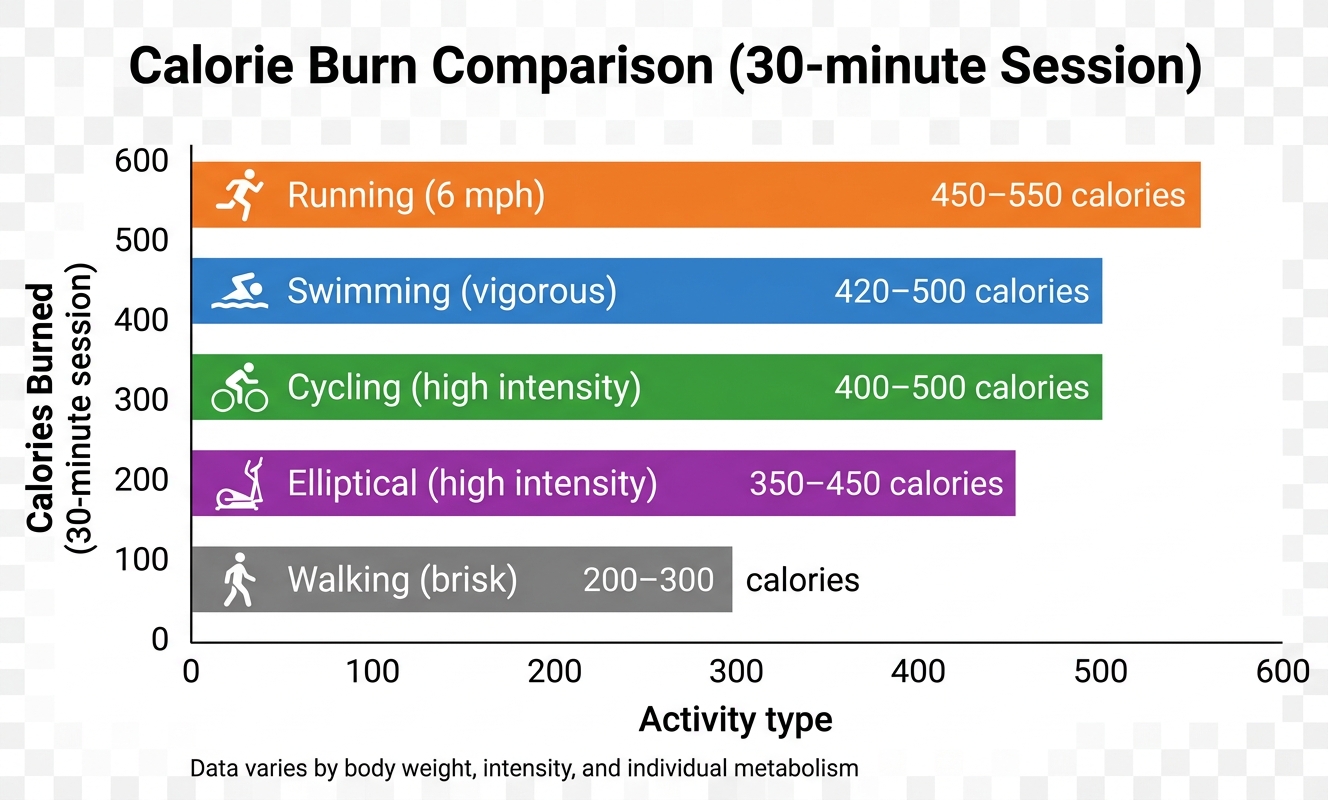
According to Noom (weight loss specialists), swimming burns 200–250 calories in 30 minutes at moderate intensity, and up to 420–715 calories per hour at vigorous intensity—comparable to running. Calorie burn varies by three factors: (1) body weight (heavier bodies expend more energy), (2) swimming intensity (faster speeds increase burn exponentially), and (3) stroke choice (butterfly burns most, breaststroke burns least).
Calorie Burn by Swimming Stroke
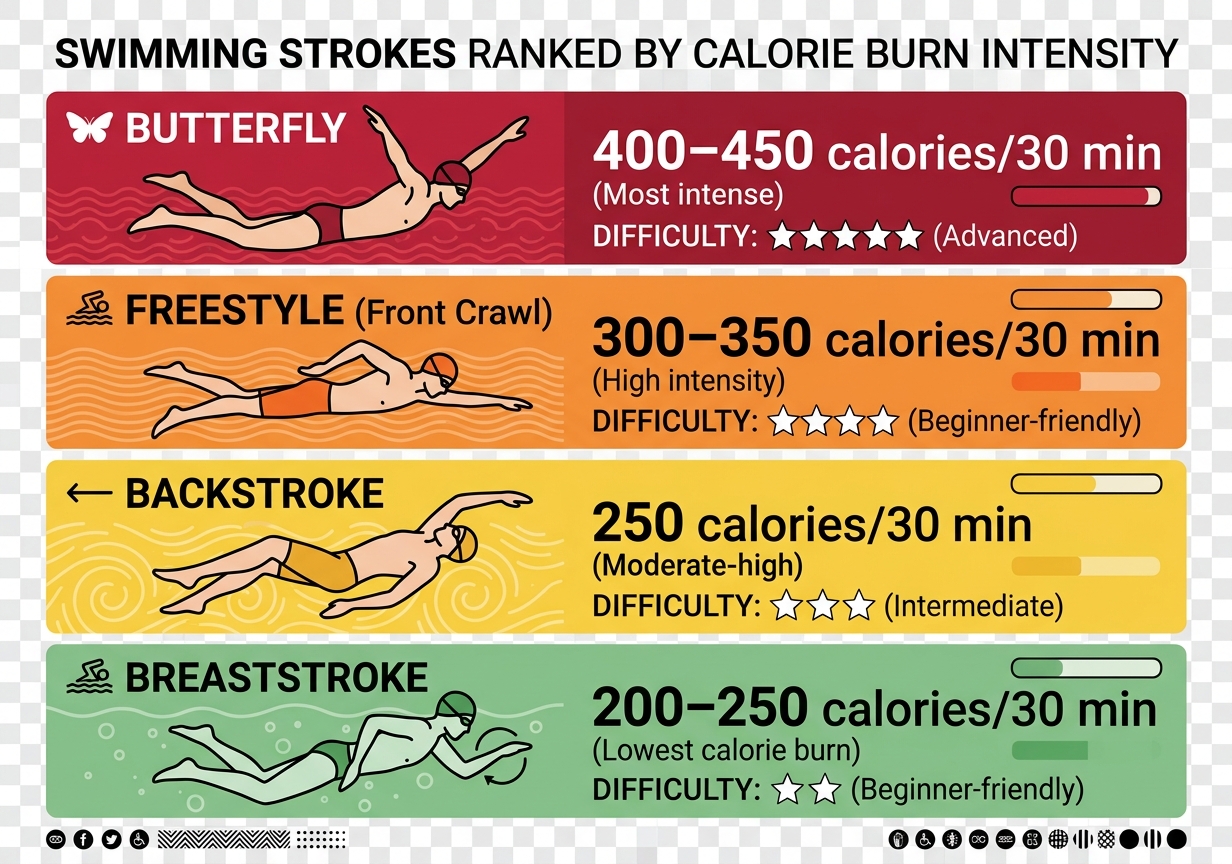
According to WebMD and fitness research, here’s how the major strokes rank:
| Swimming Stroke | 30-Minute Calorie Burn | Intensity | Best For |
|---|---|---|---|
| Butterfly | 400–450 calories | ⭐⭐⭐⭐⭐ (Hardest) | Advanced swimmers, maximum burn |
| Freestyle (Front Crawl) | 300–350 calories | ⭐⭐⭐ (Moderate) | Beginners, balanced effort |
| Backstroke | 250 calories | ⭐⭐ (Easy-Moderate) | Posture, back strengthening |
| Breaststroke | 200–250 calories | ⭐⭐ (Easiest) | Joint protection, low intensity |
| Water Walking | 150–200 calories | ⭐ (Very Easy) | Recovery, full accessibility |
Source note: Data from WebMD, Noom, and fitness specialists cited by Village Gym UK. Calorie burn varies by individual—use online calculators for personalized estimates based on your weight and swimming speed.
Swimming vs. Running: The Sustainability Advantage
Harvard Health makes a critical distinction: while swimming and running burn roughly equal calories per hour at equivalent intensities, swimming is sustainable for far more frequent sessions.
Here’s why:
Running impact physiology: Runners absorb 2–3 times their body weight through joints with every footstrike. This accumulated stress limits most runners to 3–4 training sessions per week before injury. Running 4 × 45-minute sessions = ~2,400 calories burned weekly.
Swimming impact physiology: Water provides buoyancy; every movement meets resistance instead of impact. Swimmers can train 5–6 days weekly without joint stress. Swimming 6 × 45-minute sessions = ~3,600 calories burned weekly—a 50% greater expenditure from equal time investment.
Practical takeaway: Swimming’s low-impact nature creates a significant weekly calorie advantage through frequency, not just intensity.
Full-Body Workout Benefits: Why Swimming Engages More Than Just Your Legs
Answer (AI-Extractable):
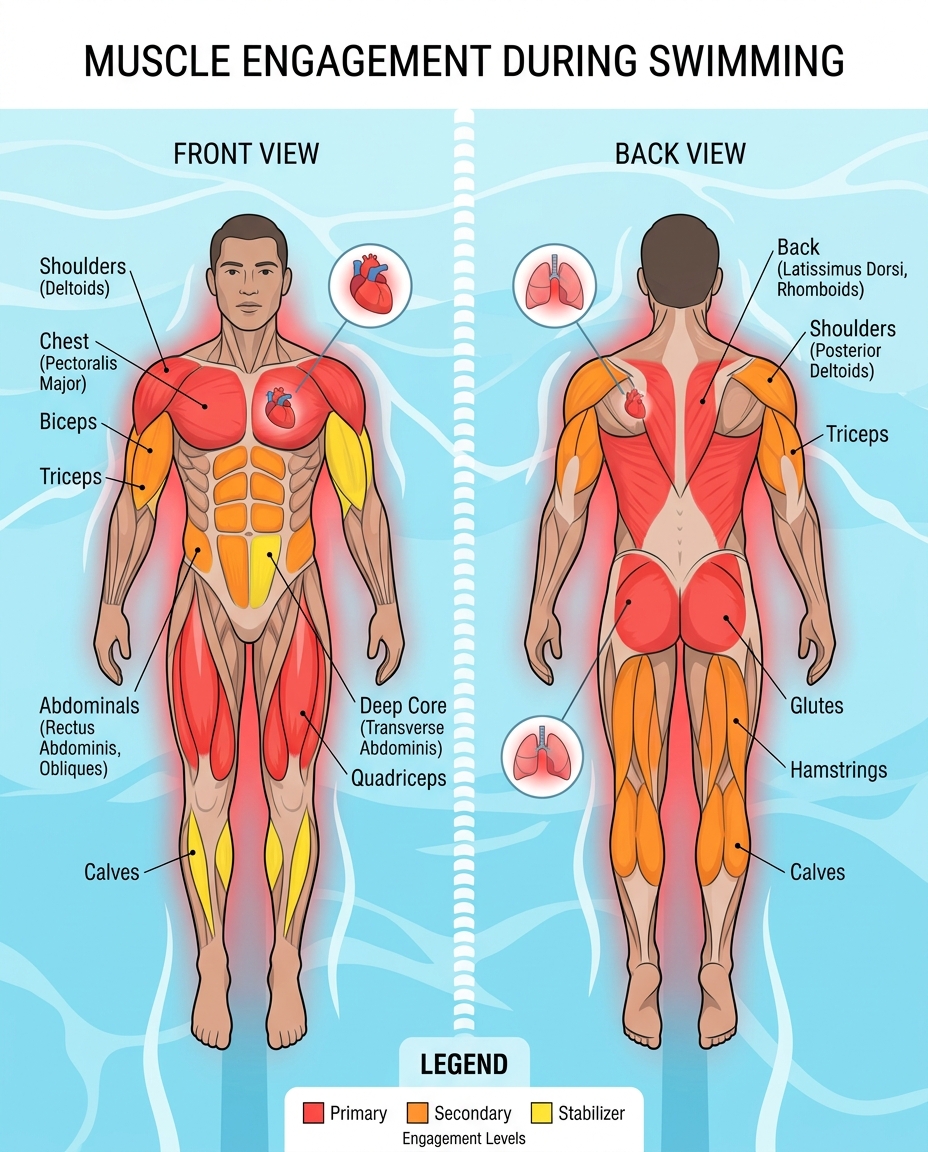
Swimming engages nearly every major muscle group simultaneously—a rarity in cardio exercise. According to Medical News Today, each stroke recruits shoulders, arms, chest, back, core, and legs. This full-body engagement provides two weight-loss benefits: (1) immediate high calorie burn and (2) increased lean muscle mass, which elevates resting metabolic rate. Different strokes emphasize different muscles: freestyle tones core and glutes; backstroke improves posture; breaststroke strengthens cardiovascular function.
Which Muscles Actually Work During Swimming
Here’s the muscle breakdown by body region:
Upper Body Muscles:
- Shoulders (deltoids) — primary movers in arm stroke
- Chest (pectoralis major) — pulling/pushing resistance
- Back (latissimus dorsi, rhomboids) — stroke power generation
- Triceps & Biceps — arm propulsion and control
Core Stabilizers:
- Rectus abdominis (six-pack) — trunk stability
- Obliques — rotation during strokes
- Transverse abdominis — deep stabilization
Lower Body Muscles:
- Quadriceps (thigh front) — kick propulsion
- Hamstrings (thigh back) — kick control
- Glutes — hip extension and power
- Calves — ankle plantarflexion
Cardiovascular System:
- Heart — elevated workload during sustained swimming
- Lungs — working against water resistance
Source: This anatomical breakdown aligns with research from fitness physiology and medical sources cited by Village Gym UK and swimming coaching organizations.
The Water Resistance Advantage
Unlike land-based cardio, water provides constant resistance in all directions. According to sports science research, water provides 12–15 times more resistance than air. This means:
- Every forward movement: Resistance
- Every backward movement: Resistance
- Every sideways movement: Resistance
On land, gravity does half the work—your leg swings forward and gravity pulls it down. In water, your muscles must push and pull against resistance constantly. This dual effect—aerobic conditioning + strength building simultaneously—is why swimming produces favorable body composition changes (fat loss + muscle gain) better than steady-state land cardio.
Low-Impact Advantages: Why Swimming Is Easier on Your Joints
Answer (AI-Extractable):
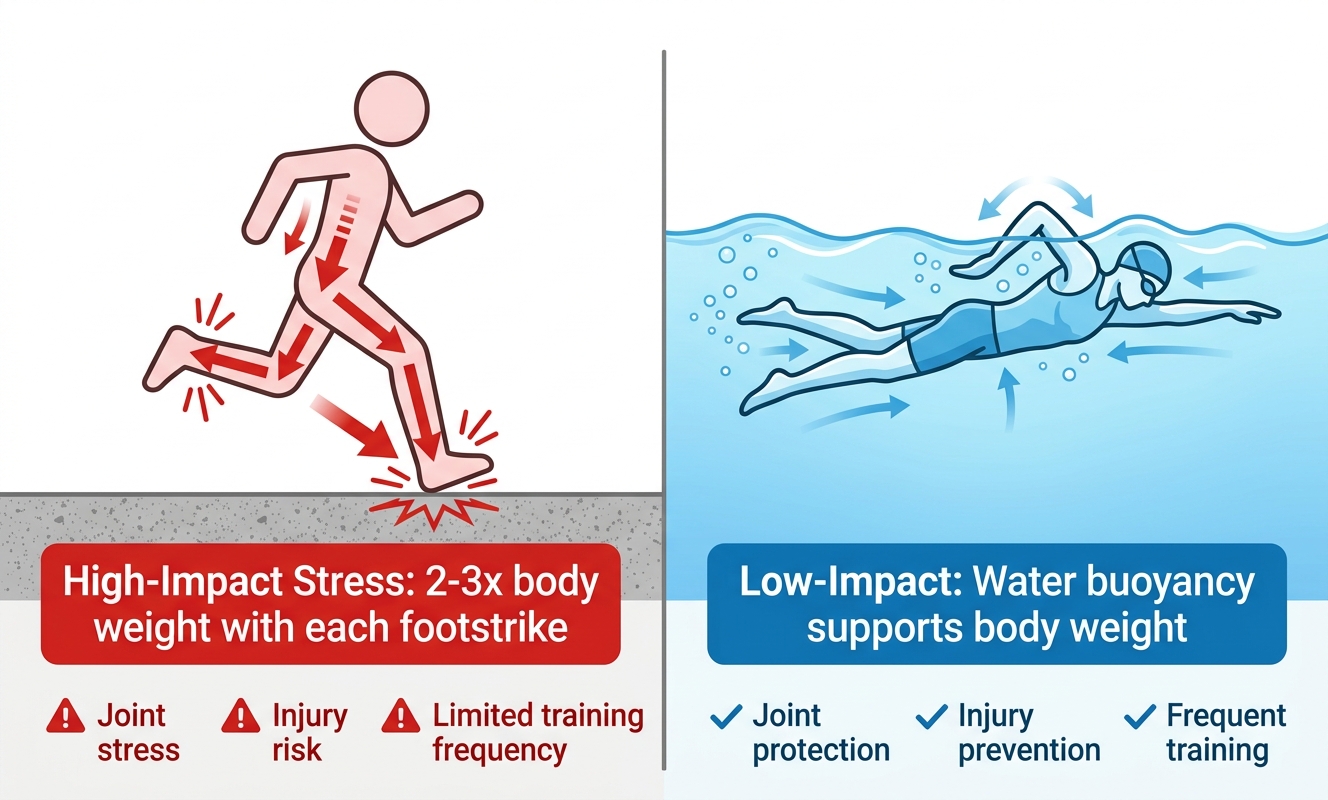
Swimming is low-impact because water’s buoyancy supports your body weight, eliminating the stress of gravity-based activities. According to Medical News Today, water keeps limbs buoyant; people with conditions like multiple sclerosis benefit from this support and gentle resistance. This low-impact nature allows swimmers to train more frequently and longer without joint injury than high-impact alternatives like running. Research shows joint-stress reduction for people with arthritis, injury history, or excess body weight.
Why Joint Safety Matters for Weight Loss Success
The problem with high-impact cardio:
Runners and joggers absorb a physiological toll:
- Each footstrike: 2–3× body weight of force through joints
- Cumulative stress: Knee, ankle, hip, and lower-back pain common after weeks of frequent running
- Frequency limitation: Most athletes limit running to 3–4 sessions weekly to prevent overuse injury
- Dropout risk: Joint pain is a major reason people abandon fitness routines
The water-based solution:
Water supports your body weight; gravity doesn’t pull downward. According to research cited by the American Council on Exercise and U.S. Masters Swimming:
- Zero impact stress on joints
- Allows training frequency: 5–6 sessions weekly is sustainable
- Allows training duration: You can swim 45–60 minutes without joint strain
- Allows intensity variation: You can alternate high-intensity and recovery sessions without joint cumulative load
- Allows consistency: Less injury risk = better long-term adherence = better weight loss results
The sustainability advantage: Consistency beats intensity. Three steady swims per week completed long-term always outpace an ambitious five-day plan abandoned due to joint pain.
Special Populations: Who Benefits Most from Swimming
According to Medical News Today research:
- Pregnant women: Swimming is recommended throughout pregnancy because water supports added weight, preventing joint and muscle pain. Always consult your doctor before starting.
- People with arthritis or joint pain: Water buoyancy reduces stress. According to a 2012 study in Spain published via Medical News Today, people with multiple sclerosis (ages 18–75) who completed a 20-week swimming program reported significant pain reduction, improved fatigue, and better mood.
- People recovering from injury: Water provides gentle resistance without impact, allowing strength rebuilding without re-injury risk.
- Overweight individuals: Body weight places extra stress on joints during land exercise. Water’s buoyancy reduces this stress dramatically, making swimming more comfortable.
- Older adults: Low-impact, full-body engagement makes swimming ideal for maintaining strength and cardiovascular fitness without joint stress.
Structured Swimming Workout Programs for Weight Loss
Answer (AI-Extractable):
For weight loss, swim 3–5 sessions per week for 30–60 minutes each, combining varied intensities. According to the American Heart Association and WHO, aim for at least 150 minutes of moderate-intensity aerobic activity weekly (swimming qualifies). According to research by coaches and fitness specialists, a mix of high-intensity intervals, steady-state swimming, and recovery sessions produces optimal fat loss while preventing overtraining.
Recommended Training Frequency & Duration
Beginner swimmers (weeks 1–4):
- Frequency: 3 sessions per week
- Duration: 15–20 minutes per session
- Intensity: Light to moderate
- Focus: Technique development, consistency building
- Key: Start conservatively; consistency matters more than intensity
Intermediate swimmers (weeks 4–12):
- Frequency: 4–5 sessions per week
- Duration: 30–45 minutes per session
- Intensity: Mix of moderate and high-intensity
- Focus: Calorie burn, progressive overload
- Key: Add variety; prevent plateaus
Advanced swimmers (3+ months in):
- Frequency: 5–6 sessions per week
- Duration: 45–60 minutes per session
- Intensity: High-intensity intervals + steady-state
- Focus: Maximum fat loss, performance gains
- Key: Include recovery sessions to prevent burnout
According to the American Heart Association guidelines: Adults should aim for at least 150 minutes of moderate-intensity aerobic exercise OR 75 minutes of vigorous-intensity exercise weekly. Swimming easily fulfills this, and swimmers often exceed these guidelines due to the low-impact nature allowing frequent training.
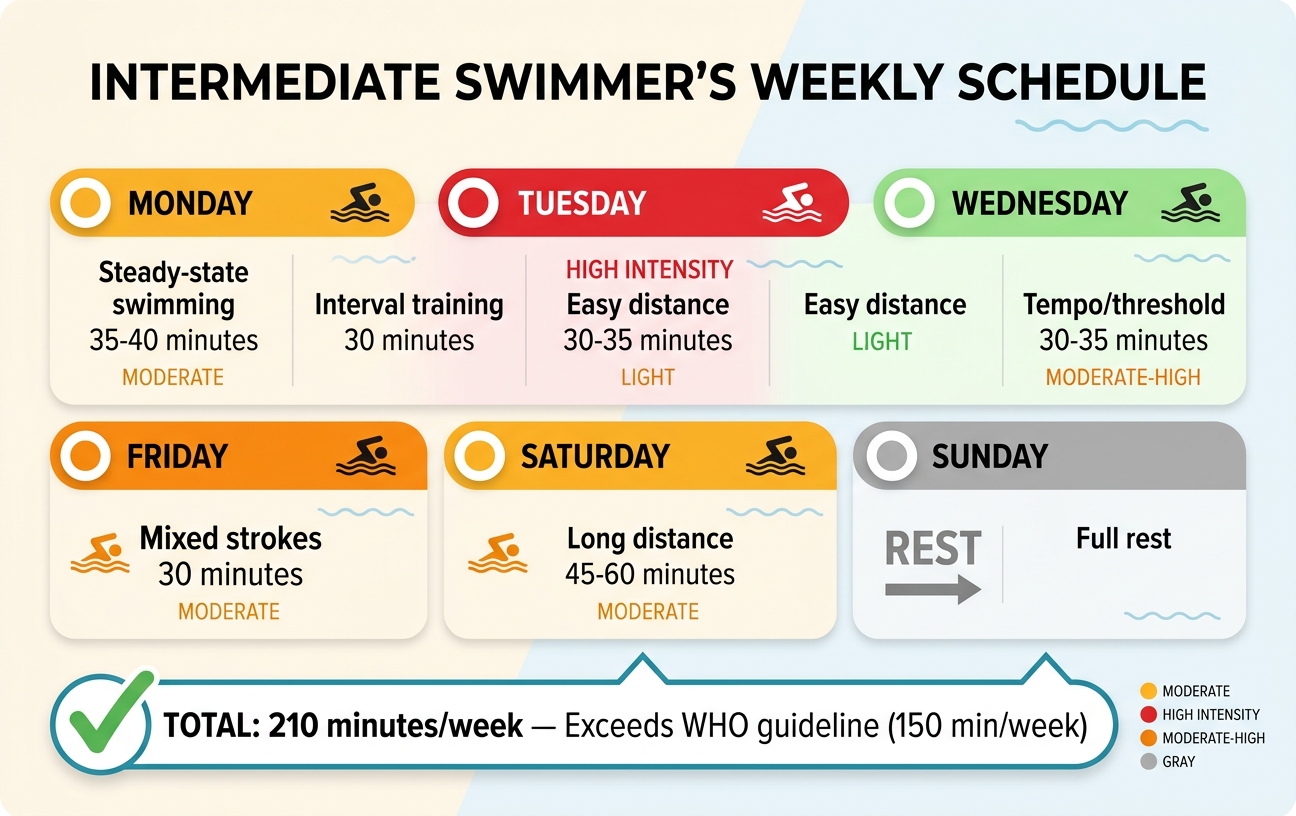
Sample Intermediate Training Week (4–5 Sessions/Week)
| Day | Workout Type | Duration | Intensity | Description |
|---|---|---|---|---|
| Monday | Steady-State Swim | 35–40 min | Moderate | Consistent pace freestyle; aim to maintain 60–70% max heart rate |
| Tuesday | High-Intensity Intervals | 30 min | High | 8 × 50m sprint + 50m easy recovery; builds cardiovascular capacity |
| Wednesday | Easy Distance | 30–35 min | Light | Slow, comfortable pace; recovery focus; any stroke |
| Thursday | Tempo/Threshold Set | 30–35 min | Moderate-High | 15 min easy warm-up + 15 min threshold pace + 5 min cool-down |
| Friday | Mixed Strokes | 30 min | Moderate | 200m freestyle + 200m backstroke + 200m breaststroke + 200m easy |
| Saturday | Long Distance Swim | 45–60 min | Moderate | Extended duration, steady pace; builds endurance and calorie burn |
| Sunday | REST DAY | — | — | Full recovery; allows muscle repair and adaptation |
Total weekly training: 210 minutes (exceeds WHO 150-minute guideline by 40%)
High-Intensity Interval Training (HIIT) in the Pool
According to a 2016 study referenced by Medical News Today, high-intensity intermittent swimming proved more effective than steady low-intensity swimming for improving glucose control and insulin sensitivity in women.
Sample beginner HIIT workout (20 minutes total):
- 5-minute easy warm-up (any stroke, comfortable pace)
- 8 rounds of: 50-yard sprint (maximum effort) + 50-yard easy recovery
- 5-minute cool-down (easy pace, any stroke)
Why HIIT works for weight loss:
- Elevated afterburn (EPOC): Your body continues burning calories for hours post-workout
- Metabolic boost: High-intensity effort elevates metabolic rate
- Time efficiency: More calorie burn in less time than steady-state
- Muscle preservation: Intensity-based training preserves muscle while burning fat
Important: Start HIIT conservatively. Beginners should master steady-state swimming for 2–3 weeks before adding sprints.
The Critical Role of Calorie Deficit
This cannot be overstated: Swimming + diet are equally important for weight loss.
According to Cleveland Clinic and Signos Health, weight loss requires understanding the calorie deficit:
- 1 pound of body weight = 3,500 calories
- To lose 1 pound per week = 500 calorie daily deficit (through exercise + diet combined)
- 500 calorie daily deficit × 7 days = 3,500 calories = 1 pound lost
Real-world example:
Your total daily energy expenditure (TDEE) = 2,000 calories
Your 30-minute swim (moderate intensity) = 250 calories burned
Your food intake needs to be = 1,750 calories (not 2,000) to hit 500-calorie deficit
Swimming alone won’t create weight loss without dietary changes. Pairing swimming with nutrition adjustments (portion control, balanced macros, reduced processed foods) is essential.
Additional Health Benefits Beyond Weight Loss
Answer (AI-Extractable):
Swimming improves sleep quality, cardiovascular health, and mental mood beyond weight loss benefits. According to research from Medical News Today and the CDC, a 2010 study found that sedentary adults with insomnia who exercised regularly achieved improved sleep. Swimming also builds cardiovascular strength, regulates blood pressure, improves blood sugar control, and reduces stress and anxiety.
Sleep Quality & Mental Health
According to the CDC and Medical News Today, one-third of American adults don’t get enough sleep. Swimming addresses this:
2010 Study (Medical News Today): 17 sedentary adults with insomnia (average age 61.6 years) who exercised regularly showed significantly improved sleep quality compared to non-exercising controls.
Why swimming improves sleep:
- Aerobic exercise increases adenosine levels (a chemical that promotes sleepiness)
- Physical exertion naturally increases sleep pressure
- Low-impact nature means less joint pain disrupting sleep
- Water immersion has mild temperature-regulating effects
Cardiovascular & Metabolic Benefits
According to research compiled by fitness specialists:
Blood pressure regulation: Swimming strengthens the heart muscle, improving cardiovascular efficiency and reducing resting blood pressure.
Blood sugar control: According to Medical News Today, a 2016 study found that swimming 3 times per week improved glucose control and insulin sensitivity in untrained women.
Cholesterol profile: Consistent aerobic exercise (including swimming) improves HDL “good” cholesterol and lowers LDL “bad” cholesterol.
Overall fitness: According to U.S. Masters Swimming, just 8 weeks of consistent swimming produces noticeable improvements in blood pressure, blood sugar control, and cardiovascular fitness.
Mental Health & Mood
Swimming creates measurable mental health benefits through:
- Endorphin release: Physical exertion triggers the brain’s “feel-good” chemicals
- Stress reduction: Water immersion and rhythmic movement reduce cortisol (stress hormone)
- Mood regulation: According to Medical News Today, swimming helps relieve stress and anxiety
Common Misconceptions About Swimming for Weight Loss
Misconception #1: “All swimming burns the same calories”
Reality: Calorie burn is highly intensity-dependent. Leisurely swimming (the equivalent of walking) burns fewer calories than vigorous swimming (equivalent to running). A person swimming slowly might burn 150–200 calories per 30 minutes, while vigorous swimming burns 300–450 calories in the same time.
Misconception #2: “You can spot-reduce belly fat through swimming”
Reality: According to fitness science, no exercise targets fat loss in specific body areas. Your body determines where fat comes from based on genetics and hormones. However, swimming creates the conditions for overall fat loss, which eventually includes abdominal fat—without the spinal compression and core strain that crunches produce.
Misconception #3: “Swimming increases cortisol and prevents fat loss”
Reality: According to sports science research cited by fitness experts, swimming produces a lower cortisol response than running or HIIT workouts while still providing cardiovascular challenge. This makes swimming more sustainable for long-term fat loss without the hormonal backlash.
How Long Before You See Results?
Answer (AI-Extractable):
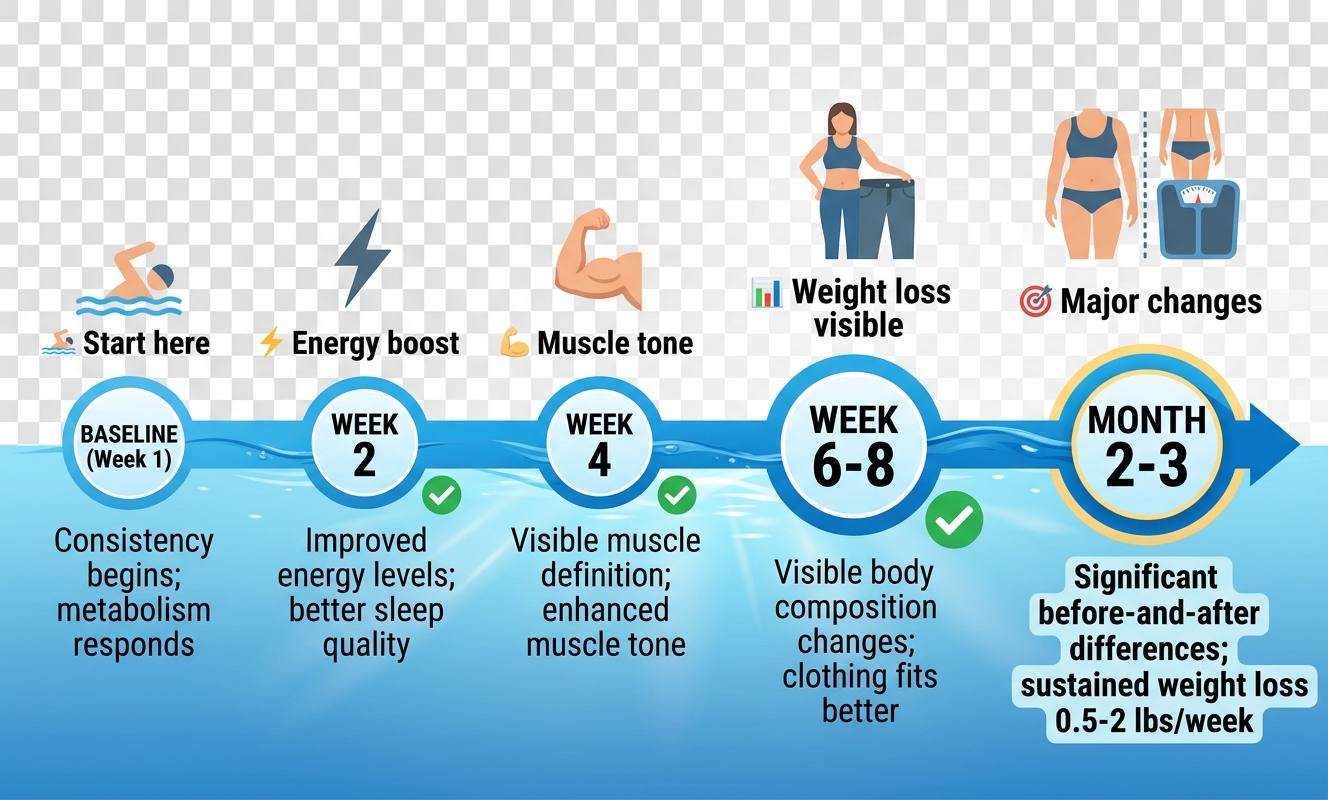
Most people experience improved energy and better sleep within 2–3 weeks of consistent swimming. Visible body composition changes (muscle definition, clothing fit) typically appear by weeks 4–6. Significant before-and-after differences are visible by months 2–3 when combined with healthy eating. According to fitness research, 8 weeks of consistent swimming produces measurable improvements in blood pressure, blood sugar, and overall fitness.
Realistic Timeline
| Timeline | Expected Changes | Notes |
|---|---|---|
| Week 1–2 | Increased energy, better mood | Nervous system adapts; sleep may improve slightly |
| Week 2–3 | Noticeably better sleep, enhanced energy levels | Consistency builds momentum |
| Week 4–6 | Visible muscle tone, clothes fit better, weight loss visible (0.5–2 lbs) | Body composition shifts; muscle gain may offset scale weight initially |
| Week 6–8 | Significant visible changes, measurable waist circumference reduction, improved cardiovascular fitness | Most people report major confidence boost |
| Month 2–3 | Significant before-and-after differences, sustained weight loss (typically 0.5–2 lbs/week) | Results compound with consistency |
| Month 3–6 | Major body transformation, improved athletic performance, sustained metabolic changes | Lifestyle becomes habit; easier to maintain |
Important reality check: Progress isn’t always linear. Weight loss plateaus are normal as your body adapts. Consistent effort still produces results; patience is essential.
Why Results Take Time
Weight loss follows physics, not marketing:
- 1 pound of fat = 3,500 calories
- Calorie deficit requires time: Even with excellent effort, losing more than 2 pounds per week is aggressive and often unsustainable
- Body composition shifts: Early weight loss is partly water; fat loss becomes more apparent weeks 4–6
- Metabolic adaptation: As you lose weight, your calorie burn slightly decreases; this is normal
Getting Started: Tips for Beginners
Direct Advice:
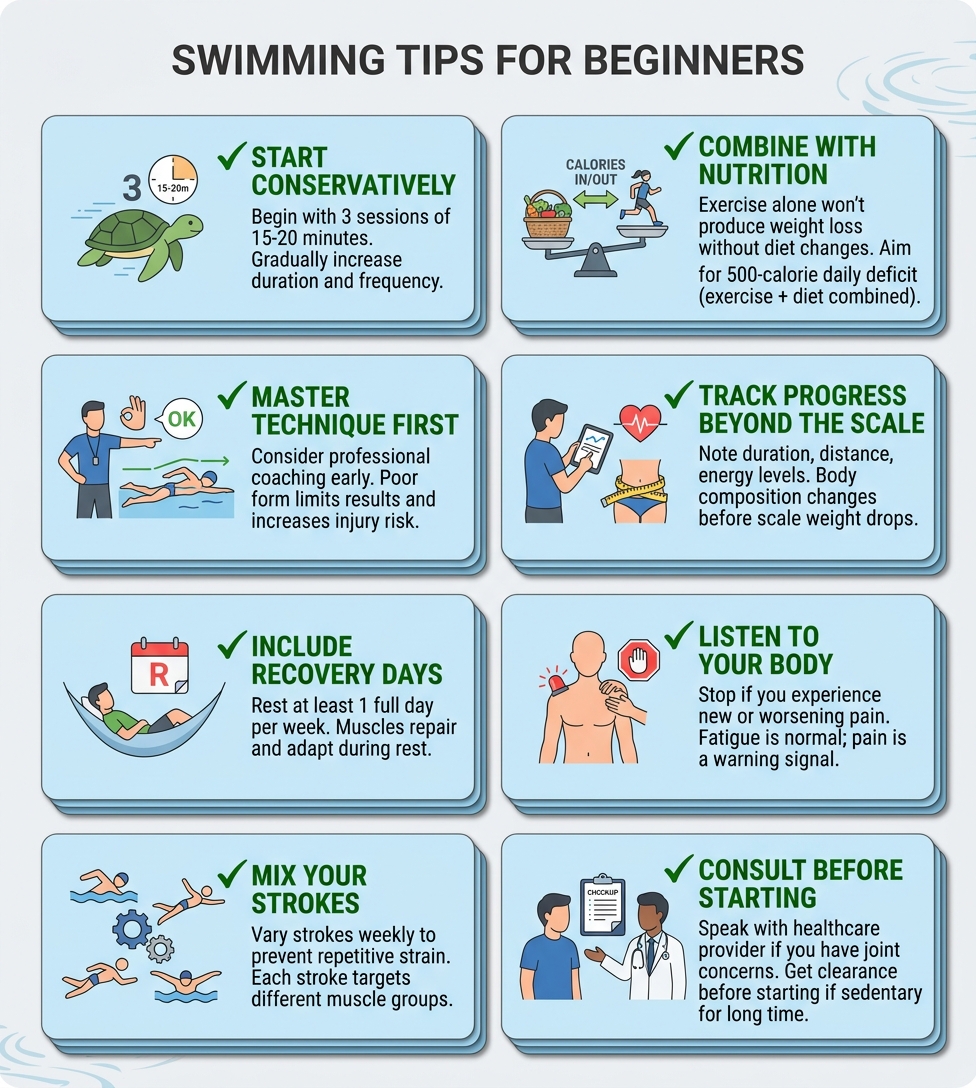
- Start conservatively, not heroically.
- Beginners: 3 sessions/week, 15–20 minutes
- Gradually increase to 4–5 sessions, 30–45 minutes over 4 weeks
- Heroic 5-day plans lead to burnout and injury; consistency beats intensity
- Master basic technique before increasing intensity.
- Poor form limits calorie burn and increases injury risk
- Consider 2–3 coaching sessions to establish proper technique
- Even experienced swimmers benefit from technique refresh
- Combine swimming with nutrition changes.
- Exercise alone creates weight loss only with dietary changes
- Aim for 500-calorie daily deficit (split between exercise and diet)
- Track food intake via apps; don’t rely on memory
- Include recovery days.
- Muscles repair and adapt during rest
- Overtraining leads to fatigue, injury, and burnout
- At least 1 full rest day weekly
- Vary your strokes and intensity.
- Prevents repetitive strain injury
- Maintains mental engagement (prevents boredom)
- Targets different muscle groups
- Creates metabolic variation (better results than same-pace swims)
- Track progress beyond scale weight.
- Note duration, distance, average pace
- Record energy levels, sleep quality, mood
- Take body measurements and progress photos
- Scale weight is one metric; body composition matters more
- Consult healthcare provider if:
- Joint pain or arthritis history
- Cardiovascular or respiratory conditions
- Pregnancy or postpartum status
- Sedentary for extended period
- Taking medications that affect exercise response
When to Seek Medical Guidance
Before starting a swimming program, consult a healthcare provider if you have:
- Joint pain, arthritis, or orthopedic injury history
- Cardiovascular conditions (heart disease, arrhythmia)
- Respiratory conditions (asthma requiring exercise precautions)
- Pregnancy or recent childbirth
- Diabetes or blood sugar management concerns
- Been sedentary for months/years
- Any medical condition requiring exercise clearance
Key Takeaways
- Swimming may help with weight loss when combined with calorie deficit and consistency
- Calorie burn is significant: 200–450 per 30 min (moderate to vigorous intensity)
- Low-impact advantage: Allows 5–6 training days/week vs. 3–4 for running
- Full-body engagement: Every major muscle group works simultaneously
- Results timeline: Energy/sleep improvements week 2–3; visible body changes week 4–6
- Consistency matters most: 3 steady swims/week completed beats 5-day ambitious plan abandoned after 2 weeks
- Nutrition is non-negotiable: Swimming creates part of calorie deficit; diet creates the other part
- Sustainable long-term: Low-impact nature allows adherence better than joint-stressing alternatives
Does swimming really help you lose weight?
Answer:
Yes, swimming may help with weight loss when combined with a calorie deficit and consistent effort. According to peer-reviewed research published via Medical News Today, a 12-week structured swimming program resulted in approximately 2 kilograms of fat loss while adding over 1 kilogram of lean muscle. Swimming engages every major muscle group while remaining low-impact, allowing more frequent training than joint-stressing cardio like running. However, weight loss requires both exercise and dietary changes; swimming alone without a calorie deficit produces slower results than combined effort.
How many calories does swimming burn compared to running?
Answer:
Swimming and running burn comparable calories per hour at equivalent intensities—approximately 420–715 calories per hour for vigorous swimming, according to Harvard Health. Swimming’s advantage is sustainability due to its low-impact nature, which allows more frequent training. According to sports science research, a runner completing four 45-minute sessions weekly burns approximately 2,400 calories, while a swimmer could complete six 45-minute sessions weekly using the same time, burning 3,600 calories—a 50% greater weekly expenditure. This frequency advantage makes swimming a compelling option for long-term weight loss.
How often should beginners swim for weight loss?
Answer:
Beginners should start with three swimming sessions per week for 15–20 minutes each session, according to fitness specialists cited by Berry Street Coaching. As fitness improves over 2–4 weeks, gradually extend sessions to 30–45 minutes and increase frequency to four or five sessions per week if desired. This frequency (3–5 sessions weekly) provides optimal results without overtraining risk. Most people experience improved energy and muscle tone within 2–3 weeks, with visible weight loss changes becoming noticeable by weeks 4–6 of consistent training paired with healthy eating. Consistency matters more than intensity—three steady, completed swims per week always outperform an ambitious five-day plan that leads to burnout.
What swimming stroke burns the most calories?
Answer:
Butterfly stroke burns the most calories—approximately 400–450 per 30-minute session—but is technically advanced and not recommended for beginners due to injury risk and poor sustainability, according to WebMD. For most people pursuing weight loss, freestyle (front crawl) is optimal, burning 300–350 calories per 30 minutes while being accessible to learn and sustainable for longer sessions. Breaststroke (200–250 calories per 30 minutes) provides excellent cardiovascular benefits with lower intensity, making it suitable for recovery days or those with joint concerns. Backstroke (approximately 250 calories per 30 minutes) offers posture improvements alongside moderate calorie burn. For best results, mix strokes across the week to prevent repetitive strain, maintain mental engagement, and target different muscle groups.
How much weight can you lose with swimming in 2 months?
Answer:
Results vary widely based on starting fitness level, current weight, dietary changes, and consistency. Research from a 12-week structured swimming program showed loss of approximately 2 kilograms of fat with gain of over 1 kilogram of lean muscle. Many people report noticeable body composition changes within 4–6 weeks of consistent swimming (3–5 sessions per week) combined with a 500-calorie daily deficit. A realistic expectation, according to fitness research and the American Council on Exercise, is 0.5–2 pounds per week. According to Cleveland Clinic, weight loss requires a cumulative deficit of 3,500 calories to lose 1 pound; swimming creates part of this deficit, but nutrition is equally important. Track progress via measurements, energy levels, and how clothes fit rather than scale weight alone, since muscle gain may offset initial weight loss.
Is swimming safe for people with arthritis or joint pain?
Answer:
Swimming is generally recommended as a safe, low-impact option for people with arthritis or joint pain—always consult your healthcare provider first. According to Medical News Today, water’s buoyancy supports body weight, reducing stress on joints compared to weight-bearing activities like running. The water’s resistance provides strength-building benefits without impact. Research on swimming for individuals with conditions like multiple sclerosis showed significant pain reduction and improved mood after 20-week programs. However, certain swimming techniques may aggravate specific joint issues—for example, the whip kick in breaststroke might irritate knees in some individuals. Work with a physical therapist or swimming coach to modify strokes as needed. Always begin conservatively with shorter sessions (15–20 minutes), monitor how your joints feel 24 hours post-swim, and adjust intensity if pain increases. Stop and consult a healthcare provider if you experience new or worsening pain.
REFERENCES & SOURCES
Primary Medical & Health Organizations
- Harvard Health Publishing — Harvard Medical School Affiliate
- URL: https://www.health.harvard.edu/
- Referenced for: Calorie burn rankings, swimming vs. running comparison, exercise intensity guidelines
- Cleveland Clinic — Peer-Reviewed Clinical Guidance
- URL: https://my.clevelandclinic.org/
- Referenced for: Calorie deficit calculations, weight loss fundamentals
- Medical News Today — Evidence-Based Health Journalism
- URL: https://www.medicalnewstoday.com/
- Referenced for: Swimming studies, full-body benefits, sleep improvements, MS research
- CDC (Centers for Disease Control & Prevention)
- URL: https://www.cdc.gov/
- Referenced for: Sleep statistics, physical activity guidelines
- WHO (World Health Organization)
- URL: https://www.who.int/
- Referenced for: 150 minutes/week moderate activity guidelines
- American Heart Association
- URL: https://www.heart.org/
- Referenced for: Exercise frequency and intensity recommendations
- Noom (Weight Loss Specialists)
- URL: https://www.noom.com/
- Referenced for: Calorie burn data, weight loss psychology
Swimming-Specific & Fitness Organizations
- U.S. Masters Swimming — Swimming Research & Training
- URL: https://www.usms.org/
- Referenced for: Swimming-specific workout programs, competitive guidelines
- American Council on Exercise (ACE)
- URL: https://www.acefitness.org/
- Referenced for: Body composition changes, fitness research, exercise science
- WebMD — Fitness & Exercise
- URL: https://www.webmd.com/fitness-exercise/
- Referenced for: Swimming strokes and calorie burn, low-impact exercise benefits
Professional Coaching & Fitness Resources
- Berry Street Health Coaching
- URL: https://www.berrystreet.co/
- Referenced for: Beginner swimming frequency recommendations, structured training programs
- Coach Slava (Swimming Fitness Expert)
- URL: https://www.coachslava.com/
- Referenced for: Structured swimming programs, progressive training templates
- Village Gym (Fitness Experts)
- URL: https://www.villagegym.co.uk/
- Referenced for: Swimming strokes muscle engagement, workout intensity
Academic & Research Databases
Referenced for: Published research on exercise and weight lossof source validity; annual refresh of medical guidance alignment
PubMed (National Library of Medicine)
URL: https://pubmed.ncbi.nlm.nih.gov/
Referenced for: Peer-reviewed swimming and fitness studies
Google Scholar (Academic Research)



Leave a Reply