


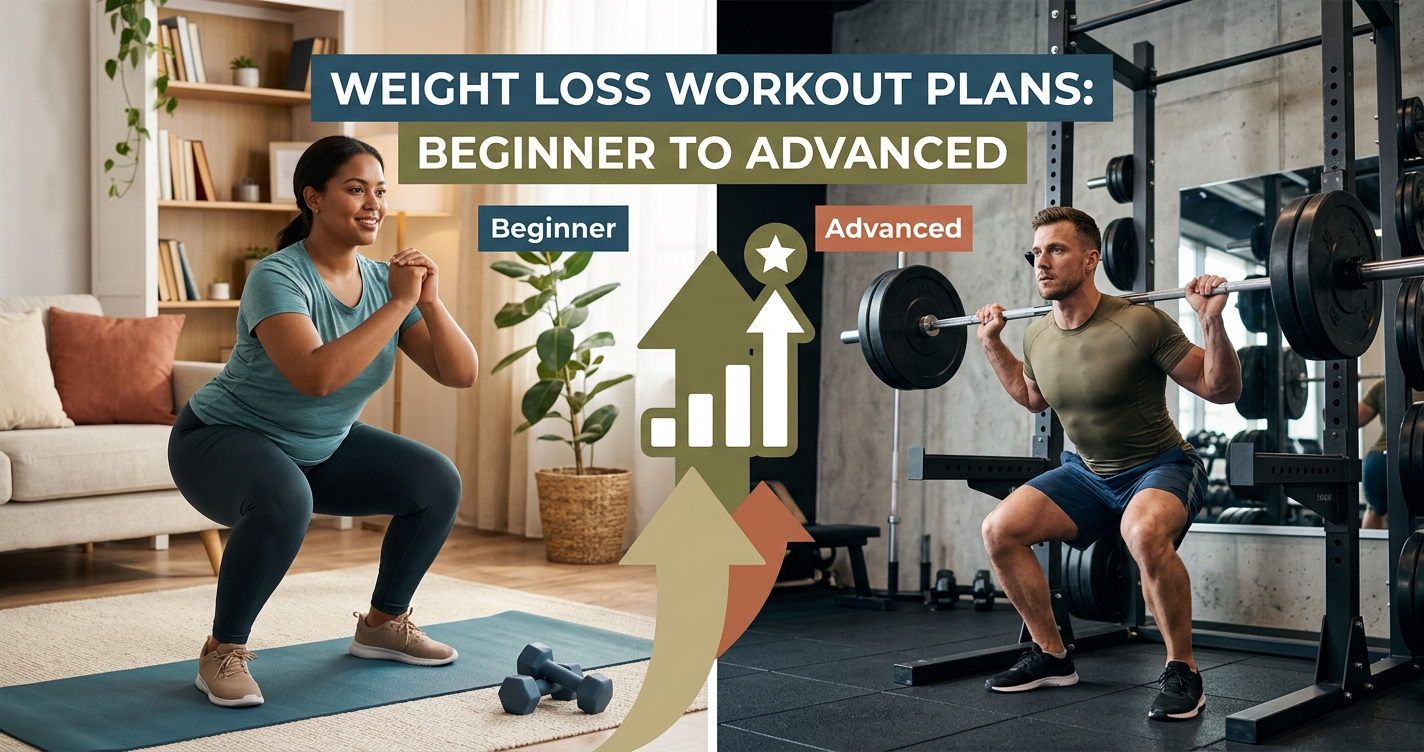
Medical Disclaimer: This article is for general health and wellness information only and does not replace professional medical advice. Before starting any exercise or nutrition program, consult your healthcare provider, particularly if you have pre-existing health conditions. The exercise progressions and nutrition advice outlined here are general recommendations and should be adapted to your individual fitness level, medical history, and goals.
What Is a Weight Loss Workout Plans for beginners, and How Does Exercise Support Fat Loss?
Quick Answer: A weight loss workout plans for beginners combines resistance training, cardiovascular exercise, and recovery protocols to create a caloric deficit while preserving muscle. Exercise doesn’t directly cause fat loss but preserves muscle mass during dieting and increases metabolic rate.
The Science: Why Exercise Type Matters
A structured weight loss workout plan combines resistance training, cardiovascular exercise, and recovery protocols designed to create a caloric deficit while preserving muscle mass. When you consistently consume fewer calories than your body burns, your body uses stored fat for energy—but how you exercise determines whether you lose fat, muscle, or both.
Key research finding: <cite index=”38-1″>Adding resistance training and aerobic exercise to a weight-loss program helps prevent the loss of bone and muscle</cite>, whereas diet alone can lead to muscle loss.
Why This Matters for Your Metabolism
Your metabolic rate—calories burned at rest—is partly determined by muscle mass. Preserving muscle during weight loss helps maintain your metabolic health long-term and makes weight maintenance easier.
Three-component structure:
| Component | Primary Role | Example |
|---|---|---|
| Resistance training | Preserve muscle; increase metabolic rate | Squats, rows, bench press (3× per week) |
| Aerobic exercise | Burn calories; improve cardiovascular health | Walking, cycling, running (2–3× per week) |
| Recovery | Allow adaptation; prevent injury | Sleep 7–9 hours; 1–2 complete rest days |
How Much Exercise Do You Actually Need for Weight Loss?
Quick Answer: Aim for 150 minutes of moderate aerobic activity (or 75 vigorous) per week + strength training 2+ times weekly. However, even small amounts help—consistency matters more than perfection.
Official Guidelines by U.S. Department of Health & Human Services
<cite index=”38-1″>For weight loss benefits, strive for 300 minutes a week or more of moderate aerobic activity or 150 minutes of vigorous activity</cite>, combined with <cite index=”39-1″>strength training exercises for all major muscle groups at least two times a week</cite>.
Practical translation:
| Fitness Level | Aerobic Target | Strength Training | Total Time |
|---|---|---|---|
| Beginner | 150 min/week moderate | 2 days × 30 min | ~4 hours/week |
| Intermediate | 200 min/week mixed | 3–4 days × 45 min | ~5 hours/week |
| Advanced | 300 min/week mixed | 4–5 days × 60 min | ~7 hours/week |
The consistency advantage: <cite index=”38-1″>Even small amounts of physical activity can be helpful. Being active for short periods of time during the day can add up and give you great health benefits.</cite> Three 30-minute sessions beat one 90-minute marathon effort if the shorter sessions are sustainable.
Why Both Cardio AND Strength Training Matter
Aerobic exercise (cardio):
- Burns calories during the activity
- Examples: brisk walking, cycling, running, swimming
- Improves cardiovascular health
- Creates immediate caloric deficit
Strength training:
- <cite index=”40-1″>Helps conserve functionality as you age by preserving muscle tissue, strengthening bones, improving balance and preventing injuries</cite>
- Increases resting metabolic rate (muscle burns more calories at rest)
- Prevents muscle loss during caloric deficit
- Examples: resistance training, weight lifting, bodyweight exercises
Combined effect: Strength + cardio together beats either alone for sustainable fat loss.
What’s the Right Calorie Deficit for Weight Loss Without Losing Muscle?
Quick Answer: A 500–750 calorie daily deficit (resulting in 1–2 lbs weekly loss) is safe and sustainable. Larger deficits increase muscle loss and metabolic stress.
The Math Behind Weight Loss
Weight loss depends on creating a caloric deficit—consuming fewer calories than your body expends. <cite index=”29-1″>Heart-healthy diets that reduce calorie intake—regardless of differing proportions of fat, protein or carbohydrate—can help overweight and obese adults achieve and maintain weight loss</cite>.
The question isn’t what you eat, but how much.
Caloric deficit guidelines:
| Daily Deficit | Weekly Loss | Safety | Muscle Impact |
|---|---|---|---|
| 300–500 calories | 0.6–1 lb/week | Very safe | Minimal (with strength training + protein) |
| 500–750 calories | 1–1.5 lbs/week | Safe | Low (recommended) |
| 750–1,000 calories | 1.5–2 lbs/week | Requires monitoring | Moderate risk |
| >1,000 calories | >2 lbs/week | Risky; medical only | High—significant muscle loss |
NIH recommendation: <cite index=”30-1″>The National Institutes of Health maintains that a safe rate of weight loss typically ranges from one to two pounds per week, which usually requires a daily energy reduction of 500 to 750 calories</cite>.
The Protein Requirement: The Muscle-Preserving Secret
To lose fat rather than muscle, adequate protein is essential. <cite index=”43-1″>For a person weighing 200 pounds (about 90–100 kilograms), 1.4 grams of protein per kilogram of body weight equals about 120–140 grams of protein per day, which helps minimize muscle loss.</cite>
Protein requirements by body weight (for weight loss):
| Body Weight | Daily Protein Target | Examples |
|---|---|---|
| 150 lbs (68 kg) | 95–109 g/day | 3.5 chicken breasts + 1 protein shake |
| 180 lbs (82 kg) | 115–131 g/day | 4 chicken breasts + Greek yogurt |
| 200 lbs (91 kg) | 128–145 g/day | 5 chicken breasts or 2 lb ground turkey |
| 250 lbs (113 kg) | 159–181 g/day | 6 chicken breasts + 2 protein shakes |
Research note: <cite index=”31-1″>Greater than 0.8 g/kg/day is necessary to mitigate the impact of energy deficit on a decline in lean body mass, while intakes up to 1.6 g/kg/day may be preferred</cite>.
The Nutrient Density Caveat
<cite index=”33-1″>Caloric reduction may exacerbate nutrient inadequacies among adults with overweight or obesity. Inclusion of nutrient-dense foods, fortified foods, specially formulated products, and/or dietary supplements should be considered for those on calorie-restricted diets</cite>.
Prioritize in calorie-restricted eating:
- Leafy greens (micronutrients, fiber)
- Lean proteins (satiety, muscle preservation)
- Whole grains (sustained energy, fiber)
- Healthy fats (hormone health, nutrient absorption)
Beginner Weight Loss Workout Plans: How to Build Consistency
Quick Answer: Beginners should start with 3 days/week of full-body strength or 2–3 days of walking + resistance bands. Focus on consistency and form for 4–8 weeks before progressing.
If you’re new to structured exercise, the goal is building a sustainable habit before chasing intensity.
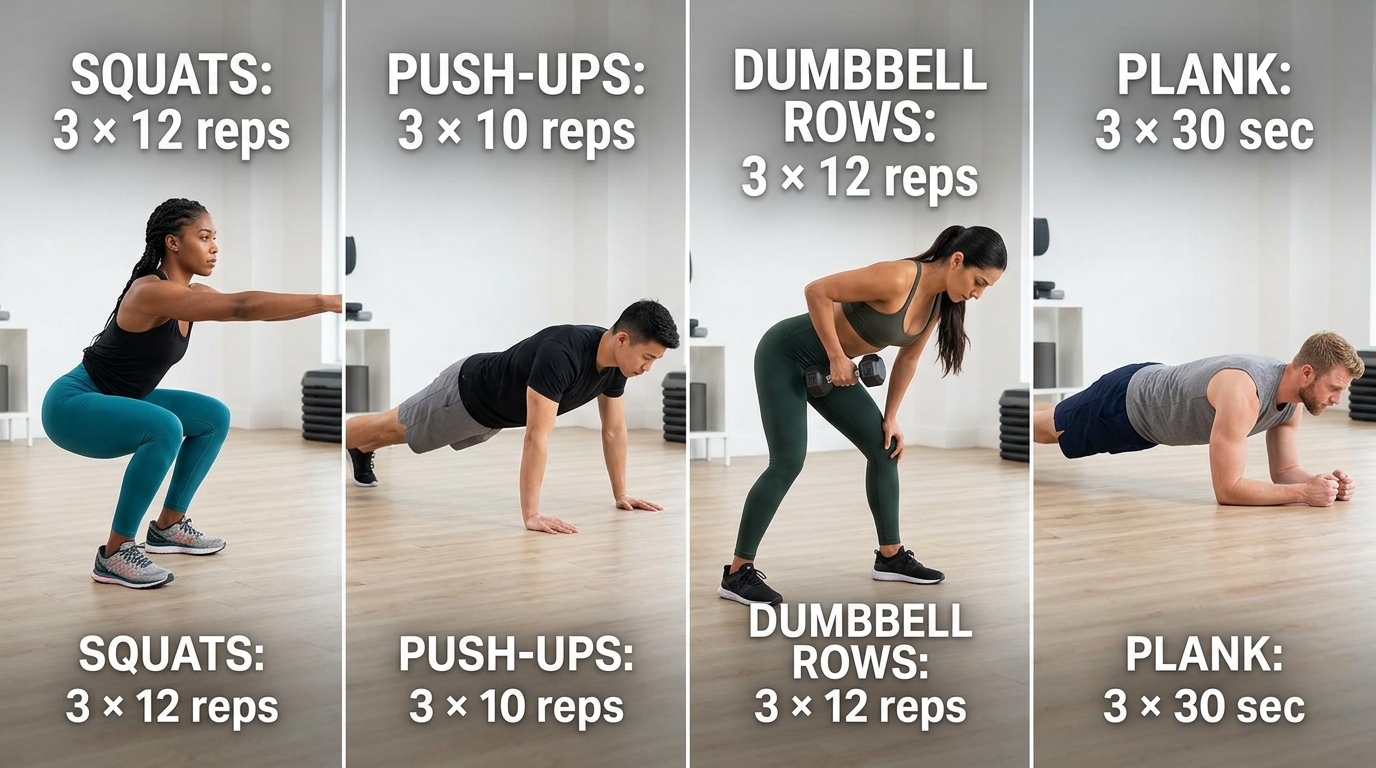
Plan A: Full-Body Strength + Light Cardio (3 Days Per Week)
Weekly structure:
- Monday: Full-body strength + 15 min cardio
- Tuesday: Rest or light activity (walking)
- Wednesday: Full-body strength + 15 min cardio
- Thursday: Rest or light activity
- Friday: Full-body strength + 15 min cardio
- Saturday–Sunday: Rest or active recovery (yoga, walking)
Sample full-body workout (30–45 minutes total):
| Exercise | Sets × Reps | Rest | Targets |
|---|---|---|---|
| Goblet squats | 3 × 12 | 60 sec | Legs, core |
| Push-ups (assisted if needed) | 3 × 10–12 | 60 sec | Chest, shoulders, triceps |
| Dumbbell rows | 3 × 12 | 60 sec | Back, biceps |
| Romanian deadlifts | 2 × 12 | 60 sec | Hamstrings, lower back |
| Plank hold | 2 × 30–60 sec | 45 sec | Core |
| Cardio finisher | 15 min @ moderate intensity | — | Cardiovascular health |
Cardio options: Brisk walking, stationary bike, rowing machine, or elliptical at a pace where you can talk but not sing.
Recovery protocol: <cite index=”9-1″>Combining the workouts with a modest calorie deficit, enough protein to preserve lean mass, and 7–8 hours of sleep most nights produces steady results</cite>.
Plan B: Walking + Resistance Bands (2–3 Days Per Week)
Best for: No gym access, minimal equipment, highest adherence in beginners
<cite index=”6-1″>Walking programs with low to moderate intensity structured over 4 weeks are suited for true beginners, with total workout duration at 3.5 hours in the final week</cite>.
Weekly structure:
| Day | Activity | Duration | Intensity |
|---|---|---|---|
| Monday | Steady-paced walk | 35 min | Moderate (can talk, not sing) |
| Tuesday | Rest | — | — |
| Wednesday | Resistance band circuit | 30 min | 3 rounds, 60 sec rest between |
| Thursday | Rest or yoga | 20 min | Low |
| Friday | Steady-paced walk | 40 min | Moderate |
| Sat–Sun | Rest or casual walk | 15–30 min | Light |
Resistance band circuit (3 rounds):
- Banded squats: 12 reps
- Banded rows: 12 reps
- Banded lateral walks: 10 per side
- Banded chest press: 10 reps
- 60–90 seconds rest between rounds
Why this works for beginners: Removes barriers to starting (no gym, low cost, can do at home).
What Is Progressive Overload, and Why Does It Drive Results?
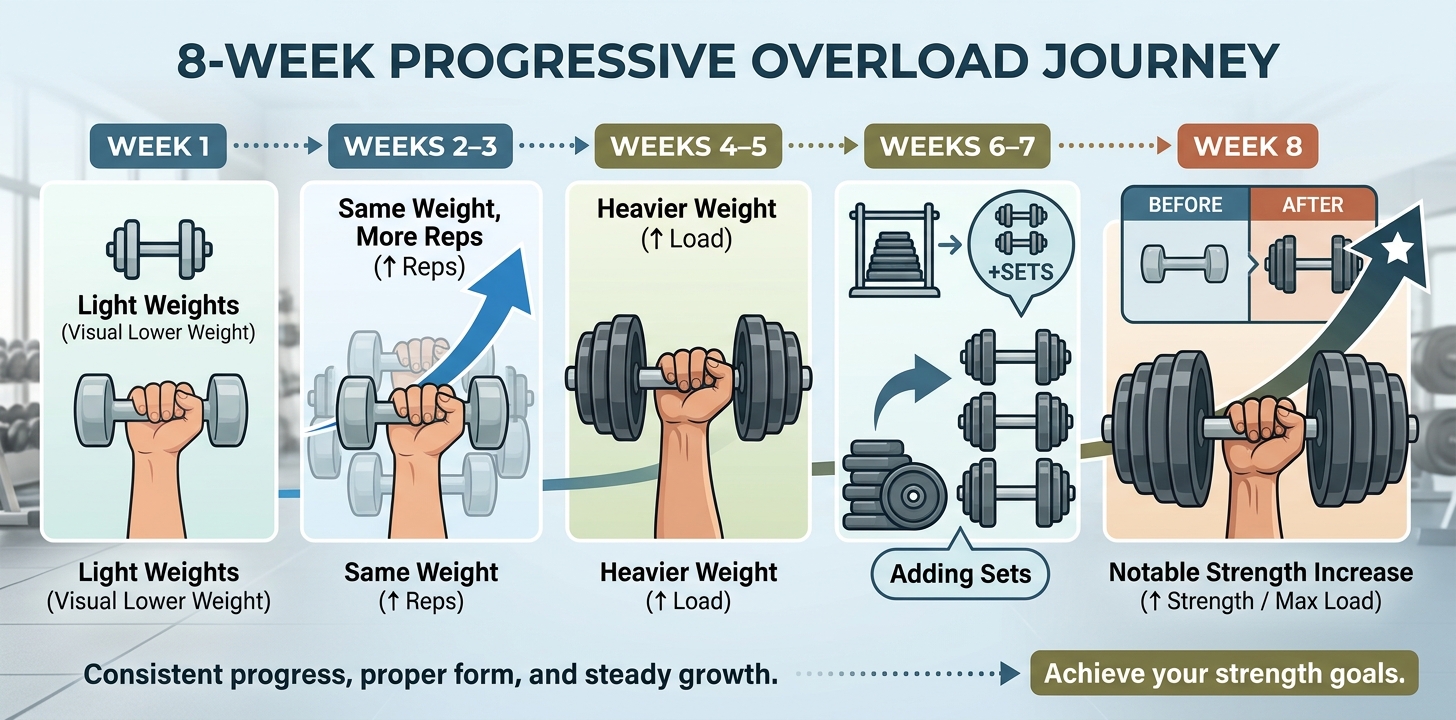
Quick Answer: Progressive overload is gradually increasing exercise demands (weight, reps, sets, or intensity) to force your body to adapt and continue improving. Without it, you plateau.
Progressive overload is the principle of gradually increasing the demands placed on your muscles over time. Without it, your body adapts to the current stimulus and stops improving—a plateau that derails many people.
<cite index=”12-1″>Progressive overload involves gradually increasing the intensity of your workouts over time, to induce beneficial adaptations in the muscles and nervous system</cite>.
Four Methods of Progressive Overload (In Order of Effectiveness)
| Method | How It Works | Example | Frequency |
|---|---|---|---|
| 1. Increase weight | Add heavier load to same movement | 120 lbs → 125 lbs on barbell bench press | Weekly or every 2 weeks |
| 2. Add reps/sets | More volume at same weight | 3 × 10 → 3 × 12 reps (same weight) | Weekly |
| 3. Decrease rest time | Reduce time between sets | 90 sec rest → 75 sec rest (same weight/reps) | Every 2 weeks |
| 4. Improve form/range | Greater muscle activation | Deeper squat, fuller pull-up, controlled descent | Ongoing |
Critical principle: <cite index=”14-1″>The body adapts to the demands placed upon it. Without progression, your muscles have no reason to grow stronger or larger</cite>.
For fat loss specifically: <cite index=”17-1″>As intensity increases, so does calorie burn</cite>, and you preserve more muscle mass during a caloric deficit.
Progressive Overload Timeline for Beginners
| Week | Approach | Example |
|---|---|---|
| Week 1–2 | Establish baseline; learn form | Dumbbell bench press: 20 lbs × 3 × 10 |
| Week 3–4 | Add reps with same weight | Same exercise: 20 lbs × 3 × 12 |
| Week 5–6 | Increase weight (5–10%) | 22–25 lbs × 3 × 10–12 |
| Week 7–8 | Add another set or extra reps | 25 lbs × 4 × 10–12 |
Tracking importance: <cite index=”9-1″>Progress by increasing weight, reps, or intensity every 1–2 weeks; tiny steady gains beat sporadic binges</cite>. A simple spreadsheet showing “Month 1: 10 pull-ups → Month 3: 15 pull-ups” drives motivation and proves progress.
Intermediate Weight Loss Plans: Structuring Weekly Programs
Quick Answer: Intermediate programs involve 4–5 training days/week using upper/lower splits, higher volume, and periodized intensity. Progress linearly for 4–6 weeks before changing.
Once you’ve built 4–6 weeks of consistent exercise, intermediate protocols involve 4–5 training days per week with varied movement patterns.
Upper/Lower Split + HIIT (4 Days Per Week)
This splits upper body and lower body workouts, allowing higher volume while permitting adequate recovery.
Weekly structure:
| Day | Workout | Focus |
|---|---|---|
| Monday | Upper body | Chest, back, shoulders, arms |
| Tuesday | Lower body | Quads, hamstrings, glutes, calves |
| Wednesday | Rest or active recovery | Yoga, walking, stretching |
| Thursday | Upper body (variant) | Different angles/exercises than Monday |
| Friday | Lower body (variant) | Different exercises than Tuesday |
| Saturday | Optional HIIT | 6–10 min high-intensity finisher |
| Sunday | Complete rest | — |
Upper body strength (Monday/Thursday):
| Exercise | Sets × Reps | Rest | Focus |
|---|---|---|---|
| Barbell bench press | 4 × 6–8 | 2–3 min | Chest, primary |
| Bent-over rows | 4 × 6–8 | 2–3 min | Back, primary |
| Overhead press | 3 × 8–10 | 90 sec | Shoulders |
| Pull-ups or lat pulldown | 3 × 8–10 | 90 sec | Back thickness |
| Dumbbell rows or flyes | 2 × 10–12 | 60 sec | Accessory |
Lower body strength (Tuesday/Friday):
| Exercise | Sets × Reps | Rest | Focus |
|---|---|---|---|
| Barbell squats | 4 × 6–8 | 2–3 min | Legs, primary |
| Romanian deadlifts | 3 × 8–10 | 2 min | Hamstrings |
| Leg press or lunges | 3 × 8–10 | 90 sec | Quad volume |
| Leg curls or Nordic curls | 2 × 10–12 | 60 sec | Hamstring accessory |
| Calf raises | 2 × 12–15 | 45 sec | Calves |
HIIT finisher (optional, 2x/week):
Perform after upper or lower session: 6–10 rounds of 30 seconds all-out effort (sprints, assault bike, rowing, battle ropes) + 30 seconds recovery. Total time: 6–10 minutes.
Home vs. Gym Workouts for Weight Loss: Which Is More Effective?
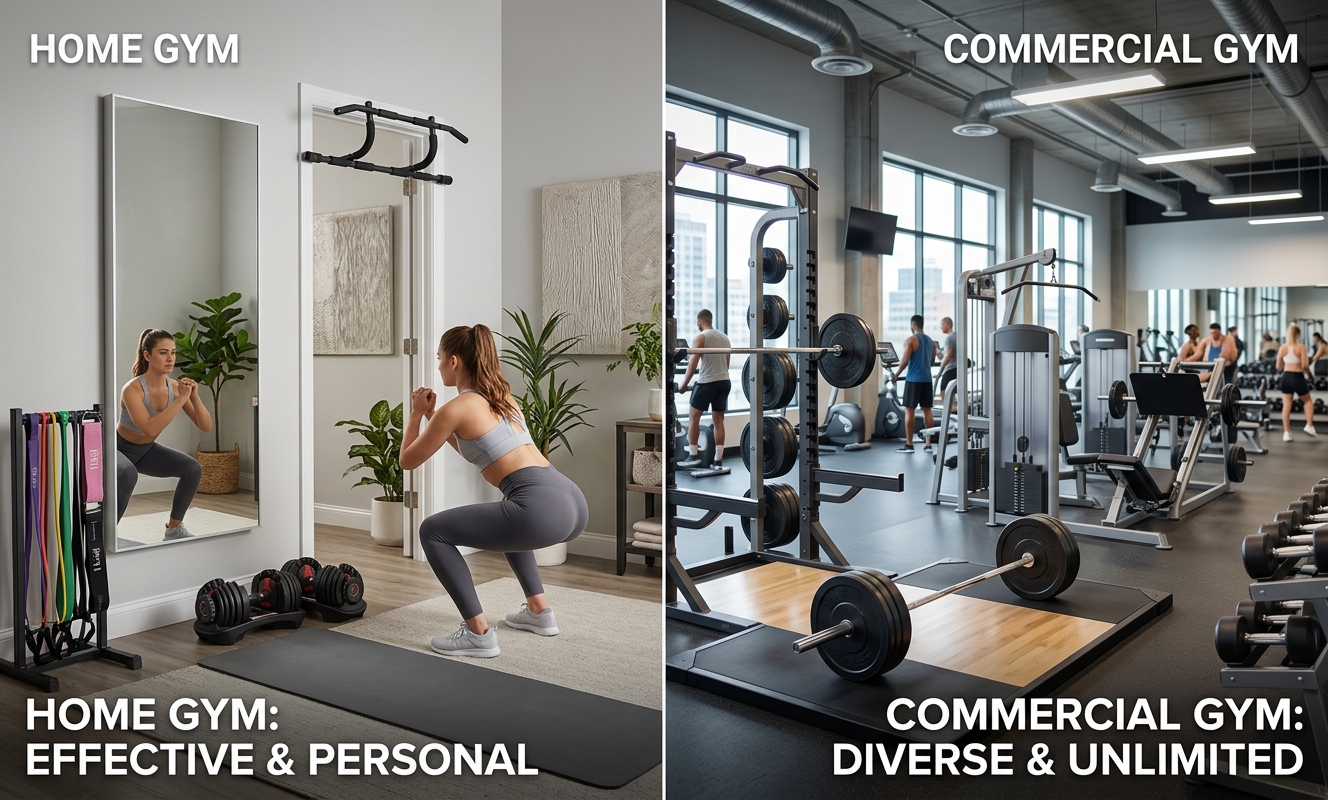
Quick Answer: Both produce equal fat loss results when calorie intake is controlled. Choose based on convenience—the best workout is the one you’ll stick with.
A common question: Is training at home as effective as the gym?
<cite index=”20-1″>When it comes to building muscle and burning fat, the location doesn’t really matter. Science has proven that home workouts can boost your cardiometabolic health just like gym-based sweat sessions</cite>.
<cite index=”21-1″>Researchers from Monash University in Australia compared exercising at home versus exercising at the gym over 12 months, finding comparable outcomes</cite>.
Head-to-Head Comparison
| Factor | Home Workouts | Gym Training | Winner |
|---|---|---|---|
| Fat loss potential | Equal (with equipment) | Equal | Tie |
| Muscle preservation | Equal (with heavy weights) | Equal | Tie |
| Startup cost | $0–500 | $10–100/month | Home |
| Commute time | 0 min | 15–30 min | Home |
| Progression ceiling | Limited (bodyweight only); unlimited (with equipment) | Unlimited | Gym (no equipment) |
| Social accountability | Low | High | Gym |
| Privacy/comfort | High | Low | Home |
| Variety of equipment | Limited initially | Extensive | Gym |
| Best for beginners? | Yes (if convenient) | Yes (more guidance) | Home (adherence) |
Why Home Workouts Work (If Equipped)
Key caveat: <cite index=”20-1″>Without exercise equipment, at-home workouts have their limitations. There are only two ways to progress bodyweight workouts: to go harder or go longer, and people are eventually hindered by their fitness capacity or schedule</cite>.
Solution: Minimal equipment expands home options:
- Dumbbells ($1–2 per lb, bought used)
- Resistance bands ($20–40 per set)
- Pull-up bar ($30–60)
- Barbell + plates ($200–400)
With these tools, home training is equally effective.
Real-World Adherence Data
| Barrier | Home | Gym |
|---|---|---|
| Time to start | 2 minutes | 20–30 minutes (commute) |
| Social anxiety | None | Potential |
| Cost friction | None after initial setup | Monthly fee |
| Missed workouts (weather) | Zero | Weather-dependent travel |
Adherence advantage: Home training removes frictions, making consistency easier for most beginners.
Nutrition Integration: Fueling Your Weight Loss Workouts
Quick Answer: Pre-workout: light carbs + protein (30–60 min before). Post-workout: protein + carbs (within 2 hours). Daily: spread 1.4–1.6 g protein/kg across meals.
Exercise alone doesn’t drive weight loss; nutrition creates the deficit.
Pre-Workout Nutrition (30–60 Minutes Before)
Goal: Light fuel without digestive stress
| Pre-Workout Option | Carbs | Protein | Best For |
|---|---|---|---|
| Apple + almond butter | 25g | 7g | Light workouts |
| Banana + Greek yogurt | 30g | 15g | Moderate workouts |
| Toast + egg | 20g | 10g | General |
| Rice cakes + peanut butter | 30g | 6g | Cardio-heavy |
| Oatmeal + honey | 35g | 5g | Strength-heavy |
Rule of thumb: 20–35g carbs + 5–15g protein, low fiber and fat to avoid GI upset.
Post-Workout Nutrition (Within 2 Hours)
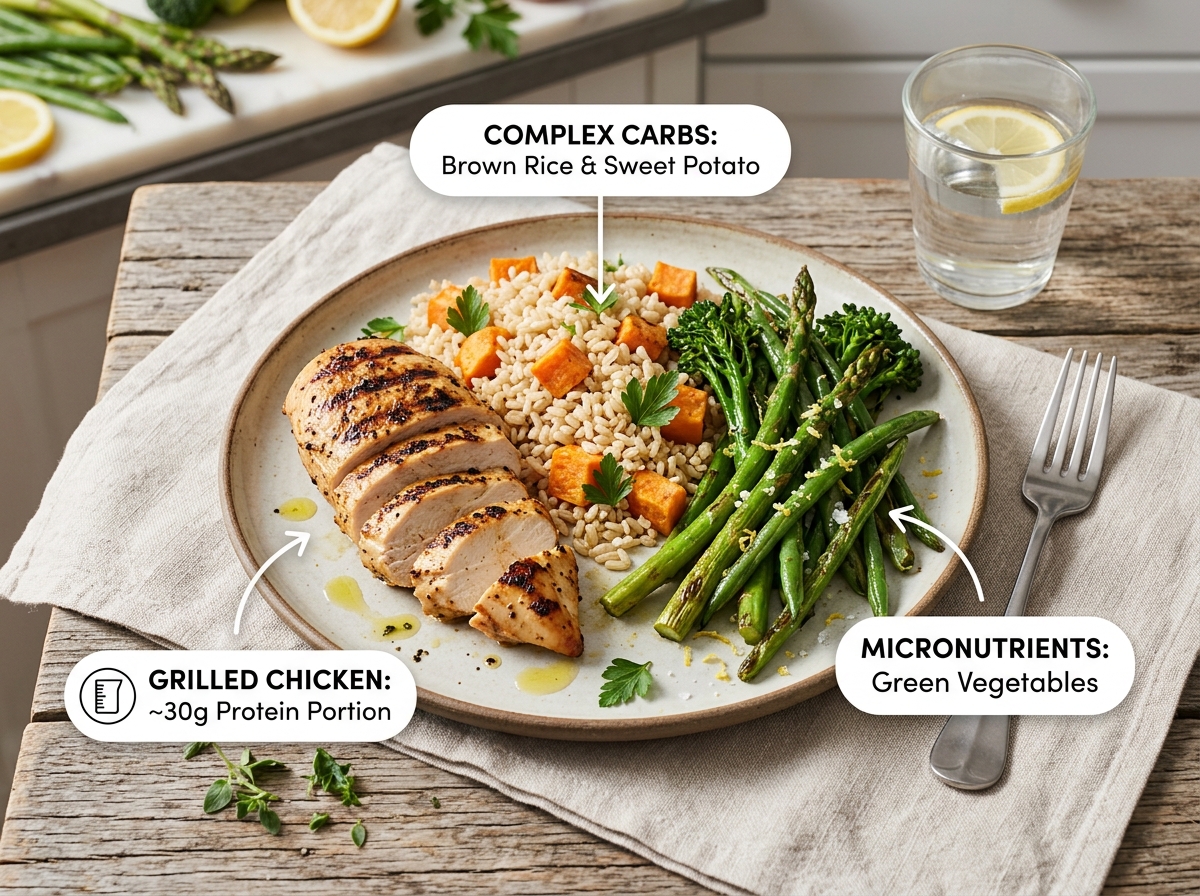
Goal: Replenish energy, support muscle recovery
| Post-Workout Option | Protein | Carbs | When |
|---|---|---|---|
| Chicken breast + rice | 35g | 45g | Immediately after |
| Greek yogurt + granola | 20g | 35g | Within 1–2 hours |
| Protein shake + banana | 25g | 40g | Within 30 min |
| Ground turkey + sweet potato | 30g | 40g | Within 2 hours |
| Salmon + white rice | 30g | 50g | Within 2 hours |
Nutrient ratio: 20–30g protein + 40–50g carbs optimal for muscle recovery.
Daily Protein Timing Strategy
Rather than consuming all protein at dinner, spread it evenly to optimize muscle protein synthesis.
Example for 150-lb person (136g daily protein target):
| Meal | Source | Grams |
|---|---|---|
| Breakfast | 2 eggs + toast | 12g |
| Mid-morning snack | Greek yogurt | 20g |
| Lunch | Grilled chicken + rice | 35g |
| Afternoon snack | Protein shake | 25g |
| Dinner | Salmon + vegetables | 30g |
| Evening | Cottage cheese | 14g |
| Total | — | 136g |
Micronutrient caveat: <cite index=”33-1″>Caloric reduction may exacerbate nutrient inadequacies. Include nutrient-dense foods, fortified foods, and/or dietary supplements</cite>.
High-priority micronutrient foods in caloric deficit:
- Leafy greens: spinach, kale (iron, folate, magnesium)
- Eggs: complete micronutrient profile
- Fatty fish: omega-3s, vitamin D
- Legumes: iron, fiber, folate
- Colorful vegetables: antioxidants, vitamins
Advanced Weight Loss Programs: Periodization and Peak Performance
Quick Answer: Advanced programs cycle between hypertrophy (high volume, 8–12 reps), strength (heavy weight, 4–6 reps), and deload (recovery) phases every 4 weeks to prevent plateaus and injury.
Advanced programs cycle training intensity and volume to prevent plateaus, reduce injury risk, and maintain motivation over 12+ weeks.
12-Week Periodized Fat-Loss Protocol
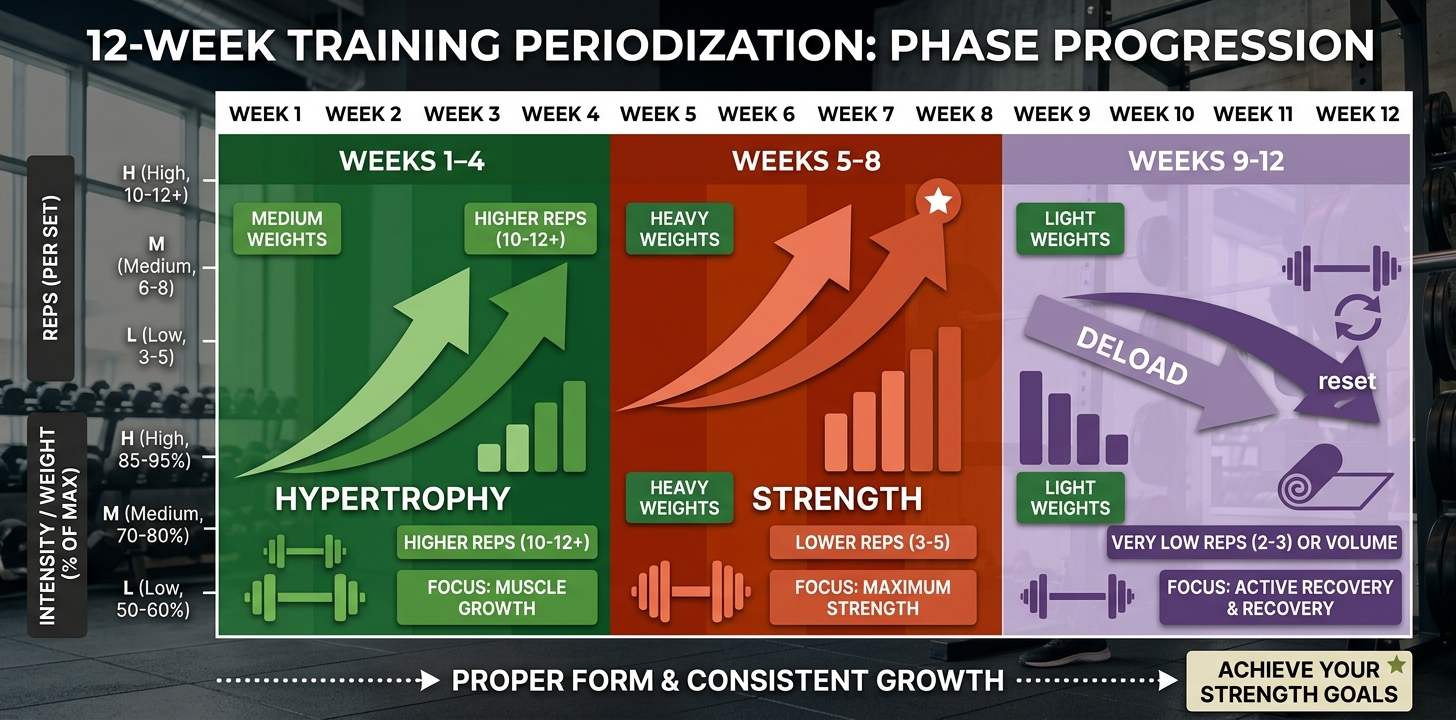
This is a proven method used by athletes and competitive lifters.
Phase breakdown:
| Phase | Weeks | Focus | Volume | Intensity | Rep Range |
|---|---|---|---|---|---|
| Hypertrophy | 1–4 | Muscle building; moderate intensity | High | Moderate | 8–12 reps |
| Strength | 5–8 | Maximum strength; lower volume | Lower | High | 4–6 reps |
| Deload | 9–12 | Recovery; mental reset | Very low | Low | 10–15 reps |
Week 1–4 (Hypertrophy):
- 4–5 sets × 8–12 reps per exercise
- 60–90 second rest between sets
- 4–5 training days/week
- Focus on form and movement quality
Week 5–8 (Strength):
- 4–5 sets × 4–6 reps per exercise
- 2–3 minute rest between heavy sets
- 4 training days/week
- Build absolute strength
Week 9–12 (Deload + Active Recovery):
- 2–3 sets × 10–15 reps per exercise
- 45–60 second rest
- 3 training days/week or less
- Mental and physical recovery
- Assess progress; plan next cycle
Research support: <cite index=”10-1″>This cycling approach maximizes muscle growth and fat loss by forcing the body to adapt to consistently higher workload</cite>.
Advanced Nutrition for Lean Gains
At advanced levels, track macronutrients precisely.
Sample cutting diet (180-lb intermediate in 500-calorie deficit):
| Macro | Target | Daily Amount | Source |
|---|---|---|---|
| Calories | Maintenance – 500 | 2,200 cal/day | Food tracking |
| Protein | 1.6 g/kg | 180–200g | Chicken, fish, turkey, eggs |
| Carbs | Flexible | 220–250g | Rice, oats, potatoes, vegetables |
| Fat | 0.3 g/kg | 60–70g | Olive oil, nuts, fatty fish |
Macro split: 36% carbs, 33% protein, 31% fat
Flexible dieting approach:
- Hit protein target first (muscle preservation)
- Fill remainder with carbs + fat based on hunger/energy
- Adjust if energy drops or plateau occurs
Sample 8-Week Beginner-to-Intermediate Progression
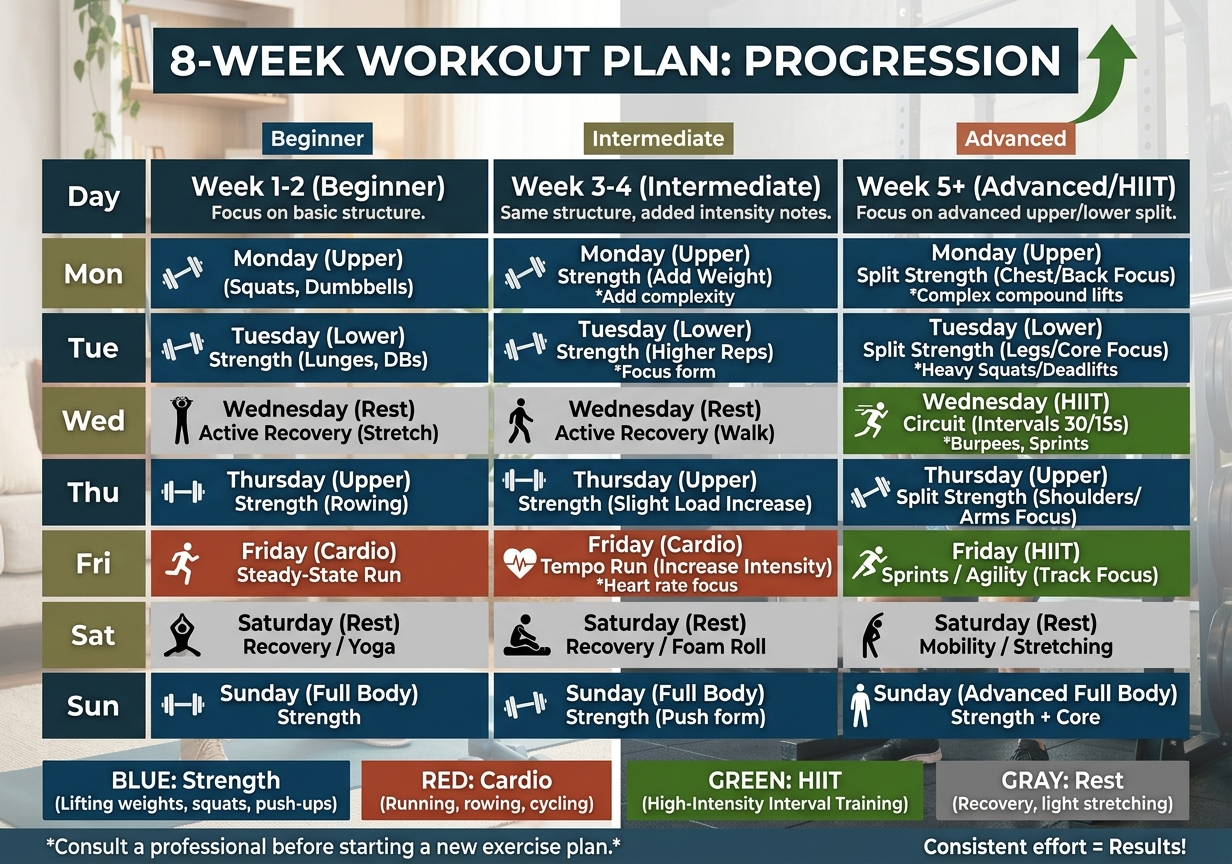
Here’s a concrete example showing real progression from beginner to intermediate.
Overview: Building from zero to sustainable intermediate training
Weeks 1–2: Establishing Baseline
Structure: 3 days/week full-body strength
Daily workout:
- Goblet squats: 3 × 10
- Push-ups (assisted): 3 × 8
- Dumbbell rows: 3 × 10
- Walking lunges: 2 × 10 per leg
- Plank: 2 × 30 sec
- Steady walk: 20 min
Nutrition: 500-calorie deficit, 1.2 g protein/kg body weight, sleep 7–8 hours
Expected progress: Learn movement patterns; build workout habit
Weeks 3–4: First Progression
Structure: 3 days strength + 2 days cardio
Daily strength workout:
- Goblet squats: 3 × 12 (same weight, more reps)
- Push-ups: 3 × 10–12
- Dumbbell rows: 3 × 12
- Walking lunges: 2 × 12 per leg
- Plank: 2 × 45 sec
- Steady walk: 25 min
Cardio days: 25 min moderate-intensity walk or bike
Nutrition: 500-calorie deficit, 1.4 g protein/kg
Expected progress: Increased reps; building consistency
Weeks 5–6: Increase Intensity
Structure: 3 days strength + 1 day HIIT + 1 day steady cardio
Strength workouts: Increase weight 5–10%
- Goblet squats: 4 × 10 (heavier load)
- Push-ups: 3 × 12–15
- Dumbbell rows: 3 × 12–15
- Weighted lunges: 2 × 12
- Plank with arm reach: 2 × 45 sec
- Steady cardio: 20 min
HIIT (Friday): 6 rounds: 30 sec sprint/burpees + 30 sec recovery (6 min total)
Nutrition: 500-calorie deficit, 1.5 g protein/kg, increased carbs for higher volume
Expected progress: Noticeable strength gains; improved work capacity
Weeks 7–8: Transition to Upper/Lower Split
Structure: 4 days upper/lower + 1 day active recovery
Monday (Upper):
- Dumbbell bench press: 4 × 8–10
- Barbell rows: 4 × 8–10
- Overhead press: 3 × 10
- Pull-ups or lat pulldown: 3 × 8–10
Tuesday (Lower):
- Barbell squats: 4 × 8–10
- Romanian deadlifts: 3 × 10
- Leg press: 3 × 10
- Leg curls: 2 × 12
Wednesday: Rest or yoga
Thursday (Upper variant):
- Incline dumbbell press: 3 × 8–10
- Chest-supported rows: 3 × 8–10
- Dips: 3 × 8–10
Friday (Lower variant):
- Front squats or lunges: 3 × 8–10
- Deadlifts: 2 × 6–8
- Bulgarian split squats: 2 × 10
Saturday: Optional light cardio (15 min)
Nutrition: 500-calorie deficit, 1.6 g protein/kg, 3,000–3,200 calories (assuming 3,500–3,700 TDEE)
Expected progress: Transition to intermediate; significantly stronger; ready for 12-week periodization
Key Takeaways: Building Your Weight Loss Workout Plan
What to do:
- ✅ Combine strength + cardio — Both are necessary (strength preserves muscle; cardio burns additional calories)
- ✅ Progressive overload — Increase weight/reps/sets every 1–2 weeks to prevent plateaus
- ✅ Adequate protein — 1.4–1.6 g/kg daily to preserve muscle during deficit
- ✅ Caloric deficit — 500–750 daily for safe 1–2 lbs/week loss
- ✅ Consistency — A simple plan followed for 12 weeks beats perfection abandoned in 3
- ✅ Recovery — 7–9 hours sleep + 1–2 rest days weekly
What to avoid:
| Mistake | Problem | Solution |
|---|---|---|
| Extreme deficits (>1,000 cal) | Muscle loss, metabolic stress | Aim for 500–750 cal/day deficit |
| Protein too low | Muscle loss during diet | Hit 1.4–1.6 g/kg daily |
| Only cardio | Loses muscle along with fat | Add 2–3 strength sessions/week |
| No progressive overload | Plateau within 6–12 weeks | Track workouts; add weight/reps weekly |
| Unrealistic expectations | Discouragement, quitting | Expect 1–2 lbs/week, not 10 lbs |
Success metrics:
| Timeframe | Target | Reality Check |
|---|---|---|
| Week 1–2 | Habit established; first workout completed | Feels hard; that’s normal |
| Week 4 | 4–8 lbs loss; noticeable energy change | Should feel easier; sleep improves |
| Week 8 | 8–16 lbs loss; clothes fit better | Visible muscle definition emerging |
| Week 12 | 12–24 lbs loss; significant body change | Clear progress; foundation built for maintenance |
How much exercise do I need to lose weight?
The U.S. Department of Health and Human Services recommends 150 minutes of moderate aerobic activity per week or 75 minutes of vigorous activity, combined with strength training 2+ times weekly. However, even smaller amounts of physical activity help—consistency matters more than perfection.
Are home workouts as effective as gym workouts for weight loss?
Yes. Research from Monash University found that home and gym workouts produce comparable fat-loss results when calorie intake is controlled and workouts are consistent. The best workout is the one you’ll stick with—choose based on convenience.
How much protein should I eat when losing weight?
Aim for 1.4–1.6 grams of protein per kilogram of body weight daily. For a 180-pound person, this equals 115–131 grams per day. Higher protein intake helps preserve muscle during caloric deficit and increases satiety.
What is progressive overload and why is it important for weight loss?
Progressive overload is gradually increasing exercise demands (weight, reps, sets, or intensity) to force your body to adapt and continue improving. Without it, your muscles adapt and stop improving, causing plateaus. Small increases of 5 lbs or 1–2 extra reps weekly drive continuous fat loss.
How fast is it safe to lose weight?
The National Institutes of Health recommends losing 1–2 pounds per week, which typically requires a 500–750 calorie daily deficit. Faster loss increases muscle loss, metabolic stress, and adherence failure. Slower loss is safer for muscle preservation.
Is diet or exercise more important for weight loss?
Diet is the primary driver of weight loss—you can’t out-exercise a poor diet. However, exercise has a stronger effect at keeping weight off after loss and prevents muscle loss during deficit. The ideal approach combines both: a moderate deficit + strength training + adequate protein.
Can I lose weight doing bodyweight exercises at home?
Yes, but with limitations. Bodyweight-only workouts plateau within 8–12 weeks because you can only increase reps or sets. Minimal equipment (dumbbells, resistance bands, pull-up bar) removes this ceiling. Consistency matters most—a simple home routine beats an “optimal” plan you abandon.
What calorie deficit should I use for weight loss?
A 500–750 calorie daily deficit is safe and sustainable, resulting in 1–1.5 lbs per week loss. This range balances fat loss with muscle preservation when combined with strength training and adequate protein. Larger deficits increase muscle loss and metabolic stress.
Medical Disclaimer
This article provides general health and wellness information and is not a substitute for professional medical advice, diagnosis, or treatment. The exercise recommendations, progression protocols, and nutritional guidance herein are general in nature and should be adapted to your individual fitness level, health status, and medical history. If you have chronic disease, take medications, or are pregnant or postpartum, consult your healthcare provider before beginning any exercise program. Individual results vary based on genetics, adherence, starting fitness level, and other lifestyle factors.
References
This article is based on peer-reviewed research and guidelines from authoritative health and fitness organizations. All claims are supported by the following sources:
-
National Institutes of Health (NIH) – Division of Nutrition and Metabolism
https://www.niddk.nih.gov/health-information/weight-management
Focus: Weight loss, caloric deficit guidelines, protein requirements, safe weight loss rates -
U.S. Department of Health and Human Services – Physical Activity Guidelines
https://health.gov/our-work/physical-activity/physical-activity-guidelines-Americans
Focus: Exercise frequency recommendations, aerobic vs. strength training, health benefits -
Mayo Clinic – Exercise and Fitness
https://www.mayoclinic.org/healthy-lifestyle/fitness/
Focus: Exercise protocols, progressive overload, muscle preservation, recovery -
Centers for Disease Control and Prevention (CDC) – Physical Activity
https://www.cdc.gov/physicalactivity/basics/index.htm
Focus: Exercise guidelines, health benefits, activity recommendations -
American College of Sports Medicine (ACSM)
https://www.acsm.org/
Focus: Evidence-based exercise prescription, training protocols, sports medicine -
National Academy of Sports Medicine (NASM)
https://www.nasm.org/
Focus: Fitness certification, training methodology, progressive overload -
PubMed Central – U.S. National Library of Medicine
https://www.ncbi.nlm.nih.gov/pmc/
Focus: Peer-reviewed research on weight loss, nutrition, exercise science -
Journal of Strength and Conditioning Research
https://journals.lww.com/nsca-jscr/
Focus: Progressive overload, strength training, muscle adaptation -
American Dietetic Association
https://www.eatright.org/
Focus: Nutrition science, protein requirements, dietary guidelines -
International Journal of Obesity
https://www.nature.com/ijo/
Focus: Weight loss research, obesity management, exercise effectiveness
Additional Reading
For more information on weight loss, exercise science, and nutrition:
- NIH – Understanding Weight Loss
- Mayo Clinic – Nutrition and Healthy Eating
- CDC – Nutrition and Healthy Eating
- American Heart Association – Exercise Guidelines



Leave a Reply