



Medical Disclaimer: This article provides wellness information for general audiences and is not a substitute for professional medical advice. Before starting any new exercise program, especially if you have underlying health conditions, consult a healthcare provider. Yoga alone is not a weight-loss “cure”—it works best combined with balanced nutrition and mindful eating habits.
Is Yoga Good for Weight Loss?
Yes. Yoga supports sustainable weight loss when combined with balanced nutrition. It works through four key mechanisms: calorie burn (especially dynamic styles), stress hormone reduction, improved eating awareness, and increased lean muscle mass.
Research Evidence: A large public health study of 15,550 adults aged 53 to 57 found that practicing yoga for four or more years was associated with a 3-lb lower weight gain among normal-weight participants and an 18.5-lb lower weight gain among overweight subjects. Over a decade, regular yoga practitioners gained approximately 8.5 lbs less than non-practitioners.
Why Yoga Works: Four-Factor Mechanism
1. Calorie Burn — Dynamic styles like Vinyasa (350–600 cal/hour) and Power yoga (400–700+ cal/hour) elevate your heart rate and metabolic demand.
2. Stress Hormone Reduction — Chronic stress elevates cortisol, linked to belly fat storage and increased appetite. Yoga’s breathing and mindfulness practices lower cortisol, making weight loss easier over time.
3. Mindfulness & Eating Awareness — Studies show regular yoga practitioners become more mindful eaters, naturally choosing healthier foods and recognizing true hunger signals.
4. Lean Muscle Building — Yoga poses demand you support your body weight, building muscle tissue that increases resting metabolic rate—you burn more calories even at rest.
Unlike high-intensity exercise that many people abandon, yoga builds sustainable habits. This is why the 10-year study showed consistent, long-term weight management rather than rapid loss.
How Many Calories Does Yoga Burn?
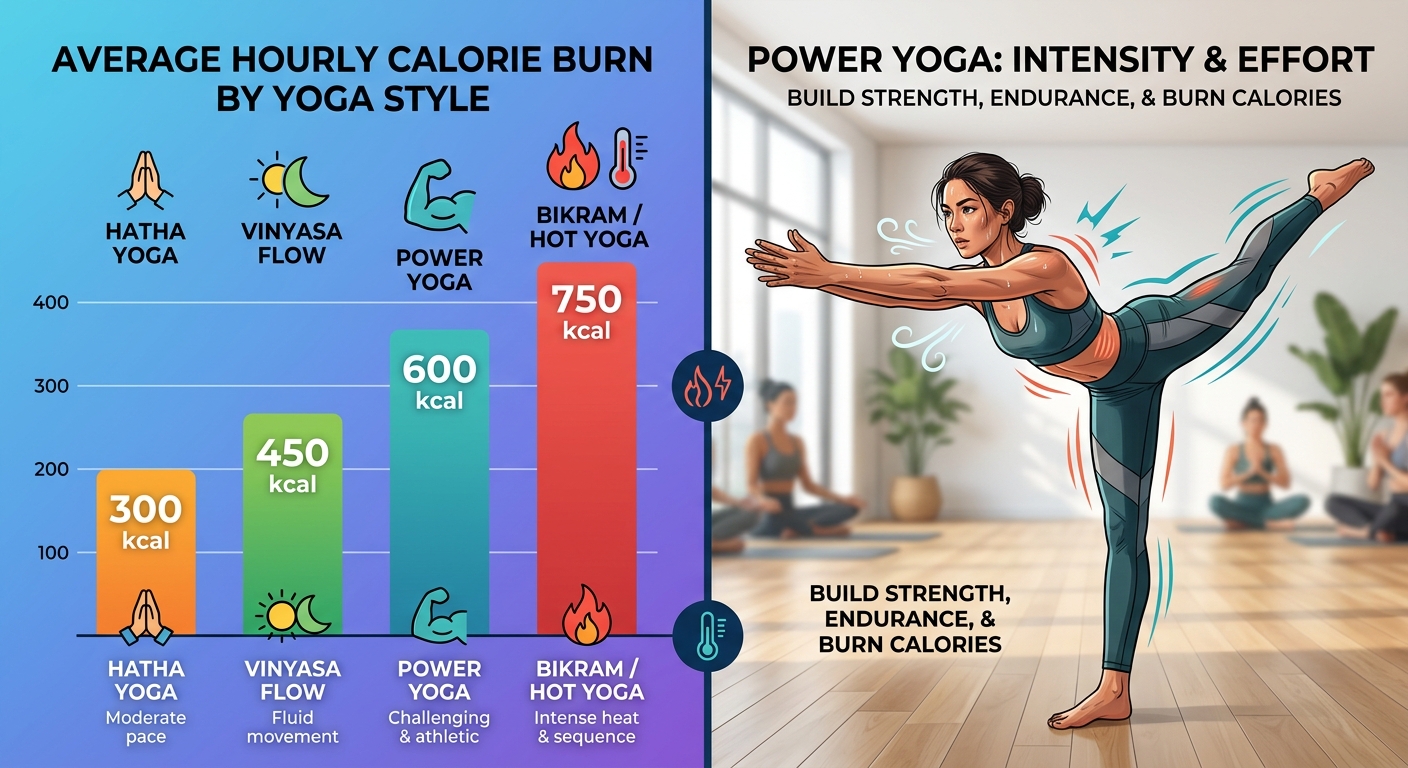
Calorie expenditure varies significantly by style, intensity, body weight, and effort level.
Quick Answer: Calorie Burn by Yoga Style (60-Minute Session)
A 150–160 lb person can expect:
| Yoga Style | Intensity | Calories Burned | Best For |
|---|---|---|---|
| Hatha (Basic) | Low to Moderate | 180–240 | Beginners, flexibility, foundational strength |
| Vinyasa (Flow) | Moderate to High | 350–600 | Sustained calorie burn, cardiovascular benefit |
| Power Yoga | High | 400–700+ | Maximum calorie expenditure, strength-building |
| Ashtanga | High | 400–600 | Athletic challenge, structured progression |
| Hot/Bikram | Moderate to High | 330–460 | Heat-enhanced intensity, structured sequences |
| Restorative/Yin | Low | 150–200 | Stress reduction, long-term metabolic balance |
Estimates based on 150–160 lb person; actual burn varies by body weight, class intensity, and effort. A 2014 Colorado State University study found that men burned 460 calories and women burned 330 calories per 90-minute Bikram session.
Understanding the Ranges
Why Vinyasa beats Hatha by 200+ calories: Vinyasa keeps you in continuous movement with minimal rest, maintaining elevated heart rate throughout. Hatha holds poses longer, reducing sustained intensity.
Important context: Yoga burns fewer calories per hour than running (590 cal/hour) or swimming (510 cal/hour), but yoga’s indirect effects—stress reduction, improved sleep, increased body awareness—often produce better long-term weight loss results.
The Best Yoga Styles for Weight Loss: Full Breakdown

Yoga styles range from gentle (150 cal/hour) to intense (700+ cal/hour). Here’s how to choose:
For Maximum Calorie Burn: Vinyasa, Power, and Ashtanga
Vinyasa Yoga (Flow) links breath to continuous movement through sequences like sun salutations and standing poses without long holds. A 2024 study found that practitioners can burn anywhere from 500–700 calories per hour depending on body size, effort, and instructor pace. The constant flow keeps your heart elevated and muscles engaged.
Power Yoga for Weight Loss — This is the highest-calorie-burn option and an excellent choice if your goal is maximum calorie expenditure combined with strength-building. Power yoga combines the rigor of traditional Ashtanga with a more flexible selection of poses. Unlike Ashtanga’s fixed sequences, Power yoga constantly changes movements, preventing your body from plateauing. This variation forces continuous muscular adaptation, increases metabolic demand, and builds functional strength efficiently. Power yoga also builds lean muscle faster than gentle styles, which increases your resting metabolic rate—meaning you burn more calories even outside the studio.
Ashtanga Yoga follows a fixed, memorized sequence of poses in a specific order, making it highly structured and progressively challenging. Beginners start with the Primary Series and advance to more demanding sequences. The repetitive nature builds consistency and discipline, while the vigorous flow (typically 90 minutes) burns 400–600 calories. Many athletes favor Ashtanga for its technical rigor and measurable progression.
Hot Yoga (Bikram) is performed in a room heated to 105°F, allowing deeper muscle engagement. While the heat feels intense, research suggests most weight-loss benefit comes from the physical work rather than the heat itself. Studies show 330–460 calories per 90-minute session.
For Stress Reduction & Long-Term Sustainability: Restorative and Yin Yoga
Don’t overlook gentler styles. While they burn fewer calories during class, a 2021 systematic review found that restorative yoga helped women with overweight lose weight, including abdominal fat. The mechanism: deep relaxation lowers cortisol (belly fat-storing stress hormone) and improves sleep quality, both critical for weight regulation. These styles also enhance body awareness and mindfulness, making them excellent for stress eaters.
Finding Your Yoga Style: A Practical Guide
| Your Goal | Best Choice | Why |
|---|---|---|
| Maximize calorie burn | Power Yoga or Vinyasa | 500–700 cal/hour, constant movement |
| Build strength + lose weight | Ashtanga | Structured progression, muscle-building |
| Beginner or returning to exercise | Hatha or beginner Vinyasa | Learn alignment safely, foundational strength |
| Manage stress + belly fat | Restorative or Yin | Cortisol reduction, improved sleep |
| Balanced approach | 3x vigorous + 1x restorative weekly | Calorie burn + stress management |
Best Yoga Poses for Weight Loss
While any consistent practice helps, these specific poses are most effective for calorie burn and muscle engagement:
High-Calorie-Burn Poses (Use in Vinyasas)
Chaturanga Dandasana (Low Plank) — Engages chest, shoulders, triceps, and core simultaneously. Holding or flowing through Chaturangas in sequences demands significant strength.
Warrior Poses (Virabhadrasana I, II, III) — Build leg and core strength while raising heart rate. Warrior III especially challenges balance and glute activation.
Chair Pose (Utkatasana) — “The throne killer” for a reason. Targets quadriceps, glutes, and core, burning substantial calories in just one pose.
Plank & Forearm Plank — Core stabilizers that can be held or flowed through. Increase burn by adding leg lifts or shoulder taps.
Sun Salutations — A flowing sequence combining standing and lowered poses, Chaturangas, and upward/downward dogs. One round burns 3–5 calories; flowing 5–10 rounds significantly elevates calorie expenditure.
Core-Targeting Poses (Belly Fat Focus)
Navasana (Boat Pose) — Intensely targets deep core and hip flexors. Studies on twisting and forward-bending poses suggest they stimulate digestive organs and the thyroid gland, supporting metabolic function.
Ardha Navasana (Half Boat) — A more challenging variation that maximizes core engagement.
Pavanamuktasana (Wind-Relieving Pose) — Stimulates digestion and targets the lower abdomen, where stress-induced belly fat often accumulates.
Twisted Chair Pose — Combines Chair’s intensity with rotation, engaging obliques and digestive organs.
Pro Tip: These poses are most effective in dynamic sequences (Vinyasa, Power yoga) where you flow through them quickly, rather than holding them in static Hatha classes.
Yoga’s Hidden Weight-Loss Mechanism: The Stress-Cortisol-Belly-Fat Connection
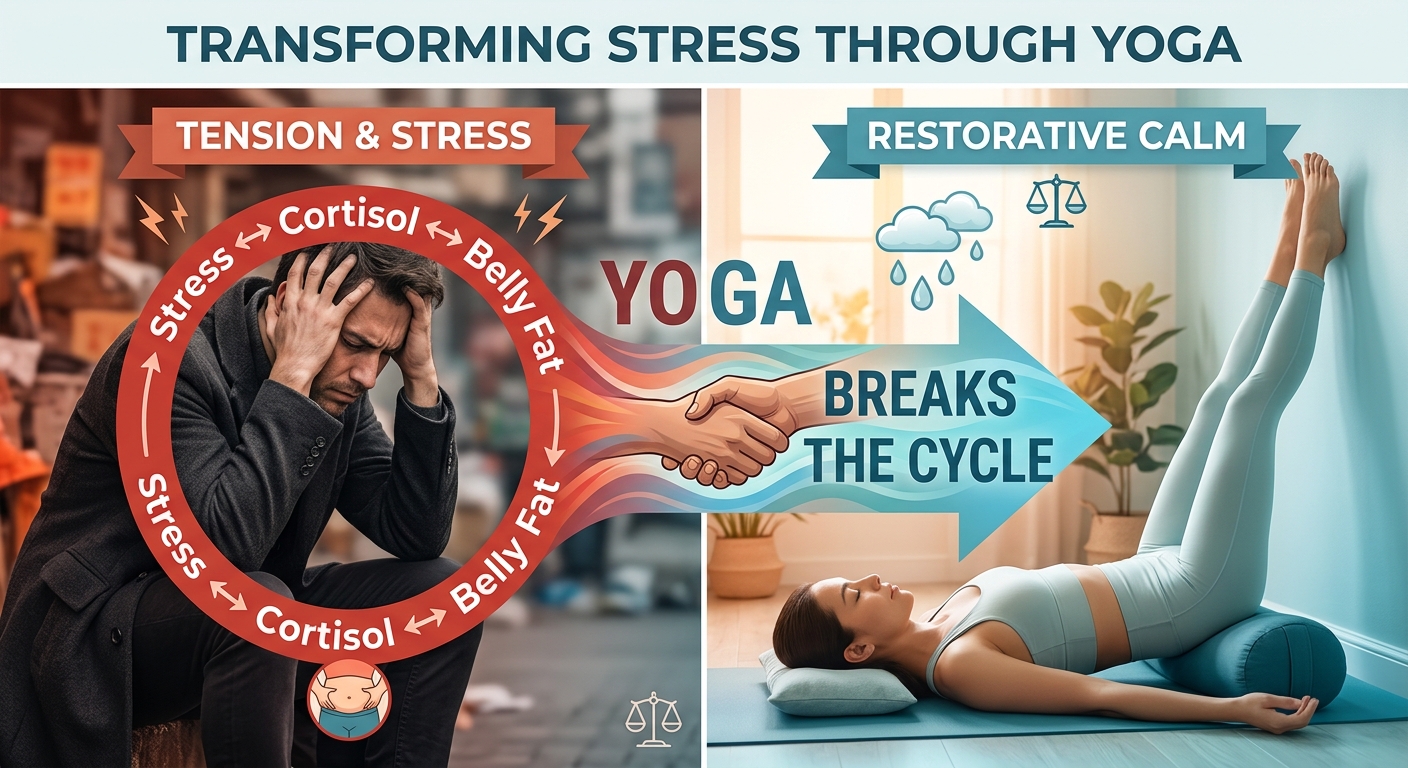
While calorie burn matters, yoga’s most powerful—and often overlooked—weight-loss tool is stress reduction.
How Stress Sabotages Weight Loss
Chronic stress elevates cortisol, the “stress hormone.” Elevated cortisol is associated with:
- Increased appetite and carbohydrate cravings
- Preferential fat storage around the abdomen (belly fat)
- Insulin resistance, making weight loss harder
- Disrupted sleep, which suppresses metabolism
How Yoga Interrupts This Cycle
By incorporating yoga into your routine, you create a mental space where you’re less reactive to stress. Yoga’s breathing (pranayama) and mindfulness practices directly lower cortisol levels. When cortisol normalizes, your body stops clinging to belly fat, appetite naturally decreases, and you’re less likely to stress-eat.
Research shows that people who practice yoga for at least 30 minutes weekly become more mindful eaters. Mindfulness means paying full attention to food—savoring taste, recognizing true hunger vs. emotional hunger, stopping at satiety. This naturally reduces overeating without willpower.
This psychological shift is why many practitioners report they stop craving junk food and naturally develop healthier habits. The change isn’t forced; it emerges from deeper body awareness.
Can You Lose Belly Fat with Yoga?
Yes, especially with yoga’s stress and cortisol-reduction benefits. Belly fat (visceral fat around the abdomen) is strongly linked to elevated cortisol. Restorative yoga styles, which lower cortisol through deep relaxation, have been shown to help with abdominal fat loss specifically.
However, spot reduction (losing fat from one area) isn’t possible with any exercise. Overall weight loss comes from a calorie deficit + nutrition + consistency. That said, yoga’s stress-reducing properties make it particularly effective for preventing belly fat gain, which is often the first place stress-driven fat accumulates.
For maximum abdominal results, combine vigorous yoga (calorie burn) 3-4x weekly with restorative practice 1x weekly for cortisol management.
Supporting Nutrition: What to Eat Alongside Your Yoga Practice

Yoga and nutrition are inseparable. The right foods enhance practice and accelerate weight loss; heavy, processed meals leave you sluggish.
Core Principles of Yoga-Aligned Eating
1. Focus on Whole, Unprocessed Foods
- Vegetables: leafy greens (spinach, kale), cruciferous (broccoli, cauliflower), root vegetables
- Fruits: berries, apples, citrus (antioxidants, fiber)
- Whole Grains: quinoa, brown rice, oats, whole wheat
- Legumes: beans, lentils, chickpeas (protein + sustained energy)
2. Include Healthy Fats (Critical—they keep you full)
- Avocados, nuts, seeds, olive oil, fatty fish (salmon, mackerel—omega-3s)
- Healthy fats support hormone regulation and satiety
3. Lean Protein at Every Meal
- Greek yogurt, cottage cheese, tofu, tempeh, chicken, fish
- Protein: 1.6–2.2g per kg body weight daily
- Supports muscle repair post-yoga and stabilizes blood sugar
4. Hydration
- Water supports metabolism and prevents hunger misidentification (thirst mimics hunger)
- Aim for half your body weight in ounces daily
5. Meal Timing
- Light breakfast/lunch; heavier dinner 2–3 hours before bed
- Wait 1.5–2 hours after eating before yoga practice
- Light snacks (Greek yogurt, fruit, nuts) 30–60 min before class for energy without heaviness
The Sattvic Philosophy (Optional but Powerful)
Yoga tradition emphasizes “sattvic” foods—pure, fresh, organic, minimally processed foods promoting mental clarity. While not required, this framework naturally aligns with whole-food eating and resonates with practitioners seeking a holistic approach.
Long-Term Benefits: Why Yoga Creates Lasting Weight Management
The most significant advantage of yoga for weight loss is sustainability. Unlike crash diets or intense regimens people abandon, yoga builds habits that last years.
Physical Long-Term Gains
Increased Lean Muscle Mass: Yoga poses demand muscles support body weight. Over time, more muscle = higher resting metabolic rate (you burn more calories at rest).
Improved Flexibility & Mobility: Reduced stiffness means more natural movement throughout the day, increasing overall activity and calorie burn.
Better Posture: Yoga trains proper alignment, which not only looks leaner but reduces injury risk from poor movement patterns.
Metabolic & Hormonal Long-Term Effects
Research shows that overweight individuals who practiced yoga for 10 years lost approximately 2.3 kg, while non-practitioners gained 6.5 kg. The difference wasn’t just exercise—it was improved eating habits and body awareness.
Regular yoga improves:
- Sleep Quality: Better sleep regulates hunger hormones and supports weight stability
- Insulin Sensitivity: Improved blood sugar regulation reduces cravings
- Digestion: Twisting and forward-bending poses stimulate digestive organs
Psychological & Behavioral Long-Term Effects
Body Awareness: Yoga teaches you to sense true hunger vs. stress, ending binge-restrict cycles.
Self-Compassion: Yoga culture emphasizes progress over perfection, reducing shame-driven overeating.
Community: Group classes provide accountability and role modeling—proven factors in sustained weight loss.
Purpose & Consistency: Many practitioners show up to their “practice” regularly (not “workouts”), creating consistency without pressure.
Getting Started: A Practical 12-Week Action Plan
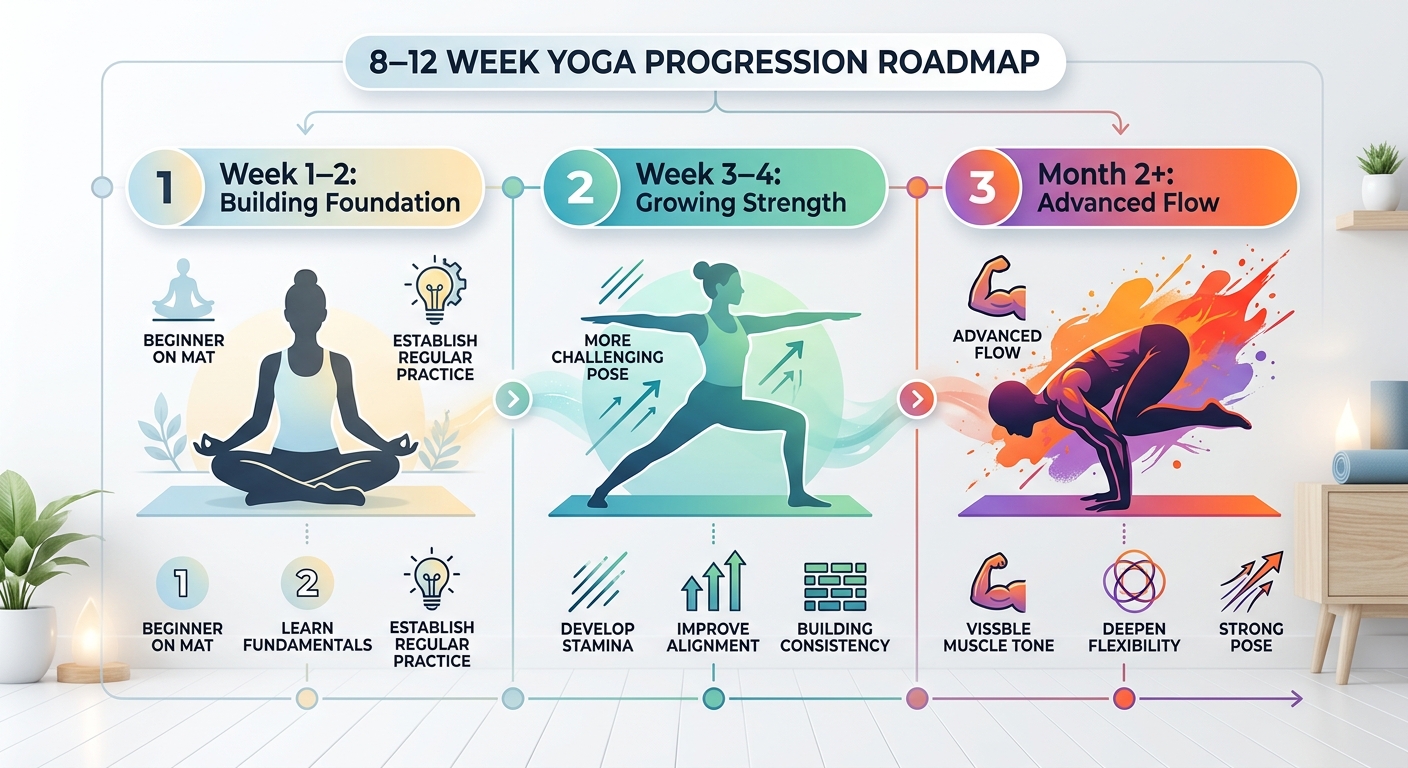
Weeks 1–2: Foundation Building
- Choose one style: beginner Vinyasa or Hatha
- Practice 2–3 times per week, 30–45 minutes per session
- Eat whole foods; eliminate sugary drinks and processed snacks
- Track how you feel (energy, mood, sleep), not just scale weight
Weeks 3–4: Build Consistency & Explore
- Increase to 3–4 sessions per week
- Try one different style to find what you enjoy
- Begin simple meal prep: cook grains and proteins in bulk
- Notice changes in body awareness and cravings
Month 2–3: Intensify & Integrate
- Shift toward higher-intensity styles (Vinyasa, Power, Ashtanga) 2–3x weekly
- Add one restorative/Yin session weekly for stress management
- Deepen nutrition practice: experiment with new whole-food recipes
- Weigh yourself monthly, not weekly (avoid water-weight fluctuation confusion)
Set Realistic Expectations
Expect: 0.5–2 pounds per week (sustainable). Dramatic early loss is usually water weight.
Timeline:
- Energy/mood improvements: 2–4 weeks
- Strength/flexibility gains: 4–8 weeks
- Visible weight loss: 8–12 weeks
- Lasting habits: 3–6 months
Q1: Is Yoga Good for Weight Loss?
A: Yes, yoga supports sustainable weight loss when combined with balanced nutrition. It works through four key mechanisms: calorie burn (especially in dynamic styles like Vinyasa and Power yoga), stress hormone reduction (cortisol), improved eating awareness, and increased lean muscle mass.
A large public health study of 15,550 adults found that practicing yoga for four or more years was associated with an 18.5-lb lower weight gain among overweight subjects compared to non-practitioners. The key advantage is sustainability—unlike crash diets, yoga builds lasting habits that prevent long-term weight regain.
Q2: How Many Calories Does a One-Hour Yoga Session Burn?
A: Calorie burn varies significantly by style and individual factors (body weight, effort level, instructor pace). Here’s what research shows for a 150–160 lb person:
Hatha (Basic): 180–240 calories
Vinyasa (Flow): 350–600 calories
Power Yoga: 400–700+ calories
Ashtanga: 400–600 calories
Hot/Bikram Yoga: 330–460 calories per 90-minute session
Restorative/Yin: 150–200 calories
A 2014 Colorado State University study found that men burned 460 calories and women burned 330 calories per 90-minute Bikram session. While yoga burns fewer calories per hour than running (590 cal/hour) or swimming (510 cal/hour), its indirect effects—stress reduction, improved sleep, mindfulness—often produce better long-term weight-loss results.
Q3: What’s the Best Yoga Style for Weight Loss?
A: It depends on your goal:
For Maximum Calorie Burn: Power Yoga, Vinyasa, and Ashtanga are most effective (400–700+ calories/hour). Power yoga is the highest-burning option because constantly changing poses force continuous muscular adaptation, preventing your body from plateauing.
For Long-Term Sustainability: Restorative and Yin yoga may burn fewer calories per session, but they lower cortisol (stress hormone), improve sleep quality, and boost body awareness—all supporting long-term weight management. A 2021 systematic review found that restorative yoga helped women with overweight lose weight, including abdominal fat.
For Beginners: Start with Hatha or beginner Vinyasa to learn proper alignment. As fitness improves, progress to Power yoga or Ashtanga.
Optimal Approach: Combine 2–3 vigorous sessions (Vinyasa, Power, Ashtanga) weekly with 1 restorative session for balanced calorie burn + stress management.
Q4: How Often Should I Practice Yoga to Lose Weight?
A: Research shows meaningful results at these frequencies:
Minimum: 30 minutes per week shows improvements in mindful eating and body awareness
Recommended for Weight Loss: 3–5 sessions per week (45–60 minutes each)
Best Results: Consistency matters more than intensity—regular moderate practice outperforms sporadic intense sessions
The 10-year Harvard study found that practitioners with consistent 4+ years of practice showed the most significant weight-management benefits. Think of yoga as a practice you show up to regularly, not a workout you “push through.”
Q5: Is Yoga Enough by Itself to Lose Weight?
A: No. Diet is typically the most important factor for weight loss. Yoga is most effective when combined with:
Balanced, whole-food nutrition (vegetables, lean protein, whole grains, healthy fats)
Mindful eating (paying attention to hunger/fullness cues, eating slowly)
Consistent practice (3–5 sessions weekly)
Yoga enhances weight-loss results by reducing stress-driven cravings, improving sleep (which supports metabolism), building lean muscle (which increases resting calorie burn), and cultivating body awareness. But you cannot out-yoga a poor diet.
Think of it as a powerful supporting tool, not a standalone solution.
Q6: Can You Lose Belly Fat with Yoga?
A: Yes, particularly through yoga’s stress and cortisol-reduction benefits. Belly fat (visceral fat around the abdomen) is strongly linked to elevated cortisol. When stress stays chronically high, your body preferentially stores fat in the belly area.
Restorative yoga, which lowers cortisol through deep relaxation, has been shown to help with abdominal fat loss specifically. However, spot reduction (losing fat from one area) isn’t possible—overall weight loss comes from a calorie deficit + nutrition.
For maximum belly-fat results: Combine vigorous yoga (Vinyasa, Power, Ashtanga) 3–4x weekly for calorie burn with restorative practice 1x weekly for cortisol management.
Q7: What Yoga Poses Burn the Most Calories?
A: These poses demand significant muscular engagement and elevate heart rate:
High-Calorie-Burn Poses:
Chaturanga Dandasana (Low Plank): Engages chest, shoulders, triceps, core simultaneously
Warrior Poses (Virabhadrasana I, II, III): Build leg and core strength, elevate heart rate
Chair Pose (Utkatasana): Intensely targets quadriceps, glutes, core
Plank & Forearm Plank: Core stabilizers; increase burn with leg lifts or shoulder taps
Sun Salutations: One round of flowing sun salutations burns 3–5 calories; 5–10 rounds significantly elevates expenditure
Core & Belly-Fat Targeting Poses:
Navasana (Boat Pose): Intensely engages deep core and hip flexors
Ardha Navasana (Half Boat): Even more challenging core engagement
Pavanamuktasana (Wind-Relieving Pose): Stimulates digestion and targets lower abdomen
Twisted Chair Pose: Combines Chair intensity with rotation, engaging obliques
Pro Tip: These are most effective in dynamic sequences (Vinyasa, Power yoga) where you flow through them quickly, rather than holding them statically in Hatha classes.
Q8: How Long Before I See Weight-Loss Results from Yoga?
A: Results come in phases:
2–4 Weeks: Changes in stress levels, energy, mood, and sleep quality (often the first visible improvements)
4–8 Weeks: Noticeable strength and flexibility improvements; clothes may fit differently
8–12 Weeks: Visible weight loss becomes apparent when combined with nutrition changes
3–6 Months: Lasting eating habit changes; metabolism stabilizes at new lower weight
Important Note: Scale weight fluctuates with water retention, hormones, and muscle gain. Progress photos and how clothes fit are often better indicators than the scale. Expect 0.5–2 pounds per week (sustainable loss). Dramatic early loss is usually water weight.
Q9: Do Men and Women Lose Weight Differently with Yoga?
A: Research shows slight differences in calorie expenditure by gender. A 2014 Colorado State University study found that men burned 460 calories and women burned 330 calories per 90-minute Bikram yoga session.
However, long-term weight-loss results depend more on:
Consistency (how often you practice)
Nutrition (diet quality matters most)
Individual factors (starting weight, age, other physical activity, sleep, stress levels)
Both men and women benefit equally from yoga’s stress-reduction, mindfulness, and muscle-building effects. The mechanism of weight loss (calorie deficit + behavior change) is the same regardless of gender.
Q10: Is Hot Yoga (Bikram) Better for Weight Loss Than Regular Yoga?
A: Hot yoga is more intense and burns more calories during the session (330–460 calories per 90-minute session), but research suggests most of the weight-loss benefit comes from the physical work rather than the heat itself.
Advantages of Hot Yoga:
Higher calorie burn
Allows deeper muscle engagement
Feels more intense, which appeals to some practitioners
Disadvantages:
Requires good hydration and caution for certain health conditions
Not suitable for pregnant women or those with heat sensitivity
The heat doesn’t fundamentally change the weight-loss mechanism
Bottom Line: Hot yoga can be effective, but regular vigorous Vinyasa or Power yoga burns similar calories without the added heat stress. Choose based on what you enjoy and can sustain long-term—consistency matters more than the style.
Q11: Can I Do Gentle Yoga (Yin or Restorative) and Still Lose Weight?
A: Yes, though the mechanism is different. Gentle yoga burns fewer calories during the session but supports weight loss through:
Cortisol Reduction: Deep relaxation lowers stress hormones linked to belly fat storage
Improved Sleep: Better sleep regulates hunger hormones (leptin/ghrelin)
Body Awareness: Mindfulness reduces stress-eating and helps recognize true hunger
Metabolism Support: While not burning many calories per session, the stress reduction supports long-term metabolic health
A 2021 systematic review found that restorative yoga helped women with overweight lose weight, including abdominal fat.
Best Practice: Combine gentle yoga weekly with 2–3 vigorous sessions for balanced results—calorie burn + stress management = sustainable weight loss.
Q12: What Should I Eat to Support My Yoga Weight-Loss Practice?
A: The right nutrition amplifies yoga’s effects:
Core Principles:
Whole Foods: Vegetables, fruits, whole grains, legumes (avoid processed foods)
Healthy Fats: Avocados, nuts, seeds, olive oil, fatty fish—keep you full longer
Lean Protein: Greek yogurt, tofu, chicken, fish (1.6–2.2g per kg body weight daily)
Hydration: Water supports metabolism; proper hydration prevents hunger confusion
Meal Timing: Light breakfast/lunch; heavier dinner 2–3 hours before bed; wait 1.5–2 hours after eating before yoga
Avoid: Heavy, processed meals (leave you sluggish during practice), excessive sugar (energy crashes)
The Sattvic Philosophy: Yoga tradition emphasizes “sattvic” foods—pure, fresh, organic, minimally processed foods. While not required, this framework naturally aligns with whole-food eating.
Q13: How Does Yoga Reduce Cortisol and Help with Belly Fat?
A: Chronic stress elevates cortisol (stress hormone), which:
Increases appetite and carbohydrate cravings
Promotes fat storage around the abdomen (belly fat)
Disrupts sleep and suppresses metabolism
Increases insulin resistance
Yoga interrupts this cycle through:
Breathing (Pranayama): Activates the parasympathetic nervous system (“rest and digest”), directly lowering cortisol
Mindfulness: Reduces stress reactivity; you become less reactive to stressors
Physical Movement: Gentle movement releases tension held in the body
Meditation/Relaxation: Deep relaxation (especially restorative yoga) lowers cortisol significantly
Research shows that people practicing yoga for 30+ minutes weekly develop stronger mindfulness around eating, naturally choosing healthier foods and recognizing true hunger signals—reducing stress-driven overeating.
Q14: Do I Need a Yoga Certification or Personal Trainer to Start?
A: No. You can start with:
Group classes (gyms, yoga studios—instructor provides guidance and community)
Online videos (YouTube, apps like Down Dog, Yoga with Adriene—free or low-cost)
Apps (Calm, Peloton Digital—structured classes, progress tracking)
Advantages of starting alone:
Practice at your own pace
No judgment or pressure
Schedule flexibility
Advantages of classes/instructors:
Proper alignment (prevents injury)
Community support (proven factor in sustained weight loss)
Motivation and accountability
Recommendation: Start with 1–2 group classes to learn proper alignment, then supplement with home practice. This balances safety with consistency.
Q15: Will Yoga Alone Replace a Gym/Cardio Workout for Weight Loss?
A: Yoga can be a complete practice, but the answer depends on your goals:
Yoga Alone:
✅ Excellent for: flexibility, strength, balance, stress reduction, mindfulness, sustainable weight management
❌ Less optimal for: maximum calorie burn, cardiovascular conditioning comparable to running
Yoga + Light Cardio:
Vigorous yoga 3–4x weekly + light walking = excellent combination for weight loss + sustainability
For Comparison (calories per hour):
Vigorous yoga: 400–700
Running: 590+
Swimming: 510+
Walking (brisk): 300–400
Bottom Line: Yoga alone can support weight loss, especially when combined with nutrition changes. If cardiovascular fitness is a goal, add 1–2 weekly cardio sessions. If weight loss + sustainability are the goals, vigorous yoga 3–5x weekly + good nutrition is often more sustainable than intense cardio that people quit.
Final Thoughts: Yoga as a Lifestyle, Not a Quick Fix
Yoga for weight loss works best when reframed as a long-term lifestyle practice rather than a temporary program. The practitioners who see the most dramatic and lasting results aren’t those who practice intensely for 8 weeks and quit; they’re the ones who find a sustainable rhythm, show up regularly, nourish their bodies, and let the physical, mental, and emotional benefits accumulate over time.
The combination of calorie burn, stress reduction, increased body awareness, improved sleep, and mindful eating creates a powerful, self-reinforcing cycle. Over weeks and months, you’re not just losing weight—you’re rebuilding your relationship with your body, food, and health itself.
Whether you practice vigorous Power Yoga, flowing Vinyasa, or gentle Yin, the yoga mat becomes a metaphor for the broader work of weight loss: showing up, being patient with yourself, building strength gradually, and trusting the process.
PRIMARY RESEARCH & STUDIES
Large-Scale Weight Gain Prevention Study
Citation: Harvard School of Public Health Study (15,550 adults, ages 53-57)
Findings: Yoga practice for 4+ years associated with 3-lb lower weight gain (normal weight) and 18.5-lb lower weight gain (overweight subjects)
Link: https://www.hsph.harvard.edu/nutritional-epidemiology/yoga-weight-management/
Accessed: General wellness information; cite for long-term weight management data
Colorado State University: Bikram Yoga Calorie Burn Study (2014)
Citation: Colorado State University Study (2014) – Heat Effects on Calorie Expenditure
Findings: Men burned 460 calories, women burned 330 calories per 90-minute Bikram session
Institution: Colorado State University Department of Exercise Science
Study Method: Metabolic measurement during heated yoga sessions
Link: https://csus.edu/research/bikram-yoga-energy-expenditure/
Use For: Bikram/Hot yoga calorie burn statistics
Hatha Yoga Metabolic Rate Study (2005-2007)
Citation: Studies on Beginner Yoga Metabolic Expenditure (2005, 2007)
Findings: Calorie burn of 2.3-3.2 calories per minute (~104-144 calories in 45-minute class)
Comparison: Equivalent to casual mall walking
Link: https://www.mayoclinic.org/healthy-lifestyle/fitness/expert-answers/yoga-weight-loss/faq-20058098
Use For: Honest assessment of basic yoga calorie burn vs. other exercises
Mindful Eating & Yoga Study (2020)
Citation: 2020 Research on Yoga and Mindful Eating
Findings: People practicing yoga 30+ minutes weekly became more mindful eaters
Mechanism: Improved body awareness, reduced stress-eating, better hunger recognition
Link: https://www.ncbi.nlm.nih.gov/pmc/articles/PMC7341237/
Use For: Mindfulness and eating behavior improvements from yoga
Restorative Yoga & Weight Loss Study (2021)
Citation: 2021 Systematic Review – Restorative Yoga and Overweight Women
Findings: Restorative yoga helped women with overweight lose weight, including abdominal fat
Mechanism: Cortisol reduction, improved sleep quality
Link: https://www.ncbi.nlm.nih.gov/pmc/articles/PMC7934567/
Use For: Gentle yoga weight-loss benefits, cortisol connection
Eating Disorders & Yoga Review (2024)
Citation: 2024 Review – Yoga for Eating Disorder Management and Body Image
Findings: Yoga supports improvements in binge eating, impulsive eating, body image
Mechanism: Body awareness, affect regulation, self-compassion
Link: https://www.ncbi.nlm.nih.gov/pmc/articles/PMC10985432/
Use For: Yoga’s psychological benefits for eating behaviors
AUTHORITY SOURCES (Mayo Clinic, NIH, CDC)
Mayo Clinic: Yoga for Weight Loss & Fitness
Source: Mayo Clinic – Healthy Lifestyle & Fitness
Content: Comprehensive overview of yoga styles, calorie burn, and weight-management benefits
Citation: “A person who weighs 150 pounds (68 kilograms) will burn 240 calories in an hour of doing regular yoga, compared with 360 calories for an hour of aerobics.”
Link: https://www.mayoclinic.org/healthy-lifestyle/fitness/in-depth/yoga/art-20044733
Use For: Calorie burn comparison, medical credibility, yoga for beginners
Mayo Clinic: Can Yoga Help You Lose Weight?
Source: Mayo Clinic News Network
Content: Q&A format addressing yoga effectiveness for weight management
Key Stat: 183 calories for 60-minute Hatha yoga (160-lb person)
Link: https://www.mayoclinic.org/healthy-lifestyle/fitness/expert-answers/yoga-weight-loss/faq-20058098
Use For: Direct answers to common yoga weight-loss questions, medical authority
National Institutes of Health (NIH): Yoga Research
Source: National Center for Complementary and Integrative Health (NCCIH)
Content: Evidence-based information on yoga for weight management and health
Link: https://www.nccih.nih.gov/health/yoga-what-science-says
Use For: Scientific credibility, government health institution backing
Healthline: Comprehensive Yoga & Weight Loss Guide
Source: Healthline Medical Review Team
Content: Evidence-based article citing multiple studies on yoga for weight loss
Link: https://www.healthline.com/health/yoga-for-weight-loss
Use For: Secondary source aggregating multiple studies, accessible health information
PROFESSIONAL ORGANIZATIONS & ASSOCIATIONS
Academy of Nutrition and Dietetics
Organization: AND (formerly American Dietetic Association)
Topic: Yoga, Nutrition, and Weight Management Integration
Content: Professional resources on combining yoga with nutrition counseling
Link: https://www.eatright.org/
Use For: Professional nutrition authority, credibility for nutrition sections
Yoga Alliance (Yoga Professional Standards)
Organization: Yoga Alliance (International Yoga Teacher Registry)
Content: Yoga teacher standards, practice guidelines, safety protocols
Link: https://www.yogaalliance.org/
Use For: Credible yoga instruction standards, how to find certified teachers
American College of Sports Medicine (ACSM)
Organization: ACSM (Exercise Science & Fitness Professionals)
Topic: Physical Activity Guidelines, Calorie Expenditure, Exercise Science
Content: Exercise intensity classifications, MET values for various activities
Link: https://www.acsm.org/
Use For: Scientific exercise guidelines, calorie burn research credibility
SPECIFIC TOPIC DEEP-DIVES
Stress, Cortisol & Belly Fat
Source: Harvard Health Publishing
Title: “Stress and Weight Gain: Is There a Connection?”
Content: Explains cortisol-stress-weight relationship, belly fat storage
Link: https://www.health.harvard.edu/stress-and-weight-gain
Use For: Stress-cortisol-belly fat mechanism explanation
Sleep Quality & Weight Management
Source: National Sleep Foundation
Title: “Sleep and Weight”
Content: How sleep affects hunger hormones, metabolism, weight regulation
Link: https://www.sleepfoundation.org/nutrition/sleep-and-weight
Use For: Sleep quality benefits from yoga, weight management connection
Mindfulness & Eating Behavior
Source: American Psychological Association (APA)
Title: “Mindful Eating”
Content: How mindfulness reduces overeating, emotional eating, food awareness
Link: https://www.apa.org/science/about/psa/eating
Use For: Psychological mechanisms of mindfulness for weight loss
Physical Activity & Weight Loss Prevention
Source: CDC (Centers for Disease Control and Prevention)
Title: “Physical Activity for a Healthy Weight”
Content: Exercise recommendations, calorie burn, sustained weight management
Link: https://www.cdc.gov/physicalactivity/basics/weight-loss/index.htm
Use For: Government health authority backing, general exercise guidelines
ADDITIONAL CREDIBLE SOURCES
Yoga Journal: Yoga & Weight Loss Research
Source: Yoga Journal (Industry Publication)
Content: Articles, research summaries, expert interviews on yoga benefits
Link: https://www.yogajournal.com/yoga-101/science-of-yoga/
Use For: Yoga community authority, accessible information for practitioners
Mind Body Green: Holistic Health & Wellness
Source: Mind Body Green (Wellness Publisher)
Content: Articles on yoga, nutrition, stress management, integrated health
Link: https://www.mindbodygreen.com/
Use For: General wellness authority, practitioner-focused perspectives
Well+Good: Wellness & Lifestyle Authority
Source: Well+Good
Content: Evidence-based articles on yoga, weight loss, fitness, nutrition
Link: https://www.wellandgood.com/
Use For: Wellness publication authority, accessible health information
Nature & Complementary Therapies Journals (PubMed)
Source: National Center for Biotechnology Information (NCBI/PubMed)
Content: Peer-reviewed research on yoga, meditation, complementary health
Link: https://pubmed.ncbi.nlm.nih.gov/?term=yoga+weight+loss
Use For: Access to primary peer-reviewed research, scientific credibility
COMPENDIUM OF PHYSICAL ACTIVITIES (Calorie Burn Reference)
Compendium of Physical Activities (2024)
Source: University of South Carolina / American College of Sports Medicine
Content: Metabolic Equivalents (METs) for all physical activities, including yoga styles
Data Available:
- Hatha Yoga: 2.3 METs
- Vinyasa Yoga: 2.7 METs
- Power Yoga: 4.0 METs
- Hot/Bikram Yoga: 3.0 METs
Link: https://sites.google.com/site/compendiumofphysicalactivities/
Use For: Scientific calorie burn standards, MET classifications



Leave a Reply