


Medical Disclaimer
This article is for educational purposes only and should not be considered medical advice. It is not intended to diagnose, treat, cure, or prevent any disease. If you have health conditions, take medications, or are considering significant activity changes, consult your healthcare provider before proceeding.
Can Household Chores Help You Lose Weight?
Quick answer: Yes. Household chores for weight loss burn calories through NEAT (Non-Exercise Activity Thermogenesis), and accumulated daily movement measurably contributes to weight loss.
Research confirms the mechanism: people who maintain weight during overfeeding unconsciously move 2 hours more per day than those who gain weight—through stairs, household movement, and fidgeting (Mayo Clinic studies by James Levine). Household chores burning 100-200 calories per 30 minutes, depending on intensity and body weight, make daily activities a practical weight loss tool when combined with consistent eating habits.
What Is NEAT and Why Does It Matter for Weight Loss?
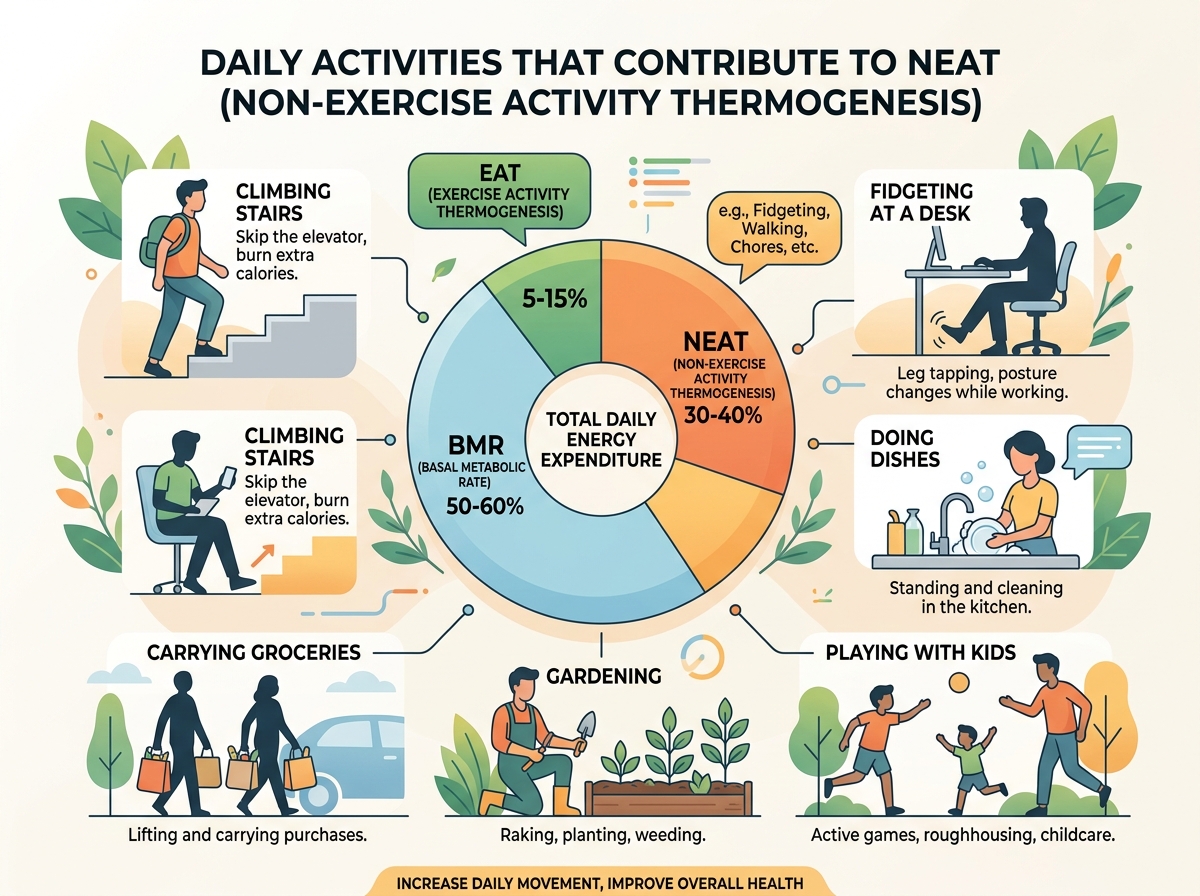
Quick answer: NEAT (Non-Exercise Activity Thermogenesis) is energy burned during non-exercise daily activities—chores, walking, fidgeting, errands. It accounts for 15-50% of daily calorie expenditure and can vary by over 2,000 calories per day between similar individuals.
What activities count as NEAT?
NEAT includes: vacuuming, mopping, scrubbing, gardening, laundry, cooking, grocery shopping, fidgeting at a desk, taking stairs, standing while working, playing with children or pets, and all informal movement throughout the day.
How much of daily calorie burn is NEAT?
Kent State University research shows approximately 30-40% of daily energy expenditure comes from activity. Mayo Clinic researcher James Levine found that simple household chores like ironing or folding clothes use up to 15% of total daily energy. This means NEAT often burns more total calories than formal exercise because it’s distributed across your entire waking day.
Why does NEAT vary so much between people?
Two people of identical size, age, and exercise habits can burn 2,000 more or fewer calories per day simply through NEAT levels. This variation often explains why some people maintain weight easily while others struggle despite similar diet and exercise. The difference: occupational movement, fidgeting, spontaneous activity, and daily chore patterns.
What research says about NEAT for weight loss
The National Academy of Sports Medicine identifies combining exercise and NEAT as the most effective weight loss strategy. Research shows increasing daily lifestyle activities is as effective as structured aerobic exercise for maintaining long-term weight loss—with the advantage of better sustainability because NEAT doesn’t trigger the hunger response intense workouts do.
What Household Chores Burn the Most Calories?
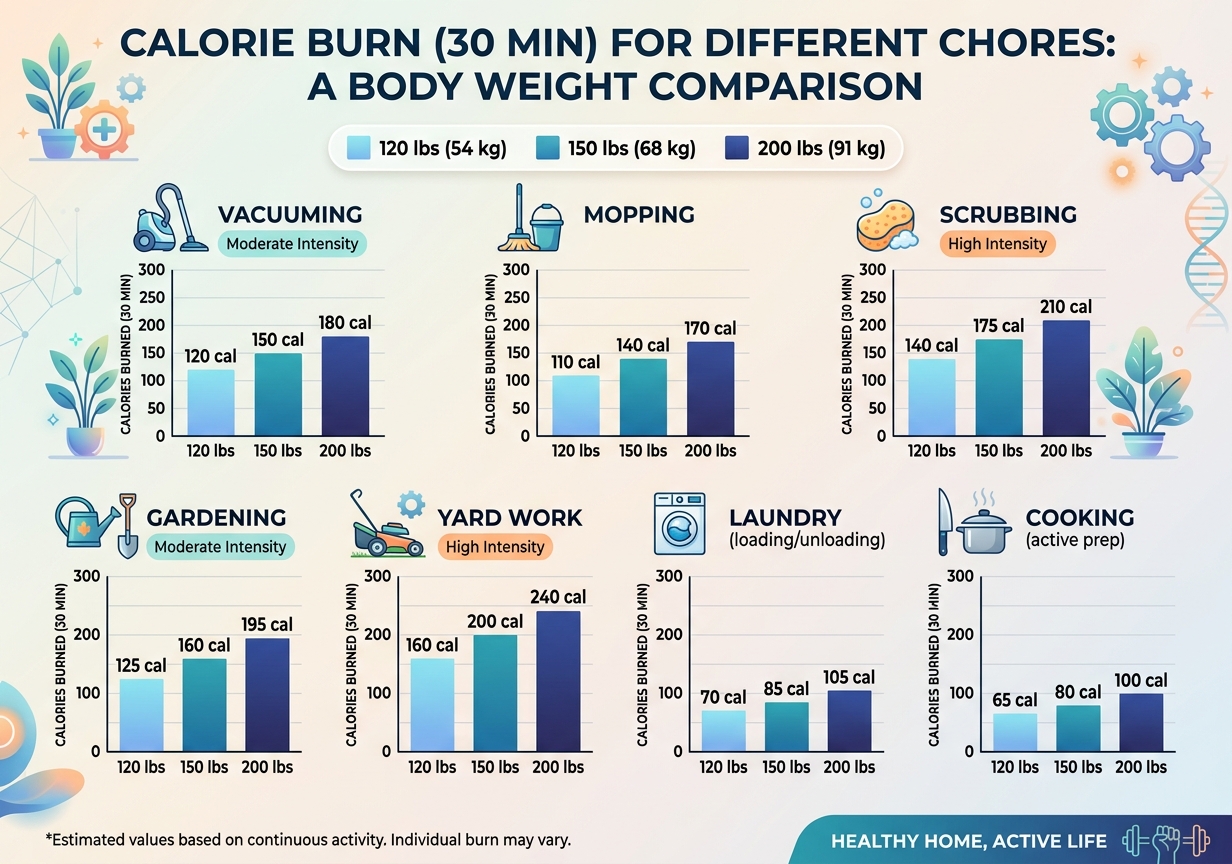
Quick answer: Yard work (mowing, planting) burns 144-240 calories per 30 minutes (highest). Vigorous scrubbing burns 126-210 cal. Vacuuming burns 99-166 cal. Mopping burns 108-180 cal. All data varies by body weight, intensity, and pace.
Calorie Burn by Household Activity (30 minutes)
| Chore | 120 lbs | 150 lbs | 180 lbs | 200 lbs |
|---|---|---|---|---|
| Yard work/mowing lawn | 144 | 180 | 216 | 240 |
| Vigorous scrubbing/cleaning | 126 | 158 | 189 | 210 |
| Walking to run errands | 135 | 169 | 203 | 226 |
| Gardening (moderate) | 117 | 146 | 175 | 195 |
| Mopping floors | 108 | 135 | 162 | 180 |
| Sweeping | 108 | 135 | 162 | 180 |
| Vacuuming | 99 | 124 | 149 | 166 |
| Cooking/food prep | 81 | 102 | 122 | 136 |
| Making beds | 81 | 102 | 122 | 136 |
| Doing laundry | 72 | 90 | 108 | 120 |
Estimates from Harvard Medical School and American Council on Exercise. Actual burn varies by intensity, duration, and individual metabolism.
How to maximize calorie burn from chores
- Pace: Move quickly enough to elevate heart rate and breathing (at least 10 minutes continuously)
- Intensity: Add dynamic movements—lunges while vacuuming, squats while cooking, brisk walking during errands
- Music: Upbeat tempo raises pace and stamina naturally
- Frequency: Spreading chores throughout the week (daily 15-20 min) burns more than weekly 2-hour sessions
How Does NEAT Compare to Exercise for Weight Loss?
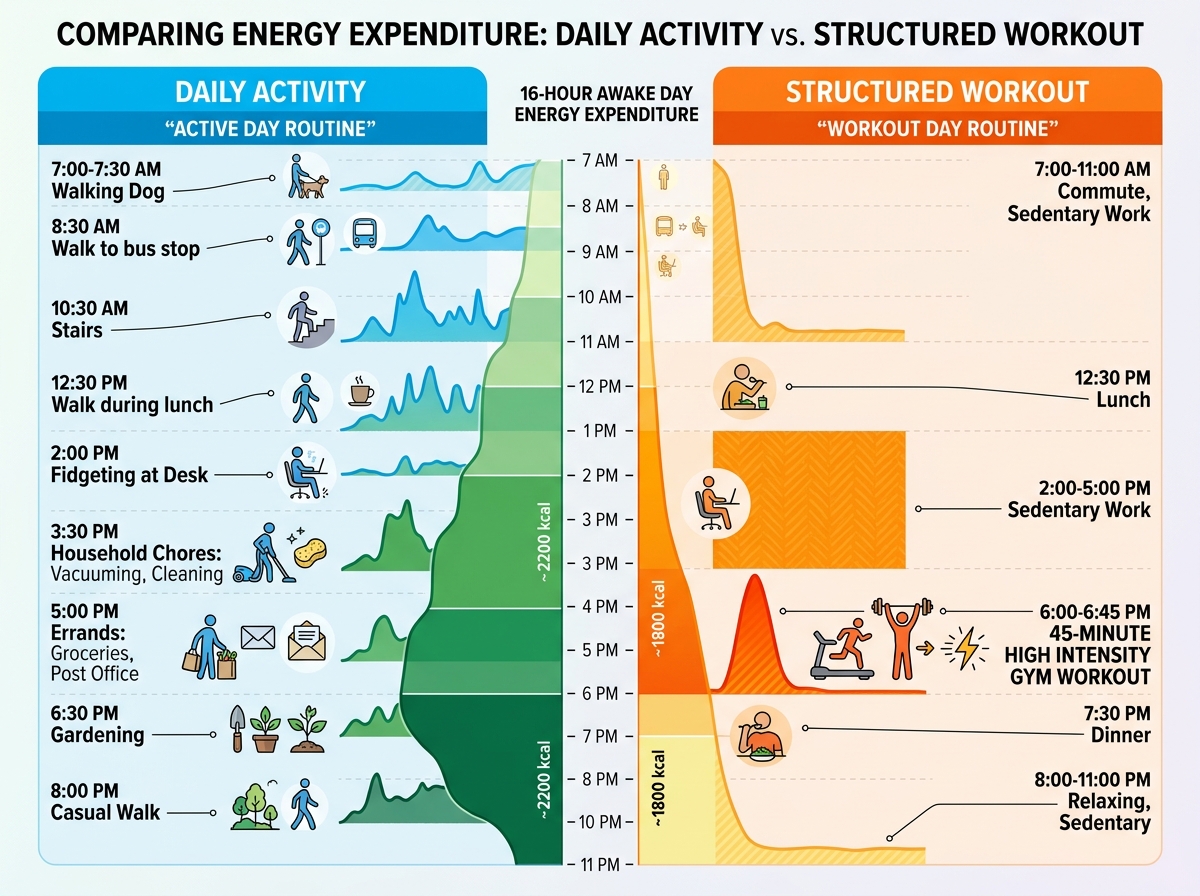
Quick answer: Both work; combining them is most effective. NEAT is more sustainable long-term because it requires no dedicated time, equipment, or recovery. Exercise burns calories faster per unit time but NEAT accumulates greater total daily burn because it’s distributed all day.
NEAT advantages over structured exercise
- Distributed throughout entire day (no single time commitment needed)
- Doesn’t trigger excessive post-exercise hunger
- Sustainable indefinitely without burnout
- Requires no equipment, gym, or special training
- Maintains metabolic engagement even when injured or busy
- No “earned treat” mentality that undermines diet
Exercise advantages over NEAT
- Burns more calories per unit time (45-min workout = hours of NEAT calories)
- Builds muscle (increases resting metabolism)
- Improves cardiovascular fitness
- Provides mental health benefits
- Creates metabolic adaptations that improve long-term weight loss
Why combining NEAT + exercise is optimal
Someone exercising 45 minutes daily while sitting 10 hours may burn fewer total calories than someone exercising moderately but maintaining 8+ hours of daily NEAT. Research shows increasing daily lifestyle activities is as effective as structured aerobic programs for maintaining weight loss—meaning both matter, but NEAT is the foundation.
What’s the Connection Between Sedentary Behavior and Weight Gain?
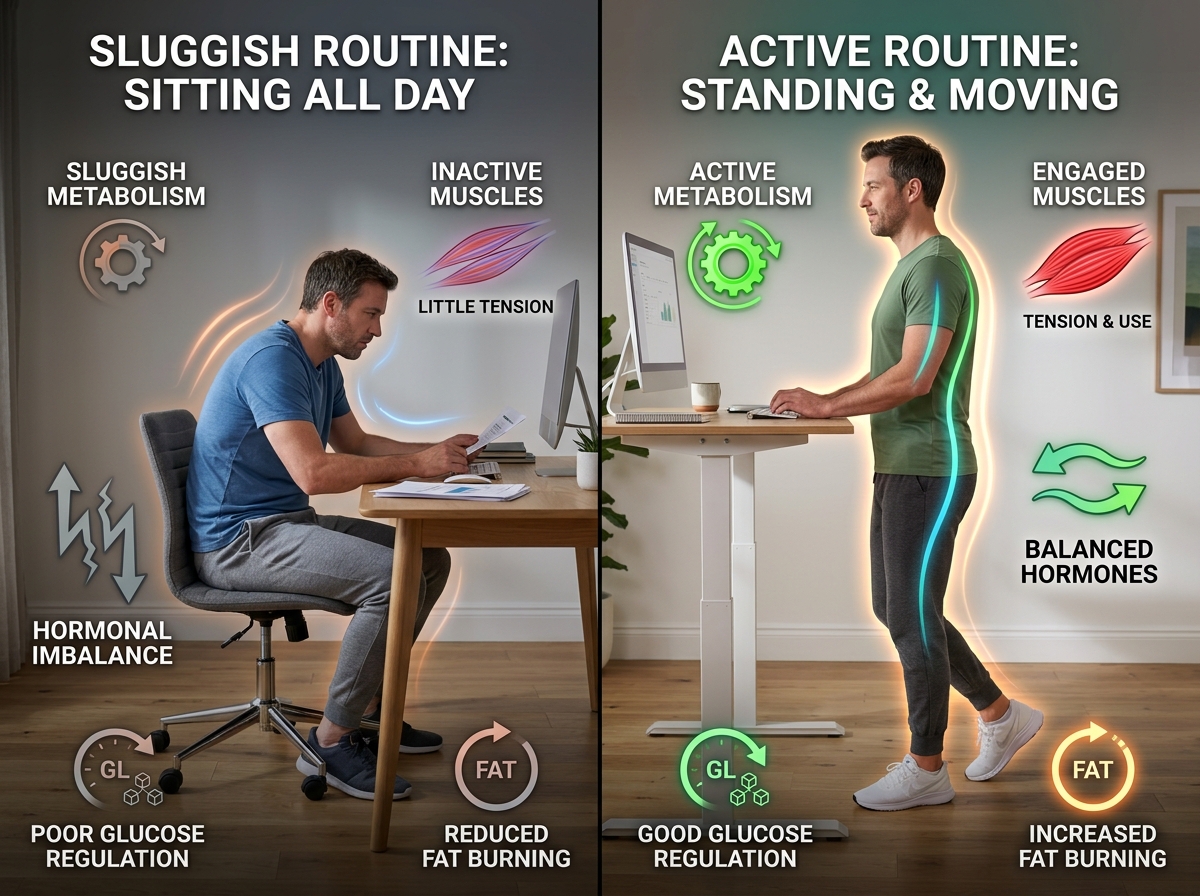
Quick answer: Sedentary behavior (prolonged sitting) independently increases weight gain and metabolic disease risk—even for people who exercise regularly. Breaking up sitting with movement breaks improves weight management outcomes.
How does sitting affect weight?
Sitting for extended periods reduces calorie expenditure by disengaging multiple body systems. When upright and active, your body contracts muscles, resists gravity, and maintains balance—all energy-costly processes. Sitting turns these off. Research shows sedentary behavior independently increases risk of: type 2 diabetes, cardiovascular disease, metabolic syndrome, weight gain, obesity, chronic disease, and poor mental health.
The 2-hour-per-day difference
Mayo Clinic research found people who gained weight during an overfeeding study sat approximately 2 hours more per day than those who stayed lean. Same calories consumed; the difference was unconscious daily movement through chores, stairs, office movement, and fidgeting.
Sitting affects appetite regulation too
Sedentary time increases hunger hormones (ghrelin) and decreases satiety signals (leptin), making you more likely to overeat without awareness. This is distinct from lack of exercise—you can exercise 60 minutes and still experience metabolic harms from 10 hours of sitting the rest of the day.
Surprising finding: Healthy weight doesn’t protect against sedentary risks
Research shows being at a normal body weight doesn’t protect you from metabolic risks of prolonged sitting. The issue isn’t just the number on the scale—it’s the cumulative effect of activity distribution throughout your day. Someone lean but sedentary faces different health risks than someone of higher weight but constantly moving.
How breaking up sitting time helps
NIH research indicates that breaking sedentary time with even brief activity bouts—getting up every 30 minutes, short walks, movement breaks—is associated with smaller waist circumference and better metabolic markers. The mechanism: each movement engagement activates muscle systems, increases calorie burn, and stabilizes appetite hormones.
Practical Strategies to Boost NEAT Through Household Chores
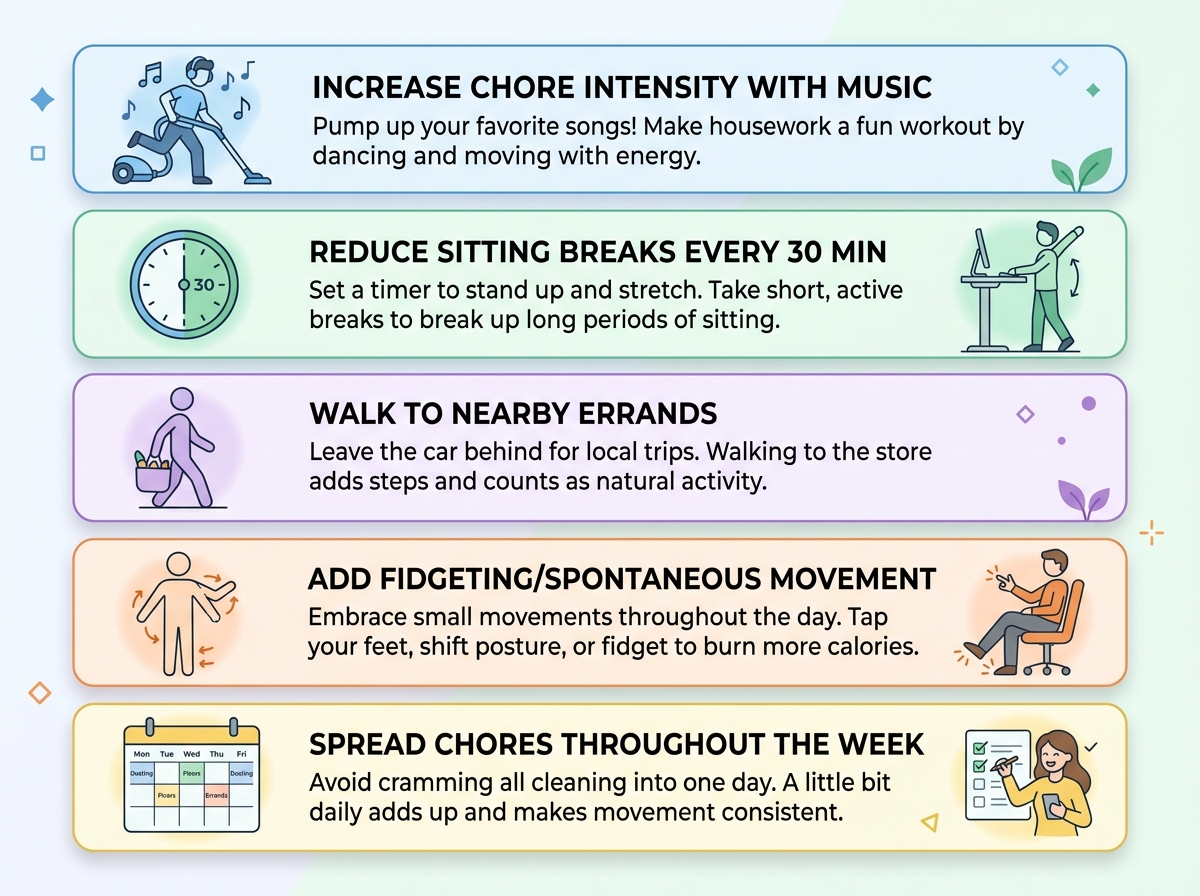
Quick answer: Five evidence-based approaches: (1) increase chore intensity with music/dynamic movement, (2) reduce sitting time with movement breaks, (3) walk to nearby errands, (4) add fidgeting/spontaneous movement, (5) spread chores throughout the week rather than batch them.
Strategy 1: Increase Chore Intensity and Pace
Research shows any activity at a pace elevating heart rate for at least 10 minutes straight burns significantly more calories. Playing upbeat music naturally raises pace and stamina.
How to apply:
- Music tempo 120+ BPM while cleaning (automatically increases pace)
- Add lunges while vacuuming, squats while waiting for water to boil
- Walk briskly to nearby errands instead of driving
- Vigorous scrubbing > leisurely tidying (2-3x calorie difference)
Strategy 2: Reduce Sitting Time Throughout the Day
Every 30 minutes of sitting reduces NEAT engagement. Breaking up sitting is more important than total exercise time for weight management.
How to apply:
- Stand while taking phone calls
- Walk for 5 minutes after meals
- Stand up every 30 minutes if desk-bound
- Use commercial breaks or streaming pauses as movement prompts
- Stand while doing light tasks (folding laundry, organizing)
Strategy 3: Incorporate Movement Into Errands
Walking errands burns 135-226 calories per 30 minutes—among the highest-calorie household activities.
How to apply:
- Park farther from store entrances
- Walk to nearby destinations instead of driving
- Take stairs instead of elevators
- Carry groceries one bag per trip (multiple journeys = more steps)
- Walk while on phone calls
Strategy 4: Add Fidgeting and Spontaneous Movement
Even small conscious movements contribute measurably to NEAT. Fidgeting—tapping fingers, bouncing knee, standing instead of sitting—accumulates significantly over hours.
How to apply:
- Tap feet while sitting at desk
- Do leg lifts while brushing teeth
- Stand on one leg while doing dishes
- Stretch during work breaks
- Play actively with children or pets
Strategy 5: Spread Chores Throughout the Week
Distributing 3-4 hours of weekly chores across 7 days (30-45 min daily) maintains consistent NEAT engagement, whereas batching chores into one 3-hour weekend session creates gaps in daily movement.
How to apply:
- Light cleaning (15 min) each evening instead of 2-hour weekend deep clean
- Walk to check laundry instead of using a chute
- Separate gardening into multiple 20-minute sessions
- Schedule a “movement snack” chore every 2-3 hours
How to Build and Maintain Consistent Daily Movement Habits
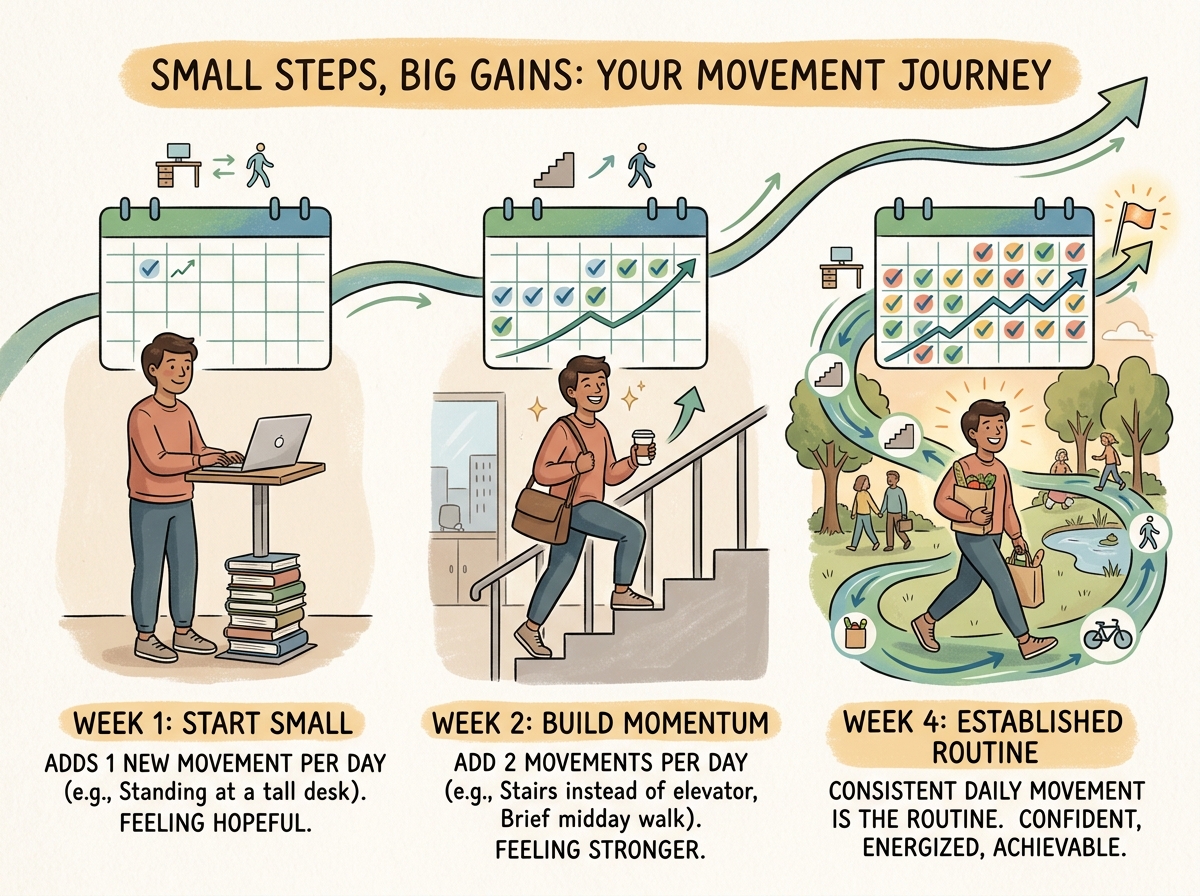
Quick answer: Start small (one movement opportunity daily), choose activities you tolerate, track progress differently (steps, sitting time reduction, energy levels—not just weight), and create environmental cues that make movement the easier option.
Why small changes stick better than overhauls
Habit formation research shows incremental changes (adding one movement opportunity per day, then expanding gradually) succeed long-term more than drastic lifestyle overhauls. Someone adding 10 minutes of daily chores has higher adherence than someone attempting to restructure their entire routine.
Choose activities that match your lifestyle
Sustainable NEAT comes from activities you naturally tolerate or enjoy. If you enjoy gardening, that’s more sustainable than forcing yourself into chores you resent. Preference matters for long-term adherence.
Track progress in ways that matter
Since NEAT isn’t “exercise,” traditional fitness metrics don’t apply. Better metrics: steps per day (using phone or pedometer), sitting time reduction, chores completed weekly, energy level changes, how clothes fit. These show progress even when the scale doesn’t move immediately.
Combine NEAT with modest nutrition awareness
Increasing NEAT alone won’t overcome significant calorie surplus. Combining daily household movement with reasonable nutrition—not restrictive dieting, just eating in line with your activity level—creates sustainable calorie balance that leads to weight loss.
Create environmental cues
Make movement the easier option: place vacuum in visible location, keep sports equipment accessible, set phone reminders for movement breaks, arrange workspace to require more walking.
Can Household Chores Alone Cause Weight Loss?
Quick answer: Household chores can contribute to weight loss but work best as part of a comprehensive approach. They’re most effective when combined with reasonable nutrition, some structured activity, and consistent daily movement.
What the research shows
NEAT measurably contributes to daily energy expenditure. Increasing NEAT alone can create a caloric deficit over time. However, calorie balance (energy in vs. out) remains fundamental—chores alone won’t overcome a significant calorie surplus.
The practical reality
For someone significantly overweight eating a calorie surplus, household chores alone likely won’t create sufficient deficit for meaningful weight loss. However, combined with reasonable nutrition habits, increased chore-based NEAT becomes a powerful weight loss tool.
Most effective combination
Research and practice show sustainable weight loss requires: (1) Increased NEAT through chores/daily movement, (2) Moderate structured activity, (3) Nutrition habits supporting calorie balance, (4) Adequate sleep and stress management.
What About People With Limited Mobility or Health Restrictions?
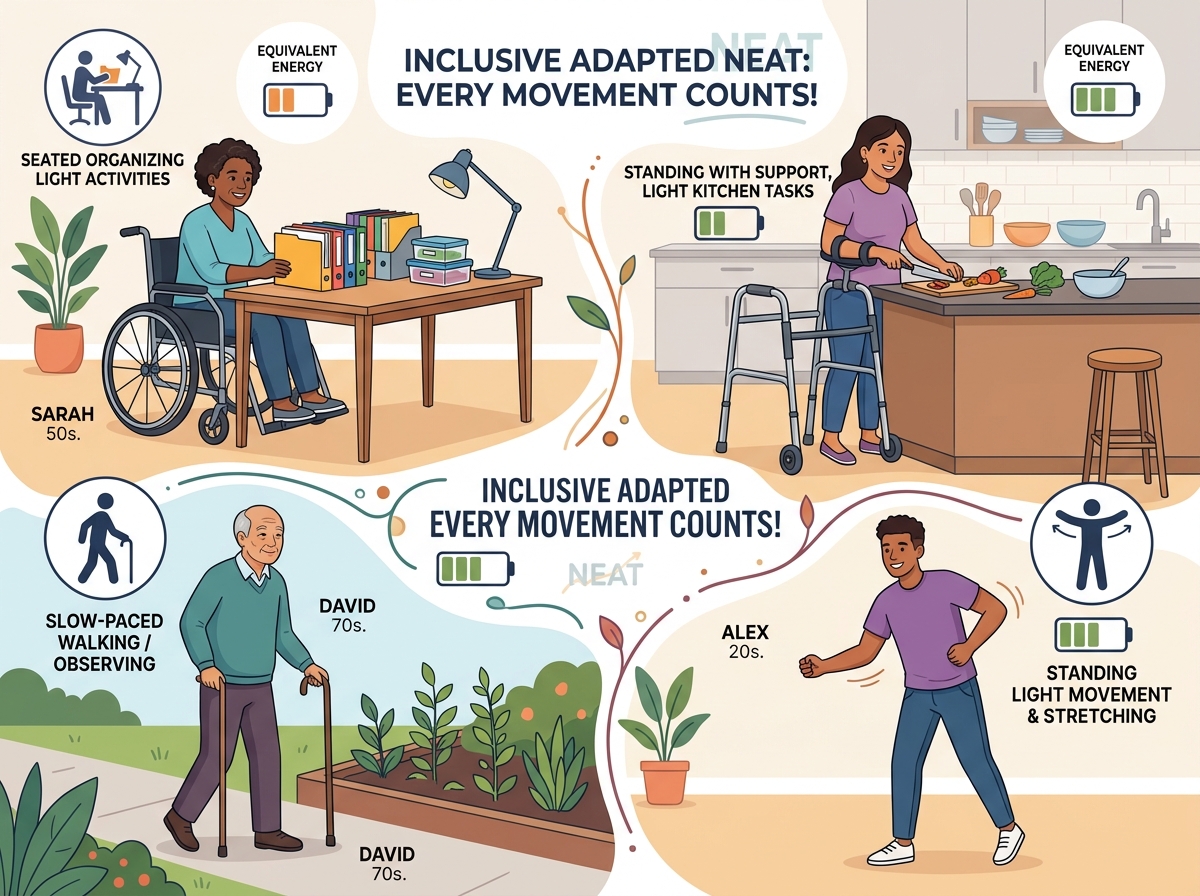
Quick answer: NEAT adapts to different abilities. Even seated or standing activities contribute meaningfully. Anyone with existing health conditions should consult their healthcare provider before significantly increasing activity.
Adaptive NEAT for arthritis, joint problems, injuries
- Seated activities: Sorting, organizing, light hand tasks (folding, arranging)
- Standing activities: Light stirring, organizing shelves, standing while working
- Slow-paced movement: Gentle walking, leisurely errands, slow gardening
- Adaptive equipment: Lightweight cleaning tools, ergonomic equipment, grab bars for safety
How much weight can I lose by doing household chores?
Weight loss depends on current weight, chore intensity, frequency, diet, and baseline activity level. Research suggests that significantly increasing NEAT through household chores—combined with balanced nutrition—may support 1-3 lbs per month for most people. Heavier individuals typically see greater results. The advantage of NEAT-focused weight loss is sustainability: you’re building habits that support long-term maintenance rather than pursuing rapid weight loss through restriction.
Consult a healthcare provider or registered dietitian for personalized projections based on your specific situation.
Can I lose weight with household chores alone, without changing my diet?
Household chores can contribute to weight loss, but the most effective approach combines increased NEAT with reasonable nutrition habits. Research shows that calorie balance—energy burned versus energy consumed—is fundamental to weight loss. If you’re eating significantly more than your body burns, household chores alone may not create sufficient deficit for meaningful weight loss. However, when chores are combined with consistent, balanced nutrition, increased daily movement becomes a powerful weight loss tool.
What is the difference between NEAT and intentional exercise?
NEAT (Non-Exercise Activity Thermogenesis) is informal daily movement: chores, walking, fidgeting, errands. Exercise is structured, planned physical activity: gym workouts, running, cycling, fitness classes. Both contribute to weight loss. NEAT is more sustainable long-term because it requires no dedicated time, equipment, or recovery—and doesn’t trigger the hunger response intense exercise sometimes does. However, combining NEAT and exercise is most effective. Exercise provides intensity and metabolic benefits that NEAT alone cannot, while NEAT provides the foundation of constant daily calorie burn.
How long does it take to see weight loss results from increasing NEAT?
Results vary based on how significantly you increase NEAT, your diet, baseline activity, and individual metabolism. Some people notice changes in energy levels and how clothes fit within 2-4 weeks. Measurable weight loss typically becomes apparent within 4-8 weeks when combined with balanced nutrition. However, the most important timeframe is long-term: sustainable NEAT-based weight loss is most valuable 3-6 months in, when the habit becomes automatic and results compound.
Can someone with limited mobility or arthritis increase NEAT safely?
Yes. NEAT adapts to different ability levels. People with arthritis, joint problems, prior injuries, or other mobility restrictions can increase NEAT through:
Seated activities (sorting, organizing, light hand tasks)
Standing activities (light stirring, organizing, standing while working)
Slow-paced movement (gentle walking, leisurely errands)
Adaptive tools (lightweight cleaning tools, ergonomic equipment)
Important: Anyone with existing health conditions should consult their healthcare provider before significantly increasing activity levels.
Is doing household chores as effective as going to the gym?
No—but NEAT and gym exercise serve different roles. Gym workouts burn more calories per unit time and build muscle more efficiently. NEAT burns fewer calories per unit time but is distributed all day and more sustainable. Research shows that increasing daily lifestyle activities is as effective as structured aerobic exercise for maintaining long-term weight loss—meaning both matter, but NEAT is the foundation. Combining moderate gym activity with high NEAT is most effective.
How much sitting is too much for weight management?
Research indicates that sitting more than 8-10 hours daily (even with exercise) increases weight gain risk and metabolic disease risk. Mayo Clinic studies found that people who gained weight sat approximately 2 hours more per day than those who maintained weight—despite identical calorie intake. Best practice: aim for no more than 7-8 hours of sitting daily, broken up with movement. If you work at a desk, get up and move every 30 minutes.
Can I replace structured exercise with household chores for weight loss?
Not entirely, but you can reduce exercise time if you significantly increase NEAT. Research shows that NEAT and exercise provide different benefits: NEAT builds sustainable daily calorie burn and is excellent for long-term maintenance, while exercise provides intensity, muscle building, and metabolic adaptations NEAT alone doesn’t achieve. Ideally, combine both: some structured activity (30-45 min, 3-5x weekly) plus high daily NEAT. If time is limited, increasing NEAT is more sustainable than zero activity.
Which household chores burn the most calories?
Yard work and mowing (144-240 calories per 30 minutes) and vigorous scrubbing (126-210 cal) are highest. Active errands involving walking burn 135-226 calories per 30 minutes. Mopping and vacuuming burn 108-166 calories per 30 minutes. Laundry and light tidying are lower (72-120 cal) but still contribute. Calorie burn varies significantly by body weight, intensity, and pace—heavier individuals and faster-paced work burn more.
Does fidgeting really contribute to weight loss?
Yes, measurably. Fidgeting—tapping fingers, bouncing your knee, standing instead of sitting—contributes to NEAT and accumulates significantly over hours. Mayo Clinic research shows that unconscious movement (fidgeting, standing, small motions) is one major difference between people who maintain weight and those who gain it. While fidgeting alone won’t cause weight loss, combined with other NEAT activities and reasonable nutrition, it’s a meaningful contributor.
Should I track calories when using NEAT for weight loss?
Strict calorie counting isn’t necessary with NEAT-based weight loss, but basic nutrition awareness is. You don’t need a food scale or app—just eat reasonably, include protein and fiber, and avoid significant calorie surplus. Combine this with increased daily movement tracking (steps, sitting time reduction, chores completed) rather than exercise metrics. This balanced approach avoids the restrictive mentality that often undermines long-term weight loss.
Key Takeaways
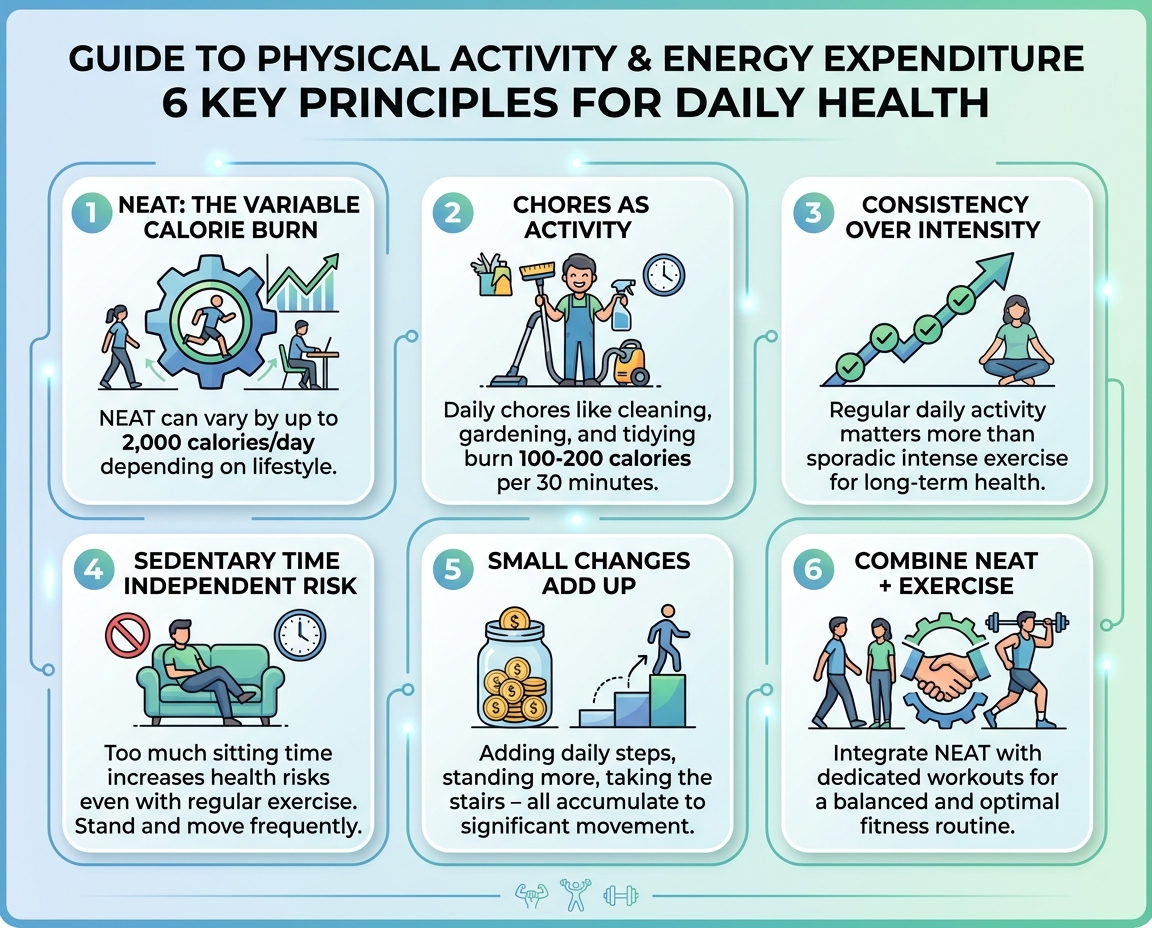
- NEAT is powerful: Activity levels vary by 2,000+ calories per day between similar individuals—making daily movement one of the most significant weight management factors.
- Household chores count: Simple chores like ironing or folding use 15% of daily energy. Yard work, vacuuming, and mopping burn 100-240 calories per 30 minutes.
- Consistency beats intensity: Regular daily movement through chores is often more effective long-term than sporadic intense exercise, because it doesn’t trigger hunger responses or burnout.
- Sedentary time matters independently: Sitting for extended periods increases weight gain and disease risk independent of exercise—even for people who work out regularly.
- Small changes accumulate: The difference between weight gainers and non-gainers often comes down to thousands of minor daily movements, not major lifestyle overhauls.
- Combined approach is optimal: The National Academy of Sports Medicine identifies combining exercise and NEAT as the most effective weight loss strategy.
REFERENCES & SOURCE ATTRIBUTION
Research & Academic Sources
NEAT (Non-Exercise Activity Thermogenesis) Research
- Levine, J.A., et al. (Mayo Clinic). “Interindividual variation in posture allocation.” PLoS ONE. 2005. — Landmark study showing 2,000+ calorie per day variation in NEAT between similar individuals.
- Levine, J.A. (Mayo Clinic). “Non-exercise activity thermogenesis (NEAT).” Best Practice & Research Clinical Endocrinology & Metabolism. 2002. — Comprehensive review of NEAT mechanisms and impact on weight.
- Novak, C.M., et al. (Kent State University). “The contribution of environmental factors to obesity.” Eating and Weight Disorders. 2006. — Research on daily energy expenditure breakdown (30-40% activity-based).
Sedentary Behavior & Health Risk
- National Institutes of Health (NIH). “Sedentary Behavior and Physical Activity.” — Official NIH guidance on sedentary behavior independent of exercise.
- Thorp, A.A., et al. “Sedentary Behavior and Metabolic Health.” Applied Physiology, Nutrition, and Metabolism. 2012. — Research on sitting’s independent metabolic effects.
Household Activity & Calorie Burn
- Harvard Medical School. “Calories Burned in 30 Minutes.” — Comprehensive calorie burn data by household activity and body weight.
- American Council on Exercise (ACE). “NEAT: Non-Exercise Activity Thermogenesis.” — Professional guidance on NEAT and weight loss.
Weight Loss & Lifestyle Intervention
- National Academy of Sports Medicine (NASM). “Weight Loss Strategy Guidelines.” — Professional recommendations on exercise and NEAT combination for weight loss.
- Rooth, D.O. “Obesity, Stigma, and Discrimination.” Obesity (Silver Spring). 2015. — Research on weight management approaches.
Habit Formation & Behavioral Change
- Lally, P., et al. “How are habits formed: Modelling habit formation in the real world.” European Journal of Social Psychology. 2010. — Research on habit formation timelines and sustainability.
Medical & Health Organizations
- Mayo Clinic — Calorie Burn & Weight Loss — Trusted source for weight management and NEAT research (James Levine research compiled here).
- NIH National Heart, Lung, and Blood Institute (NHLBI) — Federal research on physical activity, sedentary behavior, and weight management.
- CDC (Centers for Disease Control) — Physical Activity Guidelines — Official U.S. government guidance on daily activity for health.
- American Heart Association — Weight Management — Guidelines on sustainable weight loss.
- Academy of Nutrition and Dietetics — Professional dietitian resource (consult for personalized nutrition guidance).
Health Information Websites
- WebMD — Calories Burned During Household Chores — Accessible health information on activity and calorie burn.
- RxList — Household Chores and Weight Loss — Medical content from Rx pharmacist network.
- Healthline — NEAT & Weight Loss — Evidence-based health articles with medical review.
- Medical News Today — Sedentary Behavior — Science-based health journalism.
Journals & Peer-Reviewed Publications
- Journal of Exercise Nutrition and Biochemistry — Peer-reviewed research on exercise, metabolism, and weight.
- PLoS ONE — Open-access peer-reviewed research (NEAT studies published here).
- Applied Physiology, Nutrition, and Metabolism — Research on sedentary behavior and metabolic health.
- European Journal of Social Psychology — Habit formation research.



Leave a Reply