


Introduction
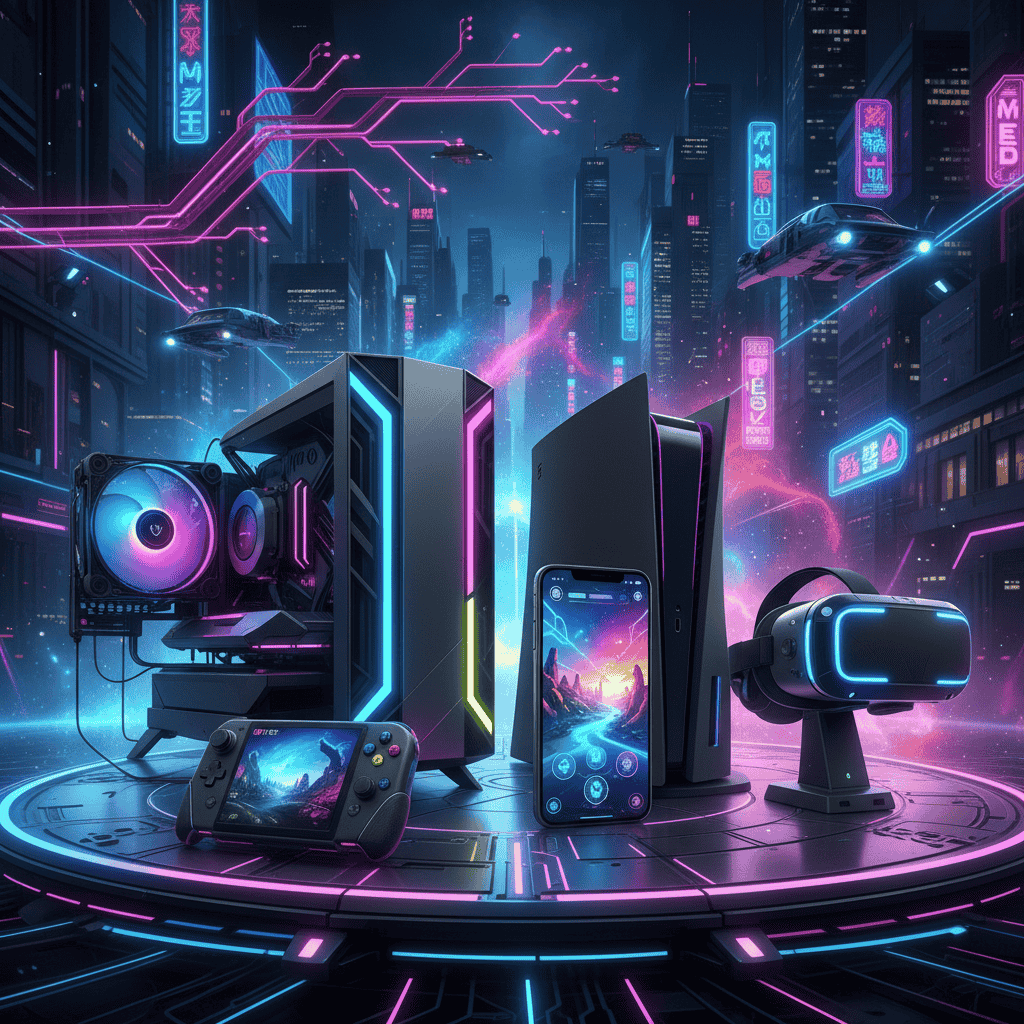
Beyond only graphics and noises, gaming has advanced significantly. The way we perceive virtual worlds is now determined by hardware capabilities in this vast realm. The gadget you select influences your path, regardless of whether you are a lover of competitive shooters, a casual commuter player, or a virtual reality aficionado.
Even though the distinctions between platforms are becoming less clear in 2026, each platform still has unique benefits. This article delves deeply into the state of gaming devices and platforms today. We’ll look at the never-ending conflict between consoles and PCs, the powerful smartphones in our pockets, the cutting-edge immersive technologies of VR and AR, and the rapidly expanding mobile gaming business.
Console Gaming vs PC Gaming: The 2026 Showdown
The debate between console and PC gaming is as old as the industry itself. In 2026, this rivalry has reached new heights. Both platforms have matured, offering distinct ecosystems that cater to different types of players.
The State of PC Gaming
PC gaming remains the pinnacle of performance and customization. In 2026, entry-level builds have become surprisingly affordable, with an $800 rig now capable of rivaling the performance of high-end consoles like the PS5 Pro.
Performance and Visual Fidelity
The PC is unbeatable for people who demand the greatest graphics, fastest frame rates, and widest resolutions. Because you may upgrade parts as needed, your machine can grow with you. Even mid-range cards now come bundled with ray tracing technology, which creates lighting and reflections that blur the boundaries between virtual and real worlds.
The Ecosystem Advantage
The ecosystem of PCs is extensive. You’re not restricted to a single store. Competitive pricing and regular sales are provided by publisher launchers like as Steam, Epic Games Store, GOG, and others. Furthermore, the PC’s backward compatibility is unparalleled; you can play a 1999 game with equal ease as a 2026 release.
Modding Community
The PC’s modding community is one of its best features. Mods prolong the life of games forever, ranging from resolving flaws that developers overlooked to totally revamping a game’s visuals or gameplay features.
The Console Experience
With a “plug and play” ease of use that PCs can’t match, consoles still rule the living room. With 4K gaming at 120Hz available for a fraction of the price of a top-tier PC, the current generation of consoles has greatly closed the performance gap.
Simplicity and Optimization
A console game is functional when purchased. There are no hardware compatibility problems, no drivers to update, and no settings to adjust for the best framerates. Developers frequently squeeze out performance that comparable PC hardware cannot match in order to optimize their games for the fixed hardware of consoles.
Exclusive Titles
Even though a lot of exclusives are eventually coming to PCs, consoles still receive them first. Sony and Nintendo’s first-party studios continue to create masterpieces that define generations, frequently delaying a PC port for years.
Cost of Ownership
Consoles contain hidden costs even though the hardware cost is lower up front. Usually, access to online multiplayer needs a subscription (around $70/year), which mounts up over the course of the console’s life. On the other hand, PC games provide free online multiplayer.
The Verdict?
Choosing between a PC and a console in 2026 depends on your priorities.
- Choose PC if: You want the highest performance, enjoy tweaking settings, want access to a massive library of indie and retro games, and don’t mind a higher upfront cost.
- Choose Console if: You prefer a standardized, hassle-free experience, want access to specific exclusive titles on day one, and prefer playing on a TV from the comfort of a couch.
Best Gaming Smartphones: Pocket-Sized Powerhouses
Mobile gaming is no longer just for passing time with puzzles. It is a legitimate competitive platform with esports tournaments offering millions in prize money. The hardware has caught up, with 2026’s flagship phones sporting processors that rival laptops from just a few years ago.
Top Contenders in 2026
1. Asus ROG Phone 9 Pro
The ROG Phone 9 Pro is widely considered to be the best gaming phone of 2026. Every movement is buttery smooth because to its amazing 6.78-inch AMOLED display and absurd 185Hz refresh rate. Under the hood, sophisticated cooling mechanisms avoid thermal throttling, which is a frequent problem with lower-end devices, during extended use. You can use it like a console without a second controller thanks to its specialized “AirTrigger” ultrasonic buttons.
2. Samsung Galaxy S25 Ultra
Although the S25 Ultra isn’t specifically marketed as a “gaming phone,” it’s a powerful device that can handle any game you throw at it. Benchmarks are crushed by its Snapdragon 8 Gen 5 processor (or similar Exynos, depending on the area). In every lighting situation, the large, bright display is ideal for gaming, and the smooth connectivity with other devices is made possible by the integration with Samsung’s ecosystem.
3. iPhone 16 Pro Max
Apple’s A-series CPUs continue to dominate the market. Unmatched raw performance and optimization are provided by the iPhone 16 Pro Max. Many developers still prefer iOS, which frequently gets game releases and upgrades first. You can play for extended periods of time without having to go for a charger because to the chip’s exceptional battery life and efficiency.
Key Features to Look For
When shopping for a gaming smartphone, looking beyond the brand name is crucial. Focus on these specs:
- Refresh Rate: 120Hz is the minimum standard for a premium experience; 144Hz or higher is preferred for competitive shooters.
- Touch Sampling Rate: This determines how quickly the phone registers your touch. Higher is better for reaction times.
- Cooling: Passive cooling is rarely enough for high-end gaming. Look for vapor chambers or active cooling fans.
- Battery Life: Gaming drains power fast. Look for at least 5000mAh capacity and fast charging capabilities (65W+).
VR & AR Gaming Experiences: The New Reality
Virtual Reality (VR) and Augmented Reality (AR) have moved past the “gimmick” phase. In 2026, they are delivering rich, immersive experiences that traditional screens cannot replicate.
VR: Immersion Redefined
VR gaming in 2026 focuses on “presence”—the feeling that you are actually inside the game world.
Hardware Evolution
Headsets are now cordless, lighter, and have better resolution. The “screen door effect”—the ability to view the spaces between pixels—is essentially eliminated. “Foveated rendering,” which saves processing power for greater performance by only rendering high detail where you are looking, is made possible by eye-tracking technology.
Haptic Feedback
These days, it’s more than just sight and sound. Players can experience the impact of a hit, the recoil of a weapon, or the feel of rain on their skin by donning haptic gloves and suits. A thrilling and, in horror games, horrifying level of immersion is produced by this sensory feedback.
Social VR
The game industry is evolving into a social metaverse. Players create their own worlds and games on platforms like VRChat, which have developed into intricate social hubs and economies. It’s more about shared experiences in a physical setting than it is about a particular story.
AR: Blending Worlds
Augmented Reality overlays digital content onto the real world. While mobile AR (like Pokémon GO) popularized the concept, dedicated AR glasses are the next frontier.
Spatial Gaming
AR glasses in 2026 can map your living room and turn it into a game level. Zombies might crawl out from under your actual couch, or your coffee table could become a battlefield for miniature armies. This “mixed reality” uses your physical environment as a playground.
Location-Based Experiences
AR is transforming how we explore cities. Large-scale AR games turn city blocks into raid bosses or puzzle rooms, encouraging players to physically travel and cooperate with others in the real world.
Handheld Gaming Devices Trend: Console Power on the Go
Perhaps the most significant shift in gaming hardware over the last few years is the explosion of the handheld market. Following the trails blazed by the Nintendo Switch and Steam Deck, the market in 2026 is flooded with high-performance portable devices.
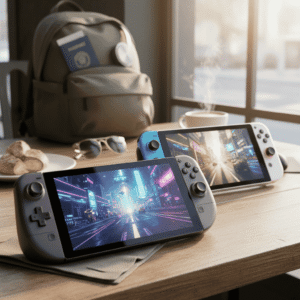
The Rise of the PC Handheld
People’s need for portable PC libraries was demonstrated by the Steam Deck. Now, rivals from MSI, Lenovo, and Asus have improved the recipe.
Windows vs. Linux
The market is divided between Windows-based devices and those running optimized Linux-based operating systems, such as SteamOS. Though they are more compatible with game launchers like Game Pass, Epic, and Battle.net, Windows handhelds frequently have a clumsier user interface that isn’t made for tiny touchscreens.
Performance vs. Battery
This is still the main compromise. Even if 2026 devices can run current AAA games at 60 frames per second, their batteries often only last two to three hours when under extreme strain. However, this problem is being lessened by effective sleep modes and quick charging technology.
The Dedicated Handhelds
Nintendo continues to play its own game. Their devices may not match the raw horsepower of PC handhelds, but their optimization and exclusive library keep them at the top of the sales charts. The focus here is on fun, local multiplayer, and unique gameplay mechanics rather than raw graphical fidelity.
Cloud Gaming Handhelds
A sub-genre of handhelds focuses purely on streaming. Devices like the Logitech G Cloud were early attempts, but 2026 models feature 5G connectivity and Wi-Fi 7, reducing latency to imperceptible levels. These devices are cheaper, lighter, and have incredible battery life because the heavy processing is done on a server farm, not the device itself.
Conclusion: What is the Right Platform for You?
The gaming landscape in 2026 is one of abundance. There is no single “best” platform; there is only the best platform for your lifestyle.
- The Purist: If you demand the highest fidelity and control, the PC is your home.
- The Traditionalist: If you want convenience and big-screen blockbusters, get a Console.
- The Competitor: If you need to game anywhere and love esports, a high-end Gaming Smartphone is essential.
- The Explorer: If you want to step inside new worlds, invest in VR/AR.
- The Traveler: If you want your library in your backpack, a Handheld Device is a game-changer.
Whatever you choose, the technology of 2026 ensures that the barrier between player and game is thinner than ever before. The only limit now is how much time you have to play.
The Future of Gaming: Beyond 2026
As we look toward the horizon, several emerging technologies promise to disrupt this landscape even further. The convergence of these platforms is inevitable. We are already seeing “cross-progression” becoming standard, where you can start a game on your PC, continue it on your handheld during a commute, and finish it on your console from the couch.

AI in Gaming Hardware
Artificial Intelligence is not just for NPCs anymore. Hardware manufacturers are using AI to upscale images (like NVIDIA’s DLSS), generate frames to smooth out motion, and even dynamically adjust game difficulty based on your biometric feedback from a smartwatch.
The Death of “Generations”?
The concept of a “console generation” is fading. We are moving toward a model of iterative upgrades, similar to smartphones. The PS5 Pro and updated Xbox models suggest a future where hardware refreshes happen every 3-4 years rather than every 7, keeping pace with the rapid advancement of PC tech.
Sustainability in Gaming
In 2026, environmentally responsible gaming will become more popular. High-end gaming consoles and PCs use a lot of electricity. Manufacturers are under pressure to increase energy efficiency and employ recycled materials in their operations. “Green modes” that use less energy when doing less demanding tasks are becoming commonplace.
Gaming platforms and devices are a dynamic, competitive, and ever-evolving industry. You may create a gaming setup that is ideal for you and guarantees that you never miss a second of the action by being aware of each one’s advantages and disadvantages. The game is on whether you are holding a controller, a mouse, or a virtual sword.


Leave a Reply