



By Talha Yousaf, Founder, WorldlyInfo.com · Last updated: November 20, 2026
Medical disclaimer: This article is for general education and is not medical advice, diagnosis, or treatment. Weight, hormones, and health conditions vary widely between individuals. Consult a qualified healthcare provider before changing your diet, exercise routine, or medications.
When comparing weight loss for women vs men, the short answer is that men lose weight somewhat faster on average during the first weeks of a calorie-controlled plan. However, long-term results depend more on habits, support, life stage, and individual health than on sex alone. Women and men often benefit from the same core principles, just with different points of emphasis.
At a glance
- In one large trial, men lost about 11.8% of body weight versus 10.3% for women over eight weeks.
- U.S. adults report roughly equal obesity rates by sex, but women are more likely to say they’ve tried to lose weight.
- Menopause shifts where fat is stored, but it isn’t the only driver of midlife weight gain.
- Evidence on who keeps weight off better is mixed.
Do men and women lose weight differently?
Yes, on average, but the gap is modest and individual results overlap heavily. The clearest data come from the PREVIEW trial of 2,224 adults with overweight and prediabetes. Participants followed a medically supervised, very-low-energy diet for eight weeks. Men lost 16% more weight than women (11.8% vs. 10.3% of body weight), while improvements in insulin resistance were similar. About 35% of both groups returned to normal blood glucose.
After adjusting for the difference in weight lost, the pattern diverged:
- Men had larger reductions in fat mass, heart rate, and a metabolic syndrome score.
- Women had larger reductions in HDL cholesterol, fat-free mass, hip circumference, and pulse pressure.
This was one study, in one population, using a very-low-calorie approach that should only happen under medical supervision. It isn’t a template for everyday dieting.
Why do body composition and metabolism matter?
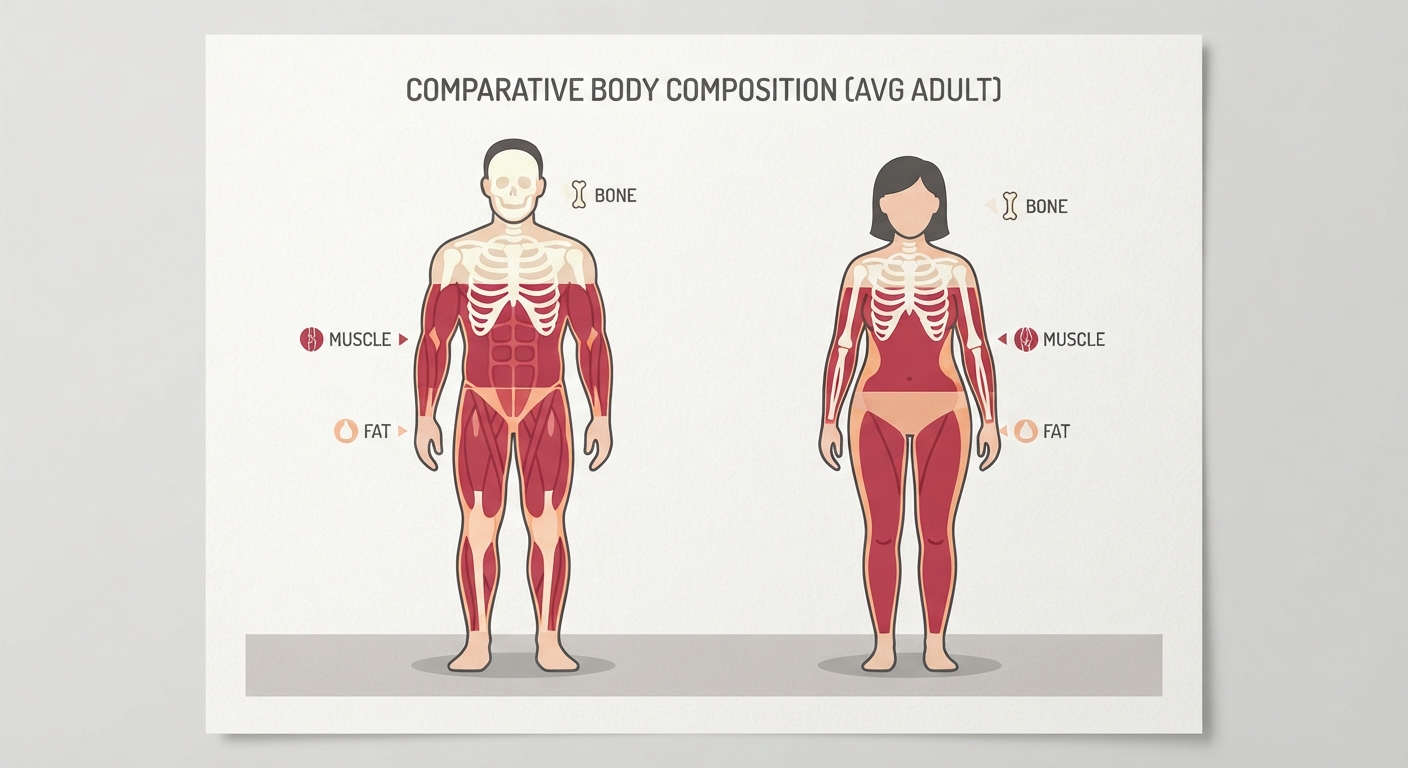
Men typically carry more lean mass and women more body fat, which often means men burn more energy at rest. [CITE: NIDDK or a PubMed review on sex differences in body composition and resting energy expenditure.] According to Dr. Rekha Kumar, speaking to Healthline, muscle is a key reason men generally need more calories than women to maintain the same weight. The practical implication is that an identical meal plan can create a larger relative calorie gap for someone with higher energy needs.
Where do men and women tend to store fat?
Men more often store fat around the abdomen, while premenopausal women more often store it around the hips and thighs. After menopause, women’s fat storage tends to shift toward the belly (Healthline; Mayo Clinic). Abdominal fat surrounds internal organs and is more strongly linked to metabolic risk, which is part of why men’s early changes can show up faster on health markers. [CITE: NIDDK or Harvard T.H. Chan on visceral fat.]
Do weight loss for women vs men approach differently?
Yes. Women report trying to lose weight more often, and the two groups tend to choose different routes. In 2013–2016, 56.4% of U.S. women versus 41.7% of men said they’d tried to lose weight in the past year (CDC/NCHS). Yet obesity prevalence was 39.2% in men and 41.3% in women, with no significant difference. Severe obesity was higher in women (12.1% vs. 6.7%).
In a maintenance trial, women more often used organized programs while men more often self-directed. Because women are more represented in weight-loss research, we know less about what works best for men.
How do hormones affect weight loss in women and men?

Hormones such as estrogen, progesterone, and testosterone influence fat distribution, muscle, appetite, and energy use. They shift across life stages, but they don’t make weight loss impossible. Think of hormones as one factor among sleep, stress, genetics, medications, and habits.
How does estrogen affect where women store fat?
Estrogen tends to favor fat storage in the hips and thighs, and its decline shifts storage toward the abdomen. A 2026 review in Menopause by Mayo Clinic researchers reports that data from the Study of Women’s Health Across the Nation showed about 2.5 times more fat-mass gain and 3 times more lean-mass loss during the menopause transition, independent of age.
Does menopause make weight loss harder?
It can, but menopause is rarely the only cause. Mayo Clinic notes that weight gain often begins during perimenopause and may continue at about 1.5 pounds (0.7 kg) per year through the 50s. The average age of menopause in the U.S. is 51. Aging, muscle loss, poorer sleep, and lifestyle changes contribute too. Mayo also notes that hormone therapy may help redistribute belly fat but has not been shown to cause weight loss. Whether it suits you is a conversation for your healthcare provider.
How does testosterone affect weight in men?
Testosterone is associated with muscle mass and fat distribution, and levels tend to decline gradually with age. [CITE: Endocrine Society or NIDDK.] Persistent fatigue, low mood, or unexplained weight changes are worth discussing with a healthcare provider rather than self-treating with supplements.
Does the menstrual cycle affect the scale?
Some women notice temporary scale changes across the cycle, often linked to fluid retention rather than fat. [CITE: ACOG or NIH/MedlinePlus.] Tracking weight trends over weeks rather than days gives a clearer picture.
What are the best weight-loss strategies for women vs. men?

The foundations are the same for both: sustainable calorie balance, regular movement, strength training, quality sleep, and support. The emphasis can differ.
| Focus area | Often especially useful for women | Often especially useful for men | Source |
|---|---|---|---|
| Strength training | Helps protect muscle and bone, especially in midlife, since women lost more fat-free mass in PREVIEW | Builds on a muscle advantage and supports metabolic health | Mayo Clinic, PubMed |
| Avoiding crash dieting | Rapid loss may mean more lean-mass loss | Skipping meals for long stretches is a common extreme tactic | Healthline |
| Structure and support | Many already use programs; fit matters more than quantity | Men are less likely to join programs, so a clinician or buddy can help | PubMed |
| Life-stage adjustments | Perimenopause and menopause may call for adjusting calories and activity | Gradual muscle loss with age makes resistance work more important | Mayo Clinic |
| Alcohol and liquid calories | Worth reviewing in any plan | Worth reviewing in any plan | Mayo Clinic |
A general framework both can follow, ideally with a healthcare provider or registered dietitian:
- Get a baseline check-in. Discuss goals, medications, and any conditions first.
- Aim for steady, gradual change. Rapid loss isn’t a goal in itself. [CITE: CDC on gradual weight loss.]
- Move regularly. Mayo cites 150–300 minutes of moderate aerobic activity weekly plus strength training at least twice a week for most adults; some may need more to lose weight.
- Choose nutrient-dense foods. Emphasize fruits, vegetables, whole grains, and protein sources you can sustain.
- Protect sleep and manage stress. Poor sleep is linked to more snacking and less activity (Mayo Clinic). See our guides on stress and weight loss and sleep and weight loss.
- Track more than the scale. Waist circumference, strength, energy, and lab markers matter too (Weight Loss Testing & Metrics).
Do men or women have higher weight-loss success rates?
In the short term, men tend to lose more on average. Long-term maintenance evidence is mixed, and regain is common for everyone.
| Study | Who and how long | What it found | Takeaway |
|---|---|---|---|
| PREVIEW, 2018 | 2,224 adults, 8 weeks | Men lost 11.8% vs. women 10.3% of body weight | Short-term edge for men |
| Obesity, 2012 | 1,685 adults, 36 months | Men lost more initially; regain did not differ by race-sex group; 36-month change ranged from −2.3% to −4.5% | Early loss predicted long-term results |
| Int J Obes, 1989 | 114 men, 38 women, 4–5 years | Women had better maintenance; under 3% stayed at or below post-treatment weight at every visit | Older, small sample; regain common |
| Am J Mens Health, 2017 | 419 adults who’d lost ≥10% (18.4% men) | Different methods, similar maintenance behaviors | Different routes, similar habits |
Several caveats apply. Most studies group people by sex, and research on transgender and nonbinary people is limited. Many trials enroll more women than men, and results are averages, so individuals vary widely. The best plan is the one a person can sustain.
What should I check before starting a weight-loss plan?
Talk to a healthcare provider first if you have a medical condition, take medications, are pregnant or planning pregnancy, or are in perimenopause or menopause. Read our hub on safe weight loss and the sibling guides on age, medical conditions, and medications.
Do men really lose weight faster than women?
On average, yes, especially early on. In the PREVIEW trial, men lost 11.8% of body weight versus 10.3% for women in eight weeks. Individual results vary widely.
Is it harder for women to lose weight?
For many women it can be, due to differences in body composition, hormonal transitions such as perimenopause, and life circumstances. It isn’t impossible, and strength training, sleep, and gradual changes may help.
Does menopause cause weight gain?
It’s associated with weight gain and a shift of fat toward the abdomen, but Mayo Clinic notes hormonal changes alone don’t necessarily cause it. Aging, muscle loss, sleep, and lifestyle contribute.
Is strength training important for women trying to lose weight?
It’s generally recommended, because it helps preserve muscle and bone while losing weight. Mayo Clinic suggests strength training at least twice a week for most adults. Check with a healthcare provider if you have joint or heart concerns.
Do men or women keep weight off better?
Studies disagree. An older long-term study favored women, while newer research found similar maintenance behaviors between sexes. Early weight loss and a healthy dietary pattern were stronger predictors.
References
- Christensen P, et al. Diabetes Obes Metab. 2018;20(12):2840–2851. PubMed
- NCHS Data Brief No. 313 (2018); No. 508 (2024). CDC, CDC
- Mayo Clinic, “The reality of menopause and weight gain.” Mayo Clinic
- Hurtado Andrade MD. Menopause 2026;33. PMC
- Obesity 2012 PubMed; Int J Obes 1989 PubMed; Am J Mens Health 2017 PubMed
- Healthline, “How men and women approach weight loss differently.” Healthline


Leave a Reply